
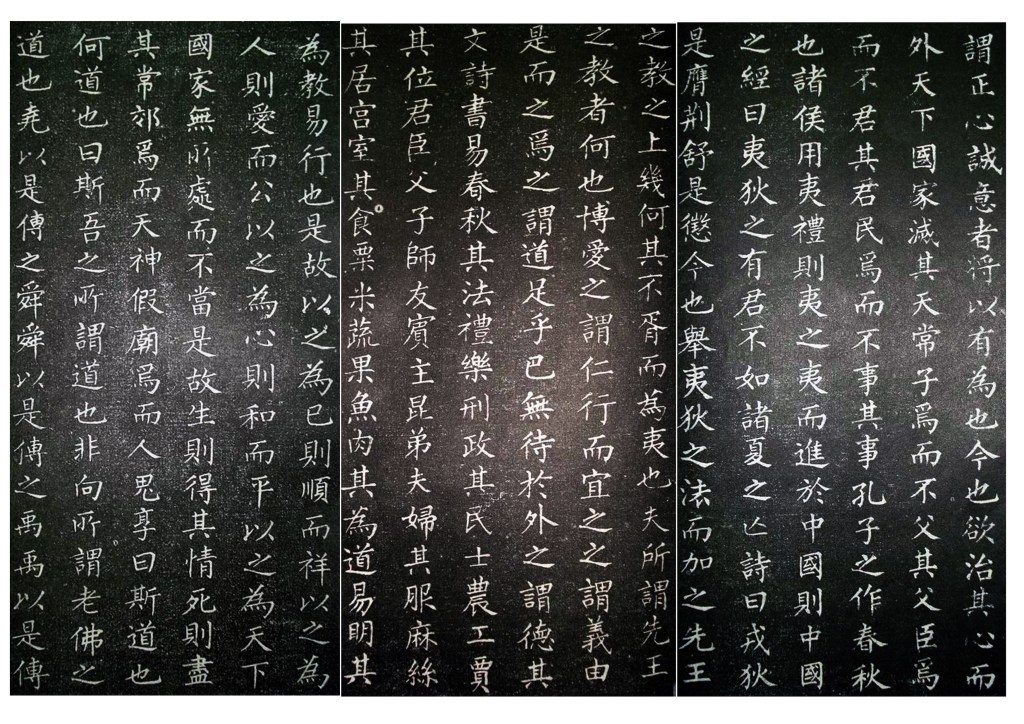
The sources translated in Chapter 2 include examples of the use of qi cosmology to argue against imperial expansion into “barbarian” lands. Cosmological theories about the difference and proper relationship between the Chinese and the “barbarians” are also found in texts of various other genres, including Confucian philosophical writings. In fact, Neo-Confucian (Daoxue) philosophy complicated the discourse of the “civilization-state” by claiming that all human beings have the capacity to overcome the moral obstruction caused by qi and achieve perfect moral understanding. Some Neo-Confucian thinkers reconciled this optimistic and universalistic message with their ethnocentric prejudices by arguing that barbarians were not fully human and thus could not become fully moral. This dehumanizing and essentializing perception of foreign peoples seems to have become common even among non-elite Chinese by the late Ming (see source 3.14).
However, interpretations of barbarian qi as fundamentally “other” and inferior coexisted with arguments warning that immoral (and hence “barbaric”) behavior by the Chinese could turn them into barbarians, a discourse that I call “ethnocentric moralism.” The corollary to such arguments, namely that barbarians who learned to be moral were essentially Chinese, appears in some texts (see sources 3.2 and 3.3 below) but is much rarer than ethnocentric statements about the barbarians’ permanent immorality.
Sources
3.2 Chen An 陳黯 (ca. 805-871), “Huaxin” 華心 (Hua at Heart), ca. 850
3.3 Cheng Yan 程晏 (fl. 895-904), “Neiyi xi” 内夷檄 (A Call to Arms against the Inner Barbarian), ca. 904
3.5 Cheng Hao 程顥 (1032-1085) and Cheng Yi 程頤 (1033-1107)
3.6 Hu Hong 胡宏, memorial to Emperor Gaozong, ca. 1135
3.7 Lü Zuqian 呂祖謙, Zuoshi boyi 左氏博議 (Wide-ranging Discussions on the Zuozhuan), 1166-1168
3.8 Hu Yin 胡寅, Dushi guanjian 讀史管見 (Limited Views on History), ca. 1155
3.10 Lu Jiuyuan 陸九淵 (1139-1192)
3.13 Lü Nan 呂楠, Jingyezi neipian 涇野子内篇 (The Inner Chapters of Master Jingye), ca. 1542
3.15 Wang Fuzhi 王夫之 (1619-1692)
Further reading
Bol, Peter K., “Reflections on the Zhong Guo and the Yi Di with Reference to the Middle Period,” The China Review, 23.2 (2023), 87–105.
He, Yuming, “The Book and the Barbarian in Ming China and Beyond: The Luo chong lu, or ‘Record of Naked Creatures,’” Asia Major, Third Series, 24.1 (2011), 43-85.
Throness, Aaron, “Paramount Boundaries,” in Brook, Timothy, and Lianbin Dai eds., Chinese Statecraft: Political Theory and Administrative Practice in Ming China (Cambridge: Cambridge University Press, 2025), 194-204.
Van Ess, Hans, “What is Chinese? Culturalism or Ethnicism in Song China? With an Appendix on Siku quanshu Censorship of Ethnic Prejudice,” Asia Major, Third Series, 34.1 (2021), 61-93.
Yang, Shao-yun, The Way of the Barbarians: Redrawing Ethnic Boundaries in Tang and Song China (Seattle: University of Washington Press, 2019).
Yang, Shao-yun, “The Song-Jurchen Conflict in Chinese Intellectual History,” in Yannis Stouraitis ed., War and Collective Identifications in the Middle Ages: East, West, and Beyond (Leeds: ARC Humanities Press, 2023), 169–190.
 Ethnic Identity in Imperial China