
The Qinshu was a history of the Former Qin (351-394), the most successful of the short-lived “barbarian” states in fourth-century north China. The Former Qin rulers were of the Dī ethnic group, which originated from the mountainous region of southern Gansu and northern Sichuan. The author Che Pin’s ethnicity is uncertain, but he was apparently a former subject of the Former Qin. After the fall of the Former Qin, he collaborated with Daozheng (lay name Zhao Zheng), a Buddhist monk who had formerly been director of the Former Qin imperial library, to compile the Qinshu. Following Daozheng’s death, Che Pin continued the project under the auspices of the southern Liu-Song dynasty (420-479) and finally completed it in 451.
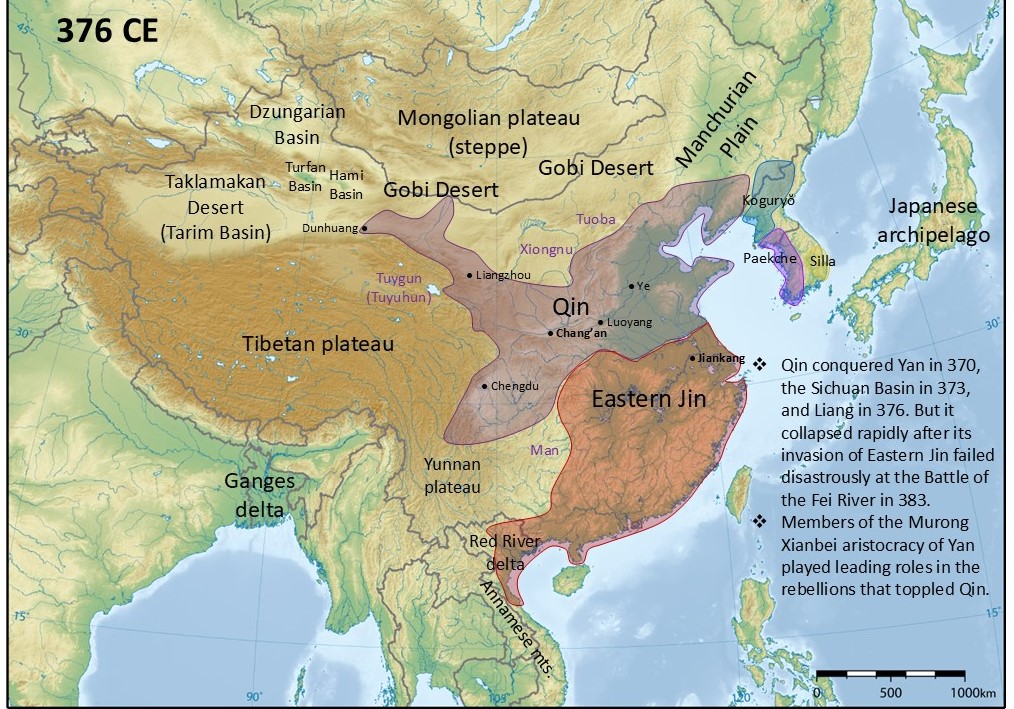
Only fragments of the Qinshu have survived as quotations in Chinese encyclopedias of the leishu (category book) genre. The passage below was preserved in a chapter on human bodies in the Taiping yulan (Imperial Readings from the Taiping Era) of 983. It reflects stereotypes associated with the physical features of peoples of different foreign regions. The “Hu” were Central Asians, and were presumably nicknamed “crooked noses” because their high noses appeared misshapen to the Chinese (here called “people of Jin” after the defunct Western Jin dynasty). The “eastern Yi” were probably peoples of the Korean peninsula. The “northern Di” would have been steppe or Manchurian peoples like the Xiongnu and Xianbei. “Swollen hooves” may be a dehumanizing reference to the heat edema sometimes suffered by visitors or migrants to the tropics.
~~~~~
During the reign of Fu Jian (r. 357-385), the barbarians of the four quarters submitted to his suzerainty and flocked to the Guanzhong region.1 The peoples of the four quarters all had strange appearances. The people of Jin gave them nicknames: The Hu people were nicknamed “crooked noses,” the eastern Yi were nicknamed “big faces and broad foreheads,” the northern Di were nicknamed “square feet and faces,” and the southern Man were nicknamed “swollen hooves.” Each country was nicknamed after its people’s appearance.
- Fu Jian was the third Former Qin ruler and succeeded in unifying north China in 376. His invasion of the Eastern Jin in 383 failed disastrously, leading to rebellions that tore the Former Qin empire apart. The Former Qin capital was at Chang’an in the Guanzhong region. ↩︎
 Ethnic Identity in Imperial China