
The Huangqing zhigong tu was a comprehensive illustrated ethnographic/geographic gazetteer first commissioned by the Qing emperor Qianlong (r. 1735-1796) in 1751 and completed in 1761, but periodically updated and expanded into the 1790s. It contains descriptions and illustrations of more than foreign peoples known to the Qing imperial court, including both foreign states and indigenous peoples of the imperial frontiers. Each entry also includes paintings of a man and woman representing each state or ethnic group. Several editions of the gazetteer were produced; the images and translated captions below are from a folio edition with both Chinese and Manchu language captions and painted images, in the collection of the Bibliothèque Nationale de France.1 These captions show that well into the eighteenth century, Chinese impressions of Europeans and Africans continued to emphasize the former’s wealth as merchants and the latter’s dehumanizing treatment as slaves, with the image of the black slave reinforced by tropes inherited from the Tang and Song periods.
A complete translation of the later Xie Sui scroll edition of the Huangqing zhigong tu (held in the National Palace Museum in Taiwan) has been published as Laura Hostetler and Wu Xuemei (trans. and eds.), Qing Imperial Illustrations of Tributary Peoples (Huang Qing zhigong tu): A Cultural Cartography of Empire (Leiden: Brill, 2022), and can be downloaded here. The translations below are my own.
~~~~~
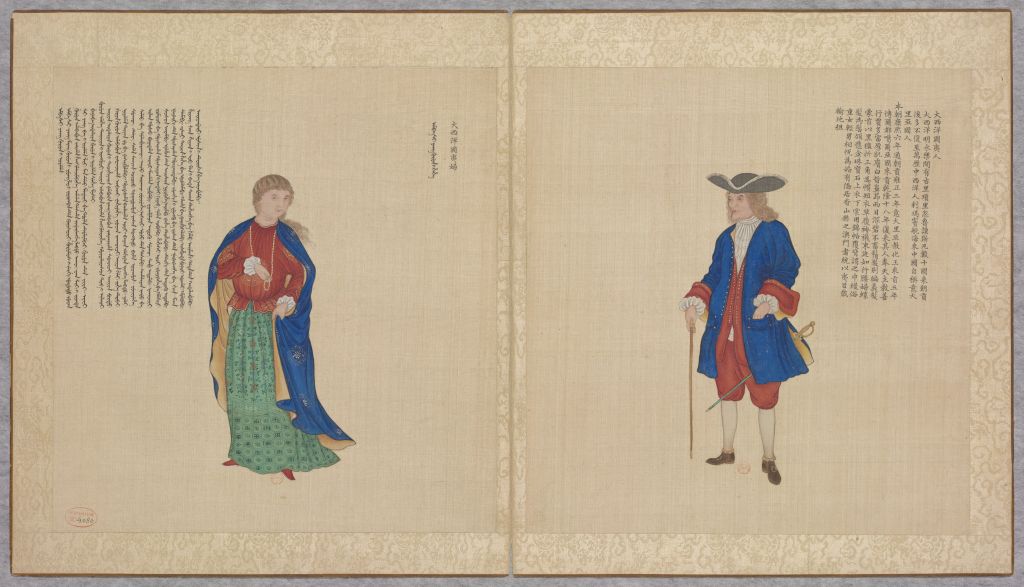
Barbarian (Yi 夷) people from the countries of the Great Western Ocean
… These people practice the religion of the Lord of Heaven (Tianzhu jiao 天主教, i,e., Roman Catholicism) and are good at commerce. Many of them are wealthy. Their skin is white, their noses are high, and their eyes are deep and greenish blue. They do not grow beards or leave their hair long; instead, they make wigs with which to cover their heads. They use black felt, folded into triangles, as hats. They wear short coats and leather shoes, and their trousers and stockings are tight-fitting as if tied with cords. Their women coil their hair into buns and hang gold necklaces with pearls and jewels around their collars. They wear separate garments on the upper and lower bodies, and cover their backs with embroidered silk capes, called jinman 巾縵.2 By custom, they esteem women more than men.3 They marry based on mutual attraction. There are some who reside as sojourners in Aomen (Macau) of Xiangshan county, under the authority of their own barbarian leader, and pay an annual land tax.
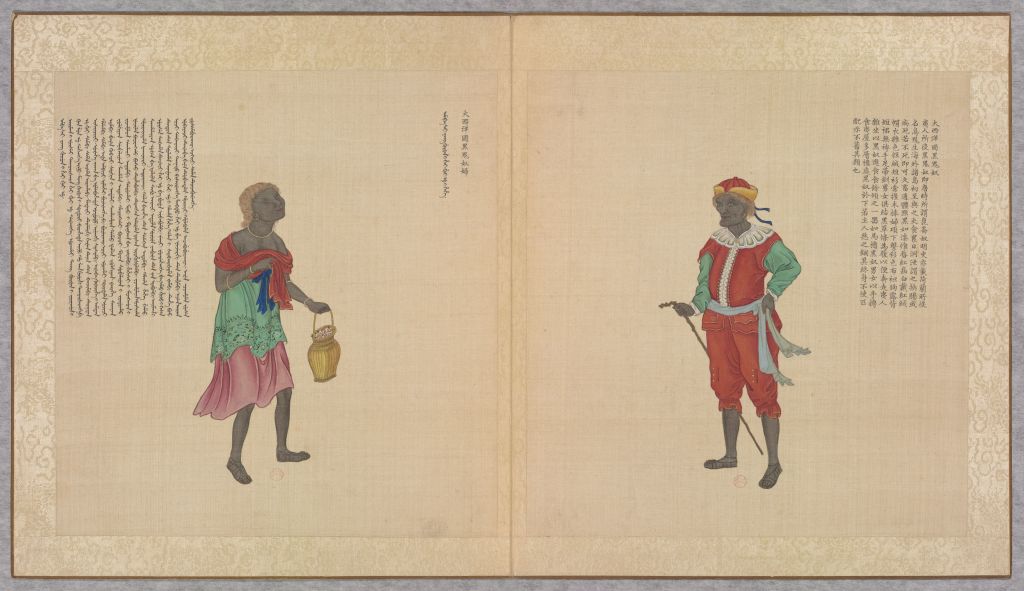
Black devil slaves (heigui nu 黑鬼奴) of the countries of the Great Western Ocean
The black devil slaves owned by the barbarian (Yi) people are the so-called Kunlun slaves of Tang times. The Mingshi (History of the Ming) also records that the slaves owned by the Dutch (Helan, i.e., Holland) are called black devils (wu gui 烏鬼).4 They live on islands beyond the sea. When they first arrive and are fed with cooked food, they suffer diarrhea for days. [The slave traders] call this “changing their guts.” Some die from this, but those that survive can be kept.5 Their entire body is black like lacquer, except for their red lips and white teeth. They wear red woolen hats and wear multi-colored shirts made of coarse wool. They often carry wooden sticks. The women tie colorful cloth below their necks but leave their breasts and backs bare. They wear short skirts without trousers, and wear bracelets on their arms and legs. Men and women alike fasten black leather strips together into sandals, which enable them to run quickly. When the barbarians sit together, they use the black slaves to serve them food. The leftover food is poured into a vessel like a horse’s trough, and the male and female slaves alike use their hands to eat from it. The barbarians’ houses have multiple floors, and they lodge the black slaves on the lowest floor. If a master is displeased with a slave, he imprisons the slave for life and does not allow the slave to marry, to show that his kind should not procreate.
- This was apparently looted from the imperial summer palace Yuanmingyuan in 1860. ↩︎
- This is probably a reference to the Manila shawl. ↩︎
- This appears to be a misreading of European “ladies first” rules for courtesy toward women, which were based on ideals of chivalry rather than female superiority. ↩︎
- The Mingshi entry on the Dutch has the following: “Their slaves are called black devils. They can enter water without sinking and walk on the sea as if on level ground.” This information appears to come in turn from the Dongxiyang kao (see source 4.33). ↩︎
- This information is taken from Zhu Yu’s Pingzhou ketan (see source 4.26). Hostetler and Wu (Qing Imperial Illustrations of Tributary Peoples, p. 65, n. 6) suggest that it may be “a reference to the ‘bloody flux,’ a type of dysentery that affected many of those transported on slave ships.” The slave ships referenced here are presumably European, with the point of reference being the Atlantic slave trade. But the idea of “changing their guts” dates from the Song period and appears to have pertained to enslaved Melanesians transported to Guangzhou by Malay merchants. ↩︎
 Ethnic Identity in Imperial China

