
The Jinshu was compiled in 646-648 by a team of Tang ministers using numerous written sources, including at least eighteen earlier histories of the Jin dynasty (266-420) that are now lost.
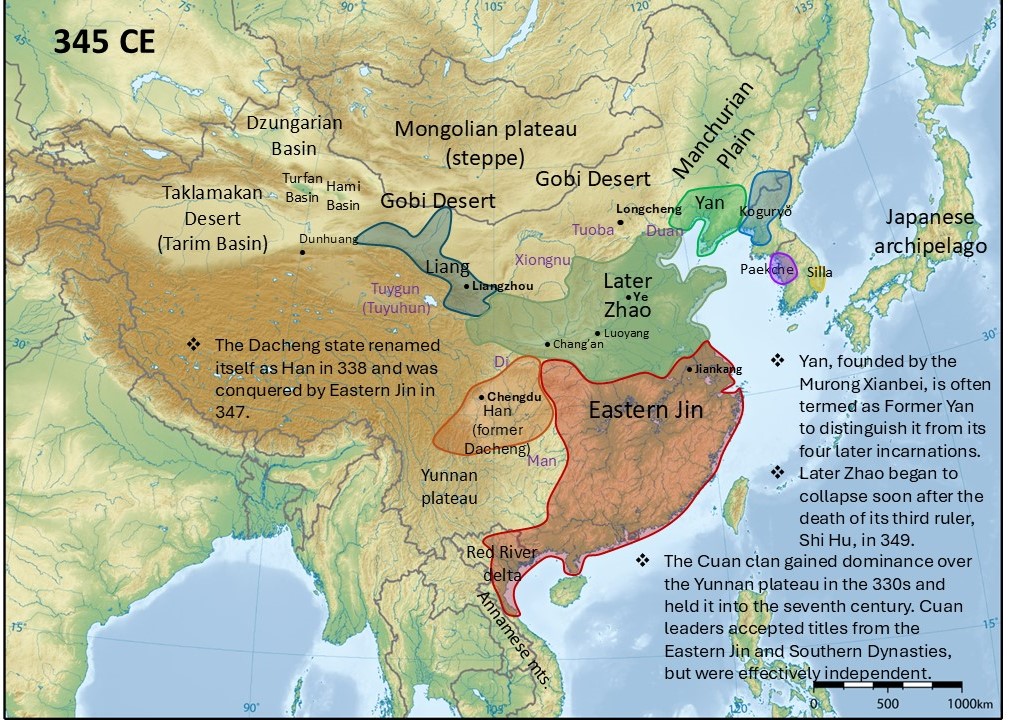
The anecdotes below are found in the Jinshu account of the history of the Later Zhao state (319-351), which conquered and ruled much of north China after the collapse of the Western Jin (266-316). The Jinshu account is based on earlier sources, some of them produced under the Later Zhao itself, but none of them is still extant. The Later Zhao rulers belonged to a people known as the Jie (Kjet) whose origins remain highly mysterious. The Jinshu describes them as a branch of the Xiongnu, but their physical features seem to have resembled those of Central Asian peoples. The Jinshu records a single sentence (in Chinese transcription) of the Jie language; linguists continue to debate over whether this should be identified as Turkic or Yeniseian.
The Jinshu indicates that the Jie were also commonly known as Hu 胡, a label that originally referred primarily to steppe nomads (especially the Xiongnu) in the Han period but gradually came to be applied also to “western” Central Asian peoples and Iranians. To the Chinese of the early medieval and Tang periods, a stereotypical “Hu” body consisted of deep-set eyes, a high bridged nose, and an abundance of facial hair and other body hair—characteristics common to Iranian-speaking peoples, such as the Sogdians1, but not to Turkic-speaking or Mongolic-speaking peoples.
After the Tang period, Hu returned to being primarily a label for peoples of the northern steppe. The Chinese gradually shifted to labeling all Central Asians as Huihui 回回 (“Uyghurs”) regardless of their physical appearance—a practice probably originating from imprecise knowledge of the Turkic Uyghur people’s migration from Mongolia to Central Asia in the ninth century. The label Huihui was eventually applied to all Muslims due to the Islamization of Central Asia, even though the Uyghurs were actually among the last Central Asians to convert to Islam.
~~~~~
[Translator’s note: In this story, which supposedly took place during the reign of the Later Zhao emperor Shi Hu (r. 334-349), a Chinese official named Cui Yue offends a Jie colleague named Sun Zhen by poking fun at his deep-set eyes. The joke in turn infuriates the Heir Apparent and brings disaster to Cui Yue and his family.]
The Supervisor of the Heir Apparent’s Household, Sun Zhen, asked the Palace Attendant Cui Yue, “I have an eye infection. Do you have a remedy for it?” Cui Yue was accustomed to teasing Sun Zhen in a frivolous manner. He joked, “Put urine in the eye and it will heal.” Sun Zhen said, “How does one put urine in an eye?” Cui Yue said, “Your eyes are so deep, they would be perfect for peeing in!” Sun Zhen was offended and told [the Heir Apparent] Shi Xuan. Of all [Shi Hu’s] sons, Shi Xuan had the most pronounced Hu features (Hu zhuang 胡狀), with very deep-set eyes. Upon hearing of Cui Yue’s words, he was enraged and had Cui and his sons executed….
…
[Translator’s note: After Shi Hu’s death in 349, a period of civil war between his sons ensued. Shi Zun emerged victorious with the aid of the powerful general Shi Min, but Shi Min then fell out with Shi Zun, killed him, and replaced him with his brother Shi Jian. In late 349, Shi Jian’s fear of Shi Min’s dominance over the imperial court led him to support a coup attempt against Shi Min, led by the ethnically Jie generals Sun Fudu and Liu Zhu. Shi Min and his political ally, the minister Li Nong, defeated the coup, but they came to believe that the Jie elite would never support them because they were Chinese by birth, not Jie. In fact, Shi Min’s father was a Chinese refugee who had been adopted by Shi Hu and served the Later Zhao loyally as a general. Shi Min was thus technically a member of the Later Zhao royal family, but apparently was not fully recognized as Jie due to his Chinese ancestry. Conversely, Shi Min seems to have been popular with the Chinese population (then known officially as “Zhao people”) and to have been confident of securing their support. The result was a genocidal massacre of the Jie, instigated by Shi Min with offers of career advancement for Chinese officials and military officers who participated. The account claims that due to either over-zealousness or unscrupulous opportunism, Chinese men whose facial features resembled those of the Jie were also in grave danger of being killed so that their heads could be used to claim rewards from Shi Min’s regime.]
The generals Sun Fudu and Liu Zhu gathered three thousand Jie warriors for an ambush at the temple to the Hu [God of] Heaven (Hutian 胡天, i.e., a Zoroastrian temple), planning to assassinate Shi Min and his allies.2 … Shi Min and Li Nong attacked and killed Sun Fudu and his associates. From the Fengyang Gate to the Kunhua Gate, the ground was covered with corpses and rivers of blood. An order was issued that any barbarian (Yi) in the capital or elsewhere who dared to bear arms would be beheaded. Innumerable Hu men then fled the capital by fighting their way through the gates or climbing over the walls…. Shi Min issued an order to people still in the city: “Those who support me can stay, and those who don’t can leave and go anywhere they want.” An edict was issued ordering the guards at the gates to let people come and go freely. All the Zhao people within a range of a hundred li flocked into the capital, while the number of Hu-Jie leaving was so large that the gates got clogged.
Shi Min realized that the Hu would not serve him, so he issued this order to Zhao people both in the capital and outside: “Whoever cuts off a Hu person’s head and brings it to the Fengyang Gate will be promoted three grades if a civil official or promoted to junior general if a military officer.” Within a day, several tens of thousands of heads were cut off. Shi Min personally led the Zhao people in massacring the Hu-Jie irrespective of status, sex, and age. More than two hundred thousand were killed and their bodies were heaped up outside the city to be eaten by wild dogs and wolves. The military commanders stationed throughout the empire also received Shi Min’s order and massacred [the Hu-Jie soldiers under their command]. At that time, about one in two [Zhao people] who had a high nose and a bushy beard was wrongfully killed.
[Translator’s note: In 350, Shi Min killed Shi Jian, reverted to his father’s original surname Ran, and proclaimed himself emperor of a new dynasty called the Wei. The Wei regime was immediately challenged by another of Shi Hu’s sons, Shi Zhi, who had the support of the surviving Jie population, as well as the Qiang and Dī peoples (who presumably also feared being targeted for genocide). Ran Min defeated Shi Zhi’s regime in 351, but was ultimately captured and killed in 352 by the invading Murong Xianbei of the Former Yan state. The former territory of Later Zhao was then partitioned between Former Yan, Former Qin, and Eastern Jin.]
- For a highly informative website on the Sogdians, see https://sogdians.si.edu ↩︎
- Some scholars have inferred from the presence of a Zoroastrian temple in Ye (the Later Zhao capital) that the Jie were Zoroastrians, like the Sogdians and various other Iranian peoples. However, an earlier record in the Jinshu suggests that the Jie traditionally practiced cremation, which Zoroastrianism forbids due to the belief that fire is sacred and should not be polluted by the dead. It is thus possible that the Zoroastrian temple was meant to serve Sogdian merchants and immigrants, not the Jie. ↩︎
 Ethnic Identity in Imperial China