
[with Appendix: “The Luting,” a poem by Qu Dajun]
On Qu Dajun and the Guangdong xinyu, see source 4.28. In the passages below, Qu asserts a view of Guangdong as a land civilized by Chinese colonization, discusses the legendary bronze pillars of Ma Yuan as symbols of that civilizing process, and describes various “barbarian” peoples of the region that (from his perspective) have yet to be fully subdued and transformed by the Chinese civilization-state.
~~~~~
From Chapter 2, “Earth” 地語
The land 地
[Translator’s note: In this passage, Qu Dajun uses cosmological theory to explain how his native region of Guangdong has become an integral part of the Chinese civilization-state over time.]
Although the movement of celestial qi goes from north to south and comes to an end here, the movement of terrestrial qi goes from south to north and begins here. It (the terrestrial qi) begins in the south, especially at the extreme south, and at such extremities, it grows and flourishes all the more. Therefore, [the far south] does not always produce men of fine talent, but when it does produce them, they always become a source of brilliant, illuminating civility (wenming 文明) for the whole subcelestial realm. This is because its position corresponds to li 離 (the trigram ☲, symbolizing fire), and li has an empty (xu 虛) center. Hence the land of Guang[dong] in the south is largely “empty” (underpopulated), and the extreme southern lands out in the sea are especially “empty.” Emptiness gives rise to brilliance (ming 明); therefore its people are naturally well-endowed with civility and keen of mind, absorbing the essence of the sages’ learning, and their writings have the classical style of the sages. It can lay claim to the title of “Zou and Lu1 by the sea” without shame! Before the Qin and Han, it was a remote land of Man barbarians; since the Tang and Song, it has been part of the Divine Realm (shenzhou 神州) [of the Chinese]. Even in tiny settlements on sandbars barely the size of an island, lying amid mists and waters where jiao dragons and crocodiles come and go, one can often still find our civilization of robes and caps, rites and music.
…
The bronze pillars marking the border 銅柱界
[Translator’s note: This long entry begins with an attempt at tracing the history of a set of bronze pillars in Qinzhou, as well as various other bronze monuments associated with Ma Yuan. But it eventually turns into a celebration of Han colonial expansion, a lament about the failure of Ming reconquest in Vietnam, and an expression of optimism that Chinese civilization will, in due course, again spread southward as far as Champa.]
Three hundred li to the west of Qinzhou is the Fenmao Ridge. Halfway up the ridge, there stand bronze pillars about two feet tall. The Shuijing zhu (Commentary on the Book of Rivers) says, “Ma Wenyuan (Ma Yuan) erected metal markers to mark the southernmost border.” These metal markers are the bronze pillars. The Linyi ji (A Record of Linyi) says, “In the nineteenth year of the Jianwu era (43 CE), Ma Yuan planted two bronze pillars at the southern border of Xianglin commandery to demarcate the border with the country of Xitu.”2 [Ma Yuan] inscribed them with the words, “When the bronze pillars break, Jiaozhi will be destroyed.” To this day, the people of Jiaozhi (Dai Viet) regard [this prophecy] with dread and awe. There are several families guarding the bronze pillars, and every New Year they add soil [to prop up the pillars], so only the upper five to six feet are still visible.3
There is more than one set of bronze pillars.4 Based on my research, the Tang and the [Later] Jin both erected bronze pillars. The ones erected by Ma Yuan were at the Big Estuary (Dapu), south of Linyi, and there were five of them. During the Kaiyuan era (713–741) of the Tang, He Lüguang pacified Nanzhao with his army and captured the walled city of Anning and its salt wells, where he again erected a set of bronze pillars.5 Later Zhang Zhou, the Protector General of Annan (in 806-810), erected a set of bronze pillars. During the Yuanhe era (806–821), Ma Zong served as Protector General of Annan (in 810-813) and again erected two bronze pillars at the old site of the Han [pillars], inscribing them with the virtues of the Tang to make it known that he was a descendant of the Wave-quelling General [Ma Yuan].6 During the fifth year of the Tianfu era in the [Later] Jin (940), Ma Xifan of the Chu state pacified the Man barbarians and, calling himself a descendant of the Wave-quelling General, erected two bronze pillars at Xizhou.7 Therefore, there is more than one set of bronze pillars. Those erected by Ma Yuan were in Linyi, so the bronze pillars at Fenmao Ridge must be the ones erected by Ma Zong. People of today only know of them as Ma Yuan’s bronze pillars; is this not because pillars erected by the descendant are considered equivalent to pillars erected by the ancestor?
But why are the pillars made of bronze? Our Yuè 粵 (Guangdong) region does not produce much bronze, yet bronze objects produced by the Wave-quelling General can be found everywhere. My theory is that in ancient times, the Man barbarians mostly used weapons made of bronze. When the Wave-quelling General pacified Jiaozhi, he may have seized all their weapons and melted them down, then used the molten bronze to cast five bronze pillars to demarcate the Han frontier. He also produced five bronze boats and several hundred bronze drums and hid them among the mountains and rivers and other places made perilous by miasma, using them as key instruments for suppressing the power of the Man. To the north of Qinzhou he also cast a bronze fish as a treasured object, so now we have a Bronze Fish Mountain. Moreover, the Wave-quelling General was a skilled connoisseur of prized horses, and he used to cast horses out of bronze to present them to the imperial court [as models]. There is a Bronze Boat Lake north of Hepu that has a large bronze bull that occasionally emerges from the water. There is also a bronze boat at Wuman Shore 烏蠻灘 in Hengzhou8: on stormy days, its bronze punt poles and oars emerge out of the waves with a sound like a thunder clap, and the boatmen often see it. All these are objects made of bronze.
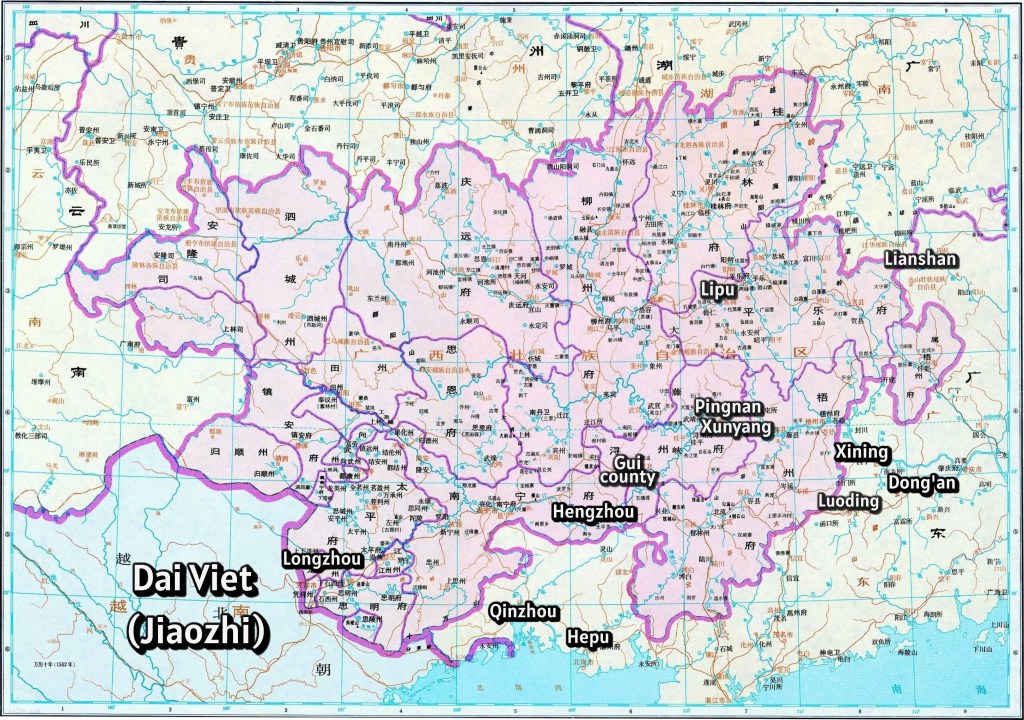
The Wave-quelling General’s divine numinous power is feared by the Man chiefs beyond the frontier. From Han times to the present, they have carefully abided by the agreements made with him. During the sacrificial rites at the beginning and end of the year, some make offerings to the bronze pillars at Xitu, while others do so to the bronze boat in Hepu. Those passing by the Wuman Shore or crossing the sea at Zhuya and Dan’er (in Hainan) also pray to him with utmost sincerity; only then can they sail safely.9 Today, even though the mountains and rivers have changed and the bronze pillars are submerged in the sea, these ignorant barefoot barbarians still fearfully regard the ancient prophecy with anxiety and dare not allow the ancient ruins to be forgotten. From this we can see how the General’s awesome numinosity still terrifies them.
Surveying the mountains of Jiaozhi, I observe that they are part of a range that originates from Guizhou, and Guizhou is an extension of Sichuan. These mountains come from Ba (Chongqing) and Shu (Sichuan) and generally roll across Longzhou like ten thousand waves, running and leaping without cease. Only when they reach Jiaozhi do they coalesce into the kind of land that can form a state. Yunnan is its rear gate, and Guangxi is its front door, while its eastern border is Qinzhou in Guangdong. In this land, the city walls are incomplete, the soldiers are only infantry, and the weapons are only Jiaozhi arquebuses. They completely lack the tactical advantages of the Central Lands.
In the past, when they took advantage of our time of crisis and blocked the arrival of our imperial envoys, a certain general charged at them with several hundred cavalry, and several tens of thousands of mallet-haired barbarians were routed and fled helter skelter. The war elephants that they rode, upon hearing the thundering of our assembled heavy cannons, also immediately panicked and ran away. From this we can see how weak they are. The Han abandoned Zhuya10, but today Zhuya is a center of ritual culture that produces droves of famous ministers. The Ming abandoned Jiaozhi11, causing the old frontier region of the bronze pillars to degenerate daily into a foreign land. One strains one’s eyes for a glimpse beyond its passes and rivers, and sees that it is no longer in the flourishing state that once existed in the Yuanfeng (111–104 BCE) and Jianwu (25–56 CE) eras. If a man like the Wave-quelling General were to emerge today, who can say that he could not subdue these rebels and restore the land to one of civilized robes and rites and music? …
Moreover, Jiaozhi consists of seventeen commanderies, forty-seven prefectures, and one hundred and fifty-seven counties. Each year, it submitted over 13.6 million cash to the Ministry of Revenue; even [the revenues of] Min (Fujian), Guang (Guangdong), Dian (Yunnan), and Qian (Guizhou) combined could not equal this amount. Yet at the beginning of the Xuande era (1425-1435), those in charge of the government discarded it like a piece of refuse. They also withdrew the army hurriedly without the slightest delay, resulting in some tens of thousands of officials, clerks, artisans, and merchants from the Central Lands being stranded among a foreign people. These decisions were ill-conceived indeed. How could men of talent and ambition not regard them with deep regret? …
Linyi is [the ancient land of] Yuechang.12 Today it is called Zhancheng (Champa). It lies to the south of Yazhou (in Hainan), and one can reach it within one to two days of sailing with a favorable wind. Qiu Wenzhuang (Qiu Jun) said, “In the past, when court historians recorded mountains and rivers in the ‘Yugong’ (Tribute of Yu), they based this on the extent to which the sages’ transformative influence had spread. Hence, they described the territories in the east, west, and north, but when it came to the south, they only spoke of the direction. This was presumably because the sages governed by embodying Heaven: wherever they turned their faces and directed their eyes was blanketed by the light of their brilliant moral power, but this power could never be limited by geographical distance. For several thousands of years, [the boundaries of civilization] have never expanded in those three directions (east, west, and north); only in the south does civilization daily expand further outward.”13 In ages past, Yazhou lay beyond the uncultivated zone of submission, but today it has been settled and developed as imperial territory. In that case, who can say that Zhancheng will not one day become a land of our commanderies and counties?
From Chapter 7, “Human beings” 人語
The real Yuè 粵 people
[Translator’s note: In this passage, Qu Dajun draws a clear distinction between the ancient Yue people and the homophonous label Yuè 粵, which the Chinese population of Guangdong had embraced as a sub-ethnic regional identity starting from Ming times. He maintains that the people of Guangdong are descended from Chinese colonists who arrived in Qin and Han times, not the indigenous “barbarians.” In his opinion, the original Yue were not assimilated by the Chinese and instead branched out into the various “barbarian” peoples that inhabited peripheral regions of Guangdong, Guangxi, and Hainan in the seventeenth century—peoples with whom he refuses to recognize any common ground or ancestry.]
Ever since the First Emperor of Qin drafted arrested absconders, matrilocal husbands, and merchants, and used them to conquer the Yang[zhou] and Yue regions, convicts sentenced to exile have lived mingled among the Yue people.14 Officials who had been unjust in settling criminal cases were also exiled to the Yue lands in the south.15 [The First Emperor] also stationed an army in the city of Panyu (Guangzhou) and another at the frontier in Taishan. Ren Xiao and Commander Tuo (Zhao Tuo) commanded tower-ship crews numbering over a hundred thousand men, and these, too, later made their homes in Yue and had children and grandchildren.16 Hence Ren Xiao said to [Commander] Tuo, “There are quite a number of people from the Central States [in this region] who can assist you.”17
Today, the people of Yuè (Guangdong) are generally of Central Lands stock (or ethnicity or lineage, zhong 種). Since the Qin and Han, their numbers have multiplied as the days and months have passed, and they have not lost the pure and refined manner of the Central Plains. The real Yue people who cut their hair and tattooed their bodies are today’s Yao 猺, Zhuang 獞, Pingzong 平鬃, Lang 狼, Li 黎, Qi 歧, and Dan 蛋 peoples. Using people from the Central Lands to colonize (literally “fill up”) foreign lands and change their barbarian (Man) customs: This was the First Emperor’s great achievement.
[Commander] Tuo set himself up as king but did not use rites and music to govern himself and his people. Instead, he tied his hair up in a mallet-shaped bun and sat rudely with his legs splayed out18, acting as a great chief of the Man barbarians and as a peer of the kings of the Western Ou, Luo, and Yue. Preventing the people of Southern Yue from receiving the transformative (civilizing) teachings of the Great Han was Commander Tuo’s great sin. Yue underwent a transformation under the First Emperor and a second transformation under Han Emperor Wu [who conquered Southern Yue]. As a result, the people of the Central Lands have been able to benefit from both prosperity and [civilized] teachings on this soil to this day. How can we remain ignorant of the origin of these benefits?
The Ma people 馬人
[Translator’s note: In this entry, Qu Dajun returns to his fascination with Ma Yuan’s bronze pillars, but now focuses on the old legend of the Ma or Maliu people, descendants of military colonists left behind by Ma Yuan to guard the pillars. Unlike Tian Rucheng, who thought the Ma people were originally from Champa (see source 5.19, note 3), Qu Daqjun firmly believes in their Chinese ancestry. In fact, he uses the motif of their adherence to “Han” identity and cultural norms as a subtle means of expressing his Ming loyalism and rejection of Manchu rule.]
The Ma people are also called Maliu 馬留. Yu Yiqi wrote: “To the south of the coast of Shouleng county, there are [the descendants of] troops left behind by Ma Yuan. These families live facing the bronze pillars and are all surnamed Ma. They are called the Maliu (“Ma’s Remnant”). There are about two hundred or more households who intermarry among themselves.”19
… In that area, people dug up a bronze drum made by Ma Yuan. It is like a stool but hollow. It takes two men to carry it, and when struck, it sounds like a military drum. The Maliu people often strike it when making offerings to their ancestor, who is none other than Ma Yuan. Someone wrote a poem about this: “The bronze drum was buried and the bronze pillars are gone/But the Maliu still wear the clothing of the Han.” I, too, composed a poem:
The mountains preserve the bronze pillars and the waters preserve the bronze boat;
The Marquis of Xinxi’s majestic spirit resides under these miasmic skies.
Since antiquity, the Maliu have called themselves Han descendants,
Guarding the frontier at Xianglin commandery in their robes and caps.
Another of my poems reads:
Striking the bronze drum at the Wave-quelling General’s shrine at dawn,
The sons and grandsons of the Great Han truly are here.
Even though the metal marker is buried and gone,
The Ma people have always known the difference between Hua and barbarians.
The bronze boat is at Hepu county. The legends say that Ma Yuan cast five bronze boats and his army went to attack Linyi in four of them, while one was left behind. When the weather is overcast and rainy, it rises out of the lake, and woodcutters and fishermen often sight it. That is why the lake is called Bronze Boat Lake.
…
The Yao people 猺人
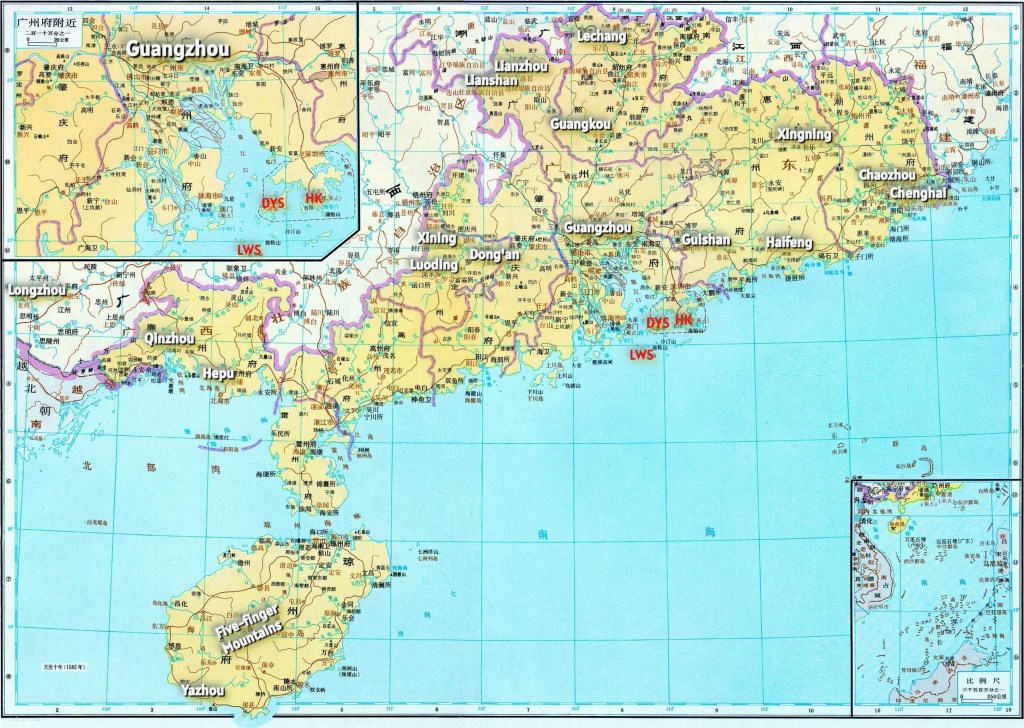
In Lianshan county there are the Eight Rows Yao (bapai Yao 八排傜), who are exceptionally coarse and savage by nature. They have small vestigial tails on their buttocks, and the soles of their feet are about an inch thick. They climb up trees and cliffs as if flying. They call themselves the Yao Lords (Yaogong 傜公) and call the people of Lian[shan] “commoners” (baixing 百姓). They call their Yao men “the eight hundred grains of millet” (babai su 八百粟) to express how large their numbers are. They call local officials “the imperial court” (chaoting 朝廷). Once a month, they send a contract to the county magistrate’s office, and their representative does not kneel [before the magistrate]. When paying a tax in grain, they hand it over to the Community Heads (lizhang 里長) of their county.20 The Community Heads maintain friendly relations with [the Yao] out of desire for their goods, but if they get into even a minor disagreement [with the Yao], then they are met with unsheathed blades.
There are eight Yao chieftains (Yaomu 傜目) in charge of maintaining order. Every year, on the sixteenth day of the eleventh month, the Yao go to the temple for an assembly, and everyone hangs up their gold, silk, clothes, and jewelry to show off to the others. The Yao chieftains choose their young men and women of marriageable age and send them into the temple. The men and women sit on the ground in separate groups and sing all night until dawn, exchanging lewd verses back and forth. If a man is interested in a woman, he is not allowed to go and sit with her, but if a woman is attracted to a man, then she goes to sit with him. Once a woman goes to sit with a man, the matchmaker compares the length of the girdles on their robes. If the lengths are similar, then they let the man take the woman back to his home. After three days, the woman’s parents send a gift of livestock and wine and the couple are married.
All [Yao] women who are already betrothed place a rectangular wooden board more than one foot long on the top of their head, shaped like a fan. The hair is wrapped flat over it, and a flowered scarf is draped slantwise over it, fixed in place with wax, and decorated with glass beads. They are called Board Yao (Ban Yao 板傜).
If not yet betrothed, they wear an arrow shaft on their head. The hair is divided into several strands, coiled and tied to the arrow on either side, and an embroidered scarf is also draped over the arrow. They make and wear their own hats, woven from wheat straw. When passing in and out of brush and bamboo, their heads tilt frequently to avoid getting tangled. They are called Arrow Yao (Jian Yao 箭傜).
Their collars and sleeves are all embroidered with five-colored velvet, with several strings of bells and coins hanging down. Their clothing is made from cloth, either blue or red, and covered with floral and grass patterns; it is called Yao Brocade.
When a girl is first married, she hangs an embroidered pouch from her waist, recalling that when their ancestress, the daughter of Gaoxin, married Panhu, she put on a menial laborer’s clothing and carried Panhu in a pouch to be united with him. Thus, this custom is preserved even down to the present. The Hou Hanshu says, “The sons of Panhu wove bark into cloth and dyed it with the juice of grass and fruits. They like wearing five-colored clothing, and all their clothing designs include a tail.” This is what Gan Bao meant when he wrote, “Red hips and wide skirts, these are the descendants of Panhu.”21 Panhu’s fur was five-colored, and that is why the Angtu of today’s Yao wear multicolored clothing.22
They are violent by nature and like to fight; a single teenaged youth is a match for several government troops. They are also good at setting ambushes. In the day, they hide in forests and thickets and smear their faces with charcoal, wearing black shirts and trousers, looking like sprites of the mountains and woods. When they see traveling merchants, they charge out with their hair disheveled, and the merchants, seeing them, flee in alarm, abandoning their goods and crying out, “Spare me, Jingfu!” Only then do they relent. “Jingfu” is what the Yao call their leaders. From Guangkou23 to Lianzhou, a distance of over four hundred li, the mountain roads are hard and perilous, and traveling merchants dare not go by land; they always travel by river (the Lian River). The government troops collude with [the Yao] to engage in banditry, and the Yao leaders pay them an annual rent of one thousand gold pieces, so they leave them alone. Fugitives from surrounding areas also serve [the Yao] as porters or guides in return for a share of their booty.
Their dens are adjacent to Lianshan, separated by just a river. When government troops arrive, entire families flee to evade them; then, as the troops are withdrawing in a state of exhaustion, they strike. They clamber around in the thickets, leaving no tracks or traces. In battle, they fight in pairs. The spearman now advances and now retreats, defending the crossbowman. The crossbowman holds a sword with his mouth and uses his hands to shoot. When he runs out of crossbow bolts, then he wields his sword and charges together with the spearman. When crossing treacherous terrain, they move in ordered ranks; when they retreat, they always set up ambushes with crossbows. Formerly, armies from five provinces were mobilized for a campaign against them, and someone told their generals the following: “The Yao always hide away and avoid battle with us. Then, at dusk, they emerge to strike us in the rear. It is best to send the armies on a direct advance, while the commanding general leads Wolf Troops (langbing 狼兵) in the rear, dispersed in ambush at strategic locations.24 When the Yao come and strike us, we come behind them and strike them instead, and the main army turns around in a pincer attack. This way, we can surely wipe them out. That is what [Art of War] means by ‘manipulating others and not being manipulated by them.’” This is indeed a good strategy.
…
The Li people 黎人
The Li Mother Mountains are tall and treacherous, and in their center are the Five-finger and Seven-finger peaks. The Raw Li 生黎 live among these mountains like animals, and the Cooked Li 熟黎 live around the mountains. The Cooked Li can speak the Han language and have previously gone to the prefectures and counties to trade. At dusk, they blow a horn to form parties and return home.25 The Raw Li never go to the cities, and people seldom get to see them. In the renzi year (1672), more than twenty Raw Li suddenly came to present items to the local official. They had a flag bearing the four characters Liren xianghua 黎人向化 (Li people turning toward civilization), hanging from a pole of betel tree wood. Two of them carried a wreath of flowers that was as big as a carriage wheel. It was white on the outside and had black patterns inside. One of them was carrying, with both arms, a yousu 油速 tree that was seven to eight feet tall. Two of them carried a black bear, and another two carried a yellow deer. All of them were ugly and black, with disheveled hair and bare feet. They wore short shirts that went down to the waist and covered their crotches with triangular loincloths. Those who saw them thought they were demons.
They wear topknots on their foreheads. In their topknots, they stick hairpins of gold or silver or cattle bone. Those who wear their hairpins vertically are Raw Li; those who wear them horizontally are Cooked Li. That is how one tells them apart….
[Li women] have flowers, plants, insects, and moths tattooed on their faces and are called Embroidered-Face Women (xiumian nu 繡面女). They do not embroider their faces for the sake of beauty. Whenever a Li woman is to be betrothed to a man, they select a mate for themselves based on physical attractiveness, and when both sides are pleased with the match, then the man begins to tattoo the woman’s face, adhering exactly to the pattern used by his ancestors, not daring to deviate from it in the slightest. They say that this is for fear that the ancestors will not recognize her spirit after she dies. Also, when they are newly betrothed, they embroider their hands; only on the night before the wedding do they embroider the face. The patterns are all provided by the man’s family to be used as a marker, so that the woman can never remarry. This is what the ancients meant by “tattooing the forehead” (diaoti 雕題26)….
The Raw Li, enticed by the Cooked Li, often come out to engage in raiding and banditry. Men and their wives and entire families go on these raids. They travel fast on foot, as if in flight, and government troops are unable to catch up with them. But the women’s Li dresses are too long and their movements are thus slightly slower. They are thus frequently captured, and only then [do their families] submit for a while. One of their branches is called the Raw Qi 生歧; these are especially ferocious and even the Raw Li are afraid of them. In general, there are many Raw Li in the Five-finger Mountains and there are many Raw Qi in the lesser five-finger mountains…. The Cooked Qi 熟歧 are slightly more tame and good. Those who live in nests (stilt houses) and practice slash-and-burn farming are Dry Feet Qi 乾脚歧 and have the same customs as the Cooked Li. The “Half-Raw Half-Cooked” are one step below them.
I estimate that the Li and Qi frontier stretches across some 1,200 li or more, and the average width [of their territories] is a little more than 400 li. The mountains coil around like a spiral conch shell. Entire clans and tribes of Li live in the outer parts, and the Qi live in the inner parts. There is a dong 峒 (polity or settlement) every twenty to thirty li, and every dong has several tens of villages. Their soil is fertile and their homes are packed densely, no differently from villages of registered [Chinese] commoners (min 民) outside [the Li areas]. It is just that with so many layers of peaks and thick forests of trees and bamboo, poisonous water and mist-filled mountains, and [miasmic] qi covering the entire place, outsiders cannot enter for long. That is why the Lao peoples can take advantage of the difficult terrain to pose a threat. Truly, if we could conciliate and pacify them in accordance with the Way, establish good defensive fortifications, and educate them with schools, then the registered commoners and the Li would coexist happily in harmony and peace, and we would not need to concern ourselves with military operations.
There are two kinds of Li. Those who live in front of the Five-finger Mountains are Cooked Li. Those who live behind the mountains are Raw Li. There are also two kinds of Cooked Li. Those who live closer to the Raw Li are called Three-degrees Li 三差黎. Those who live closer to the registered commoners are called Four-degrees Li 四差黎, and we levy a small amount of taxes and corvée from them. The Cooked Li are the troublemakers in our relations with the Raw Li, and the Grain Headmen (liangzhang 糧長) are the locusts among the Cooked Li. Whenever the Raw Li become restive, it is always because the Cooked Li have provoked them, and the treachery and deceitfulness of the Cooked Li is provoked by the excessively harsh demands of the Grain Headmen. The Grain Headmen are like the Community Heads (lizhang) of today. They order the Li people around like slaves, and the Li address them as “official” (guan 官). The Grain Headmen, behaving like officials, also call the Li people “commoners” (baixing). They are allowed to count whatever taxes are collected [from the Cooked Li], and all of it goes into their own pockets. When [our officials] question them, they say, “These are Raw Li and if you provoke them, I fear they will rebel.” That is how treacherous and deceitful they are.
When officials go to a Li village to collect taxes or grain, it is best that they taste the wine and food offered at every household they visit. The Li people appreciate fairness from officials, and when they see this, they urge one another to quickly complete their state obligations. But if even a single household is neglected, the people become angry; they secretly arm themselves with bows and arrows and lie in wait in the forest, indulging their fierce and wild nature.
When they go to the prefecture or county seat, they go naked except for their hair coiled on top of the head, standing upright with a single rooster tail feather, and a bone hairpin stuck crosswise. This, for them, is formal dress or a kind of official headgear. The official should meet them cheerfully, speaking with a smile and accepting their gifts, rewarding them with a silver badge or red cloth. The Li people then return home delighted and place the reward item in a shrine to receive incense as a family heirloom. If, however, the official looks down on their nakedness and insists they wear clothes to meet him, word spreads quickly among their people, and their visits become rare. Their willingness to pay taxes also declines, so in the end it becomes necessary to entrust the collection to the Grain Headmen….
The She people 輋人
There are She households living in the hills of Chenghai.27 Both men and women tie their hair into mallet-shaped buns and go barefoot. They carry spears and crossbows and pay an annual tribute of animal pelts, rather than taxes. The She live in nests (stilt houses), and those who have permanent households and native (hill) officials pay a small amount of native (hill) taxes. Those who pay a tax rate based on the number of swords owned are called Yao. The settlements of the Yao are called kan 冚 or dong 峒, but they are also called she 輋. In the Haifeng area, there are Luo 羅 She, Calabash (hulu 葫蘆) She, and Big Stream (daxi 大溪) She. In Xingning there are Daxin 大信 She, while in Guishan there are Kiln (yao 窰) She.28
These people do not use plows and hoes in agriculture. Instead, they all use knives to till the soil and plant grains. This is called knife-plowing. They burn trees in the forest and cause the ashes to enter the soil. The soil then heats up and the snakes and worms in it die, becoming fertilizer. This is called “clearing the land with fire.” Such are the She Man 輋蠻, whom gazetteers describe as clearing the hills into fields, burning the grass to sow seeds, living in the mountains and valleys as hunter-gatherers, and wearing no caps and shoes.
There are Hill She in Chaozhou, comprising two kinds: the Pingzong 平鬃 (Flat Manes) and the Qizong 崎鬃 (Jagged Manes). Both are also Yao tribes. There are Mo Yao 莫傜, also called White-robed Hill Dwellers (baiyi shanzi 白衣山子). They live dispersed among the streams and valleys, living a self-sufficient life. They are not under the jurisdiction of our officials or of dong chiefs. These are all Good Yao 善傜. Those called Doulao 斗老, as well as the three big surnames (clans) of Pan, Lan, and Lei, are quite recalcitrant and hard to tame. In Lechang there are Fake Yao 僞傜, many of whom live in the hills of Jiufeng.29 Originally, these were people who, finding the government’s demands too onerous, leased their fields and land to tenants and fled among the Yao. This was meant to be a temporary escape, but over time, they began imitating the dispositions of the Yao and became real Yao. They lead the Yao in breaking the law and indulging in raiding, inflicting harm on the local region. Even the Good Yao fear them….
In the eastern part of the Yuè region (i.e., Guangdong), there are many Yao but no Zhuang 僮. There are many Zhuang only in the western part of Yuè (i.e., Guangxi). From Lipu to Pingnan, the Zhuang live mixed among the registered commoners (min 民) and none can tell them apart.30 In general, those who live in houses are registered commoners, and those who live in lan 欄 (stilt houses) are Zhuang. The lan are built by erecting wooden frames. People shelter on the top, and livestock shelter underneath. These are called lanfang 欄房 (lan houses) and also gaolan 高欄 (tall lan) or malanzi 麻欄子. The Lang 狼 (Wolf) people do not do this (i.e., live in stilt houses). From Lipu to Pingnan, there are many Zhuang people, while from Xunyang to Gui county there are many Lang people.31 In the eastern part of Yuè, only Luoding, Dong’an, and Xining have Lang people. These are presumably [Wolf Troops] mobilized from the western part of Yuè and deployed for campaign and garrison duty in Luopang; their clans number in the tens of thousands.32 Each person pays an annual “sword tax” of three coins to the local prefecture or county in which he lives.33 They are tasked with guarding the city walls, cleaning government offices, and providing firewood and charcoal. In temperament, they are generally submissive and respectful of the law.
…
The Dan household (Danjia) pirates 蛋家賊
The pirates of Guangdong are dangerous when dispersed, not when they are gathered. The dangerous ones are those without dens, not those with dens. Those with dens are few, while those without are many, and the Dan households are one such kind. The Dan households originated from pirate clans and are addicted to killing by nature. Their ships and boats come and ago among the waves; the rivers and estuary being divided into many waterways, their raiding parties gather and disperse in an unpredictable fashion. Furthermore, they form alliances with various criminal gangs on land and water. If our patrol boats are too few, we cannot track their movements; if our naval forces are too small, we cannot withstand their assaults. Therefore, we must always ensure that our military forces outnumber the pirates, never allowing the pirates to outnumber our troops….
From Chapter 18, “Boats” 舟語
The boats of the Dan households 蛋家艇
The Dan people use their boats as houses and are thus called Dan households. Families with an unmarried son place a pot of grass at the stern of their boat, while families with an unmarried daughter place a pot of flowers at the stern of their boat. This enables them to arrange matches. At weddings, they greet each other with Man songs; when the man’s singing wins, then he grabs the woman over to his boat. Their adult women are called Fish Elder Sisters (yuzi 魚姊), and their girls are called Clam Younger Sisters (xianmei 蜆妹). Fish are larger than clams, so elder sisters are called fish and younger sisters are called clams.
Dan people are skilled at diving and often fight with giant fish in the water, wielding swords and spears. When they see a large fish in a cave, they sometimes toy with it, stroking its scales and fins, and wait for the large fish to open its mouth, upon which they use hooks tied at the end of long ropes to hook onto the fish’s cheeks and pull it out of the water. Sometimes, several tens of them spread a large net out, and several dive into the water to lure the large fish into the net. When the net is lifted out of the water, the men come up with it. There have been instances when one of them was swallowed and eaten by a large fish, or when a large fish swam back into its cave and blocked its entrance, causing a diver to be trapped in the cave and drown. The longest whales (haiqiu 海鰌) are a hundred li in length and often carry their calves on their backs. The Dan regularly tie long ropes to spears and throw them to harpoon the whale calves. They wait until the calf dies, and then drag it onto the beach to extract its fat, a commodity worth tens of thousands of coins.
Dan women all love to eat raw fish and know how to swim. In former times, the Dan were known as Dragon Households (Longhu 龍戶) because they typically tattooed their faces and bodies before diving into the water, so as to resemble the sons of jiao dragons.34 They could swim underwater for thirty to forty li without being harmed. Now, they are called Otter Households (Tajia 獺家) instead. The women are called otters and the men are called dragons because none of them seem human….
The Dan, too, are gradually learning how to read. Some of them live on land and form villages, such as Zhoudun and Lindun to the west of Guangzhou city. However, good families do not intermarry with them because they are vicious by nature and given to banditry, often posing a threat to coastal villages. In the past, the four clans of Xu, Zheng, Shi, and Ma often had hundreds of warships that they used for marauding along the eastern and western tributaries of the Pearl River. The extent of slaughter that they perpetrated was terrible indeed. After they accepted an offer of amnesty and surrendered, there were still the Red Flag and White Flag pirates, all of whom were fierce and cunning Dan. Even their women could charge into battle and fight, or pilot a ship and handle the sails to travel around in pursuit of profit. People say that the Yao live in the hills and are given to enduring hardship, while the Dan live on the water and are given to stupidity, but this is not completely true. The Yuè (Guangdong-Guangxi) region has very many bandits and pirates, and those who gather to raid on the sea mostly come from the Dan households. Their boats come onto the rivers in assorted groups of unpredictable size: at times ten or more boats form a squadron (zong 䑸), and at other times anything from one or two to more than twenty nets (gu 罛) can form a band (peng 朋). Every band is accompanied by several auxiliary supply boats carrying salted fish; when the opportunity arises, they too engage in piracy, preying on merchant ships. During the autumn harvest, they sometimes rush in to cut and seize all the rice stalks. The farmers who do manage to harvest rice have to each pay the pirates in coins and rice grains in order to be allowed to come out to the shore [to sell their crops to merchants?]. Such is the extent of their tyranny….
From Chapter 22, “Scaly creatures” 鱗語
Strange fish 怪魚
[Translator’s note: Qu Dajun saw the Dan as essentially human despite the dehumanizing language likening them to dragons and otters. However, in his eyes the Luting of the Guangzhou area were not “a kind of Dan” (as Zhou Qufei thought; see source 5.11) but a different race of merpeople who only superficially appeared human. His understanding of the Luting was probably inspired in part by the descriptions of Sea Monks and Human Fish in Huang Zhong’s Haiyu (see source 4.42), but he seems to have collected local lore about the Luting as well. In fact, Qu claimed to have encountered a group of Luting himself and composed a poem about it. This poem (preserved in his poetry collection Wengshan shiwai 翁山詩外) is translated in an Appendix below.]
… During storms at sea, one sees strange sea beings with disheveled hair and red faces riding fish back and forth. These fish riders are also fish and are called Human Fish (renyu 人魚). The male Human Fish are called Sea Monks 海和尚, and the females are called Sea Women (or Mermaids) 海女 and have the ability to bewitch [the sailors on] ships. Navigators have a prayer that goes, “Let us not run into Sea Women; let us not see Human Fish.”
There is a kind of Human Fish called the Luting; there are many of these at Dayushan Island (Lantau Island) in Xin’an and Laowanshan Island (Dawanshan Island) in Nanting. They are shaped like human beings, with both males and females. Their hair is yellowish and short, and their eyes are also yellow. Their faces are black, and they have tails about one inch long. The sight of people leads them to dive into the water in shock and fear. They often drift to our shores with the waves, but people see them as monstrous beings and hurry to chase them away.
There was a man who captured a female [Luting] and had sex with her. She was unable to speak and could only smile. Eventually, she was able to wear clothes and eat grains. But when he took her to Dayushan Island, she still dove back into the water. Presumably, she was a kind of Human Fish that does not harm people.
Human Fish are six to seven feet tall and resemble humans in their bodies, hair, and genitals. One can only tell that they are fish from the short mane (fin) on their backs, which is light red. They occasionally emerge onto beaches and can enchant and seduce men. When a ship encounters them at sea, the crew always performs rituals to repel them. Most Sea Monks have human heads and the bodies of softshell turtles. Their legs are rather long, and [unlike turtles] they do not have shells.35
Appendix: “The Luting,” a poem by Qu Dajun
On Laowanshan Island there are many Luting 老萬山中多盧亭
Male or female, each one has a human form 雌雄一一皆人形
Their bodies are covered with green fur, except for their faces 綠毛遍身祗留面
Their lower bodies are half-clothed with blue-green pine tree bark 半遮下體松皮青
Two or three of them clamber up my ship and refuse to leave 攀船三兩不肯去
When we throw wine and food to them, they call out like birds and beasts 投以酒食聲咿嚶
One after another, they bring fish to present to their guests 紛紛將魚來獻客
They give us fish with hook-pierced cheeks, wisteria vines, and unnamed flowers 穿腮紫藤花無名
They eat fish raw, without using fire 生食諸魚不煙火
They come to me carrying a big sea bass 一大鱸魚持向我
They earnestly ask for more good wine 殷勤更欲求香醪
Some of the female ones have attractively slim waists 雌者腰身時嫋娜
Since they’re on an island, we know they’re not Human Fish 在山知不是人魚
But Fish-like People living on an island 乃是魚人山上居
Weaving thatched roofs, they’ve built hundreds or thousands of houses 編茅作屋數千百
Most fishing villages by the sea can’t compare to theirs! 海上漁村多不如
Surely they are descendants of Lu Xun 盧循苗裔毋乃是
Who transformed into a different race due to the workings of cosmic principle?36 化爲異類關天理
Or perhaps those who wear clothing are descended from ancient people 或有衣裳即古人
Who escaped from the Qin empire and left behind many sons and grandsons?37 避秦留得多孫子
I, too, am an ancient man of Qin times 我亦秦時古丈夫
Holding hands with two or three pretty green-furred girls 手攜綠毛三兩姝
It‘s just that I mistakenly ate grains and meat 祗因誤餐谷與肉
And got too fat and heavy to become a skinny transcendent38 遂令肥重非仙癯
The Luting envy my unconstrained life 盧亭羨爾無拘束
These people from a Naked Country seemingly can be tamed!39 裸國之人如可畜
Although apes that can speak are inferior to them 猩猩能言雖不如
Nonetheless, they have not risen above the level of beasts40 彼卻未離禽獸族
These Fish-like People are certainly people from primeval times 魚人自是洪荒人
Eating raw meat and drinking blood, how primitive they are! 茹腥飲血何狉獉
I wish to clothe their scaled and shelled bodies41 我欲衣裳易鱗介
And teach all these frogs and toads how to become our people42 儘教蛙黽皆吾民
Since antiquity, the Yue people have looked like the dragon’s sons 自古越人象龍子
Diving into the rivers with tattooed faces and bodies43 入江繡面兼文身
Though like animals with human faces, they were still able to avenge their humiliation44 靦然人面能雪恥
And were thus somewhat superior to the capped and robed people of the Central Regions45 差勝中州冠帶倫
Distributing wine and meat to them 觴酒豆肉且分與
I hope that all creatures who have blood and breath will know how to honor and love a sage!46 期爾血氣知尊親
- The home states of Mencius and Confucius ↩︎
- On the Linyi ji, see source 4.19. On the legend of Ma Yuan’s bronze pillars, see source 5.8, note 5. ↩︎
- The legend of Ma Yuan’s oath is first recorded in the Lingwai daida: see source 5.11. ↩︎
- The multiple sets of bronze pillars were already a subject of fascination for Zhou Qufei in the 1170s, five centuries earlier: see his discussion in source 5.11. ↩︎
- This was actually in 751, during the Tianbao era. ↩︎
- On these pillars, see also source 5.8, note 6. ↩︎
- Ma Xifan was the third ruler of the tenth-century Chu state, reigning from 934 to 947. According to the Zizhi tongjian, “Xifan claimed himself to be a descendant of the Wave-quelling [General] (Ma Yuan) and cast pillars out of 5,000 jin of bronze, 12 feet in height with 6 feet buried underground, inscribed an oath on them, and had them erected at Xizhou.” Xizhou 溪州 corresponds to Xiangxi Tujia and Miao Autonomous Prefecture, Hunan. ↩︎
- Hengzhou, Guangxi ↩︎
- See Su Shi’s account of this practice in source 5.9. ↩︎
- See source 2.4. ↩︎
- See source 2.18. ↩︎
- On Yuechang, see source 2.4, note 3. ↩︎
- This quotes Qiu Jun’s “Wanzhou qianxue ji” 萬州遷學記 (Inscription Commemorating the Relocation of the Wanzhou Prefectural School) of 1494: see source 5.15. ↩︎
- The Shiji dates this policy to 214 BCE. Absconders were men who had left their homes to evade taxes and conscription. Matrilocal husbands or zhuixu (赘婿), literally “superfluous sons-in-law” (zhuixu), were typically a poor man of low status who married into a richer woman’s household and took her surname. Merchants were regarded as parasites in the Qin system and subject to persecution. ↩︎
- The Shiji dates this policy to 213 BCE. ↩︎
- Ren Xiao and Zhao Tuo were officers in the Qin expeditionary army that conquered and then garrisoned the Southern Yue region. ↩︎
- Ren Xiao said this to Zhao Tuo around 210 BCE, when the Qin empire began to collapse. Ren was dying from an illness and urged Zhao to found an independent kingdom based in Panyu. Zhao took his advice and established the state of Southern Yue, ruling until 137 BCE (when he died at more than a hundred years of age). ↩︎
- This alludes to the Shiji account of how Zhao Tuo behaved disrespectfully toward the Han envoy Lu Jia in 196 BCE, only to be won over by Lu’s persuasion and agree to pay tribute to the Han emperor Liu Bang. ↩︎
- This is a loose paraphrase of Yu Yiqi’s account of the Maliu; for a translation of the full version, see source 5.8, note 5. In Yu’s telling, “The people of Jiaozhou (Jiaozhi) call them Maliu 馬流 because they are exiles (liu 流) in a foreign land.” Qu Dajun reinterpreted the liu as the homophonous 留, meaning “to remain.” ↩︎
- In the Ming and Qing administrative systems, Community Heads were locally appointed chiefs of a group of neighboring households, responsible to the country magistrate for maintaining peace and order, collecting taxes, and providing corvee laborers. Under earlier dynasties, they were known as lizheng 里正. ↩︎
- See source 5.3. ↩︎
- According to the Hou Hanshu, the descendants of Panhu called their leaders Jingfu 精夫 and called each other Angtu 姎徒. ↩︎
- Corresponding to Hanguangzhen 浛洸镇, now part of Yingde city, Guangdong province. ↩︎
- The Wolf Troops were elite auxiliary or mercenary units recruited by the Ming from the Zhuang and Yao peoples of Guangxi. They were typically commanded by their own chiefs. ↩︎
- These two lines are based on the Lingwai daida (see source 5.11). ↩︎
- The phrase diaoti is found in the Liji document “Wangzhi” and named as a characteristic of the Man barbarians – see source 1.6. ↩︎
- Chenghai was a county located in modern Shantou, Guangdong. ↩︎
- Haifeng and Xingning are located in eastern Guangdong. Guishan corresponds to modern Huizhou, to the east of Guangzhou. ↩︎
- Lechang is located in the mountains of northern Guangdong, near the modern provincial border with Hunan. Jiufeng town is located on the northern end of Lechang. ↩︎
- Lipu and Pingnan county were located in eastern Guangxi. ↩︎
- Xunyang 潯陽 here refers not to modern Jiujiang, Jiangxi, but to the northern bank of the Xun River in southeastern Guangxi. Gui county corresponds to Guigang in southeastern Guangxi. ↩︎
- On Wolf Troops, see note 21 above. These were mercenaries whom the Ming would normally have classified as Yao or Zhuang, but their status as garrison troops, deployed from another part of the region, led to a different quasi-ethnic categorization. Luopang 羅旁, a mountainous region on the Guangdong-Guangxi border, was the site of a major Yao rebellion against Ming rule in 1575–1577. The rebellion was suppressed by troops from Guangdong and Guangxi, and the counties of Dong’an and Xining and the prefecture of Luoding were then established to govern the surviving Yao population. ↩︎
- This is somewhat similar to the Yao tax on swords described earlier. ↩︎
- This alludes to Han-era passages in the Shuoyuan and Ying Shao’s (see source 1.10) commentary to the Hanshu, which interpret the ancient Yue people’s practice of cutting their hair short and tattooing their bodies as a means of disguising themselves as juvenile dragons and thus warding off jiao dragon attacks when diving underwater. ↩︎
- The content of this paragraph is taken from the entries on Sea Monks and Human Fish in the Haiyu (see source 4.42). ↩︎
- On the legend linking the Luting to the early fifth-century maritime rebel Lu Xun, see source 5.11, note 17. ↩︎
- This other theory about the Luting’s origins seems to be inspired by the famous story of the Peach Blossom Spring. However, it seems incongruent with Qu Dajun’s belief that the Chinese people of Guangdong are themselves descended from exiles and colonists from the Qin empire. ↩︎
- This is a humorous reference to the traditional Daoist belief in avoiding grains and meat in order to pursue weightless immortality (transcendence, xian 仙). ↩︎
- For the legend of the country of naked people, which even the great sage-king Yu could not change, see source 1.3, note 6 and source 1.7. ↩︎
- This alludes to a line from the Liji (see source 1.6) document “Quli” 曲禮: “Parrots can speak but are still birds; apes can speak but are still beasts. Now, if a human being lacks ritual propriety, even though he can speak, is he too not still an animal in his heart?” ↩︎
- This language alludes to Yang Xiong’s praise of Jia Juanzhi and denigration of the indigenous people of Hainan in the Fayan: see source 2.5. ↩︎
- This alludes to a story in the Guoyu 國語, in which the Yue minister Fan Li (in conversation with a foreign envoy) sardonically describes the people of Yue living on islets with softshell turtles, crocodiles, fish, frogs, and toads (黿鼉魚鱉之與處,而蛙黽之與同渚). ↩︎
- See note 31 above. Here, Qu Dajun engages with a different theory tracing the origins of the Dan to the ancient Yue people. ↩︎
- The first part of this line alludes to the Guoyu story mentioned in note 42 above. Fan Li belittles himself and the Yue people by saying, “ Though I have a human face, I am still more like an animal, so how could I understand your eloquent words?” (余雖靦然而人面哉,吾猶禽獸也,又安知是諓諓者乎?) The second part alludes to Fan Li’s lord Goujian, who submitted to humiliation by the state of Wu but eventually avenged himself by destroying Wu. ↩︎
- Qu Dajun appears to be subtly criticizing his peers for serving the Qing and not seeking to avenge the fall of the Ming. ↩︎
- This alludes to a passage in the Liji document “Zhongyong” (see source 1.6) that describes sage-kings as having such great moral charisma that “all creatures who have blood and breath honor and love them” (凡有血氣者,莫不尊親). Earlier in the poem, Qu Dajun playfully claimed to be a Daoist transcendent; here, he seems to be claiming to be a Confucian sage. ↩︎

