
On Wang Fuzhi, see source 3.15.
The passage below is from Wang Fuzhi’s Songlun, a commentary on the history of the Song dynasty. In it, he defends the Song minister Zhang Dun’s 章惇 (1035–1106) program of establishing new Chinese colonies in the frontier areas of western Hunan and western Hubei during the 1070s. Although Zhang was generally vilified by later historians due to his alignment with Wang Anshi’s controversial reform program (which the Neo-Confucians opposed), Wang Fuzhi (a native of Hengyang, Hunan) argues that his project of civilizing the “barbarian” inhabitants of these areas, known to the Chinese as Man, Yao, and Miao, was both practically and morally justified as it saved both “barbarian” and Chinese lives. It was also possible to civilize these peoples, Wang believed, because they were descended from Chinese people who had degenerated into barbarism in ancient times.
~~~~~
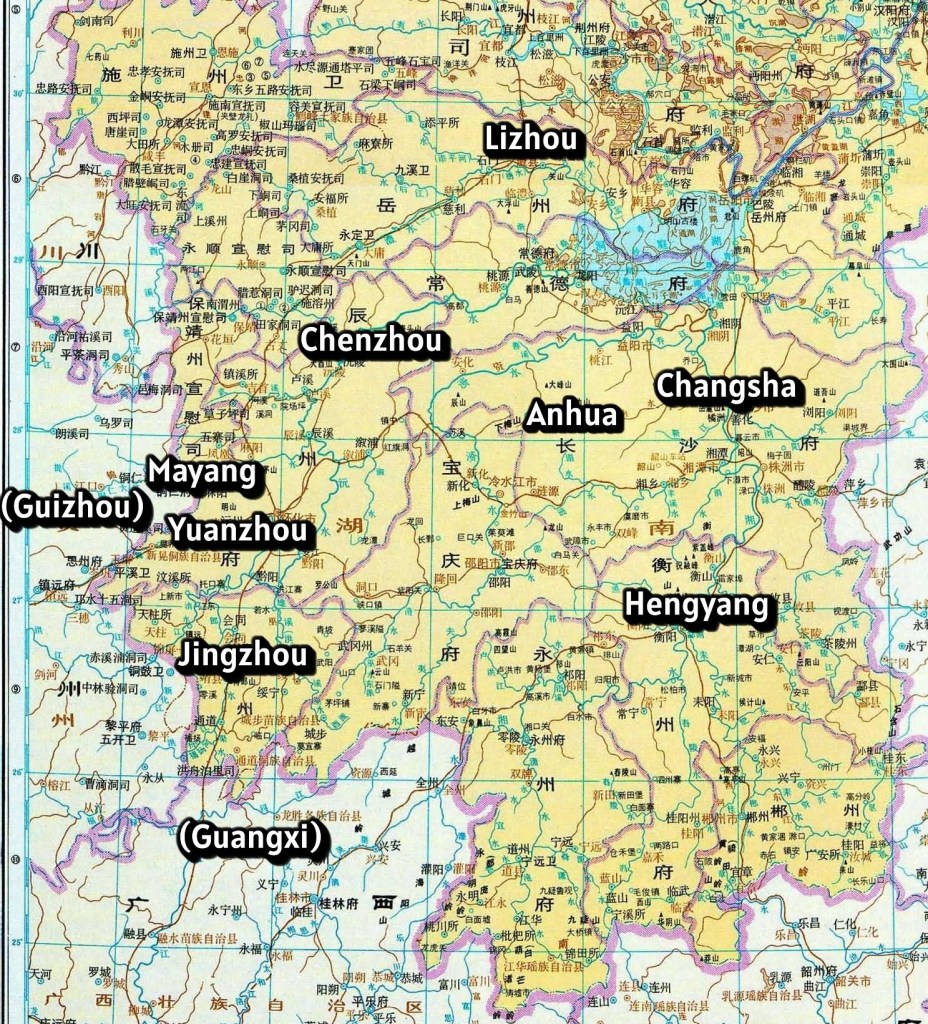
Zhang Dun’s villainy was glaringly obvious and requires no further debate. His request to govern the Hubei barbarians was motivated by a desire for military glory and rewards, pandering to Emperor Shenzong’s desire for war—this was rightly condemned by the whole realm. This, too, was glaringly obvious and requires no debate. Yet in the prefectures of Lizhou, Yuanzhou, Chenzhou, and Jingzhou, the Man ceased to cause internal disturbances. Moreover, prefectures and counties like Anhua and Jingzhou have remained places of civil governance to this day, standing on equal footing with other prefectures and counties in Hu (Hubei) and Xiang (Hunan). How can this achievement of Zhang Dun be discounted? Because Zhang Dun’s project was cut short, to the west of Mayang and the south of the Yuan and Xu rivers, the Miao bandits have remained unchecked, causing problems even today.1 The local people living near the Man cannot protect their lives, families, oxen and horses, or millet and wheat. Thus, whether Zhang Dun’s actions were meritorious or villainous is clearly evident; but why then do people delight in condemning him as evil without ever reflecting on their bias?
If we consider the matter from the standpoint of higher principles, then Zhang Dun’s achievement was not merely a matter of frontier security. It is said, “The true king does not govern the barbarians.”2 By this they meant the places north of the desert, west of the Yellow and Tao rivers, south of Rinan, and east of Liaodong and the sea. In those lands, the qi of the heavens differs from ours, the patterns of the earth differ from ours, the people’s temperament differs from ours, and their other living creatures are of different stock from ours. Different lands should each give birth to and raise their own kind, each have their own ruler, and each have their own lineages. They should not invade us, and we should not defraud them; each should simply rest content in their own laws and not offend the other.
In the lands within the Nine Regions, however, there are many families who live near hills or valleys. Some are Xia surrounded by barbarians, while others are barbarians surrounded by Xia; they overlap like the lapels and belt on a robe. To segregate [the barbarians from the Xia] would be like forcing one’s chest and armpits or one’s elbows and arms to act independently and have nothing to do with each other. It is not impossible to govern these barbarians, nor is it inappropriate to govern them. In that case, if we choose not to govern them, then what superiority is there to being ruler of the subcelestial realm (tianxia 天下)? To rule the subcelestial realm is to be humane to the subcelestial realm. There is no display of humaneness to the subcelestial realm greater than distinguishing human beings from animals and enabling human beings to treasure human life.
The chiefs of the Miao barbarian tribes have all set themselves up as rulers in their lands; they lead their people in acts of perversity, viciousness, depravity, and cruelty. They are immersed in animality, pillaging and slaughtering even their own kin. This is surely unbearable to humane people. Hence, we execute their chiefs, pacify and tax their lands, wash them clean of their foul stench, and clothe them in robes and caps. Gradually, we cause the influence of the Odes and Documents and rites and music to arise. Then, talented men who are loyal, filial, incorrupt, and skilled in letters and administration will be born as the local qi becomes harmonious. Is this not the greatest wish of one who would show humaneness to the subcelestial realm? The order of heaven is such that the Xia of the Central Lands must not govern barbarians who live outside the Nine Regions. But the order of humanity is such that they must govern barbarians who live within the Nine Regions. In that case, conquering the land of the southern barbarians and dividing it into commanderies and counties was an act of great merit, great morality, and great humaneness.
Moreover, the barbarians who dwell within the Nine Regions are not really barbarians. In ancient times, ten thousand lords were enfeoffed with states, and all of these were civilized states of people who wore caps and belts. During the three dynasties (Xia, Shang, and Zhou), tyrants arose in each dynasty and brought the subcelestial realm to a state of division and collapse. Thus, in the foothills of mountains and on the banks of rivers, local rulers came to rely on the inaccessibility of their lands and did not pay tribute at the royal court. As their styles of dress and institutions became ever more different, they descended into a crude and primitive state.
In the time of the Annals, the rulers of Ju and Qĭ were descendants of enlightened sages and outer vassals of the Zhou, but they descended into barbarism of their own accord.3 In that case, the Di of the Lu and Jia clans, the Yi of the Huai River, and the Rong of Luhun were originally all people of the Central Lands and their rulers were originally enfeoffed lords, but as generations passed and the Way was lost, they degenerated into alien peoples.4 Surely, then, it was only a matter of time before they reawakened and purified themselves. That is why, after their states were conquered and they were incorporated into the nobles’ zone of submission (houfu)5, they permanently became lands where civility is taught and social order maintained. Because of this, the Annals specially records these conquests to emphasize what great achievements they were. How could it be saying that the true king should not govern them and instead allow them to afflict the Central Lands?
After the Yongjia era (307–313) [of the Western Jin], there were people called Man-Yi barbarians in Yiyang and Rong barbarians in Chouchi, but after their pacification, they were no different from the [capital cities of] Bian (Kaifeng), Luo[yang], and Fenghao.6 In that case, how could the inaccessible hills and valleys of Chenzhou, Yuanzhou, Lizhou, and Jingzhou not be good (governable) places where Han and Tang administration once extended?
- “To the west of Mayang” refers to Guizhou, and “south of the Yuan and Xu rivers” refers to Guangxi. ↩︎
- This quotes the Gongyang commentary to the Annals for Lord Yin, Year 2 (see source 1.5). ↩︎
- For the case of Qĭ, see source 1.2. Ju was a minor state in Shandong whose rulers were believed to be descended from Shaohao, a son of the sage-king Huangdi. Like Qĭ, it was regarded as a barbarized state that had adopted the ways of the eastern Yi. ↩︎
- The Lu and Jia were Red Di clans in Shanxi that were conquered by the Jin state in 594–593 BCE. On the Rong of Luhun, see source 1.2, note 14. ↩︎
- For the zones of submission, see source 2.2. ↩︎
- Yiyang 義陽 was a commandery in southern Henan and northern Hubei from the third century to the sixth century. Its Man population is best known for a major rebellion led by Zhang Chang in 303–304 CE. Chouchi was a statelet in southern Gansu, ruled by the ethnically Dī Yang family from 296 to 443. The reference to the Yongjia era here means the collapse of the Western Jin empire. ↩︎

