
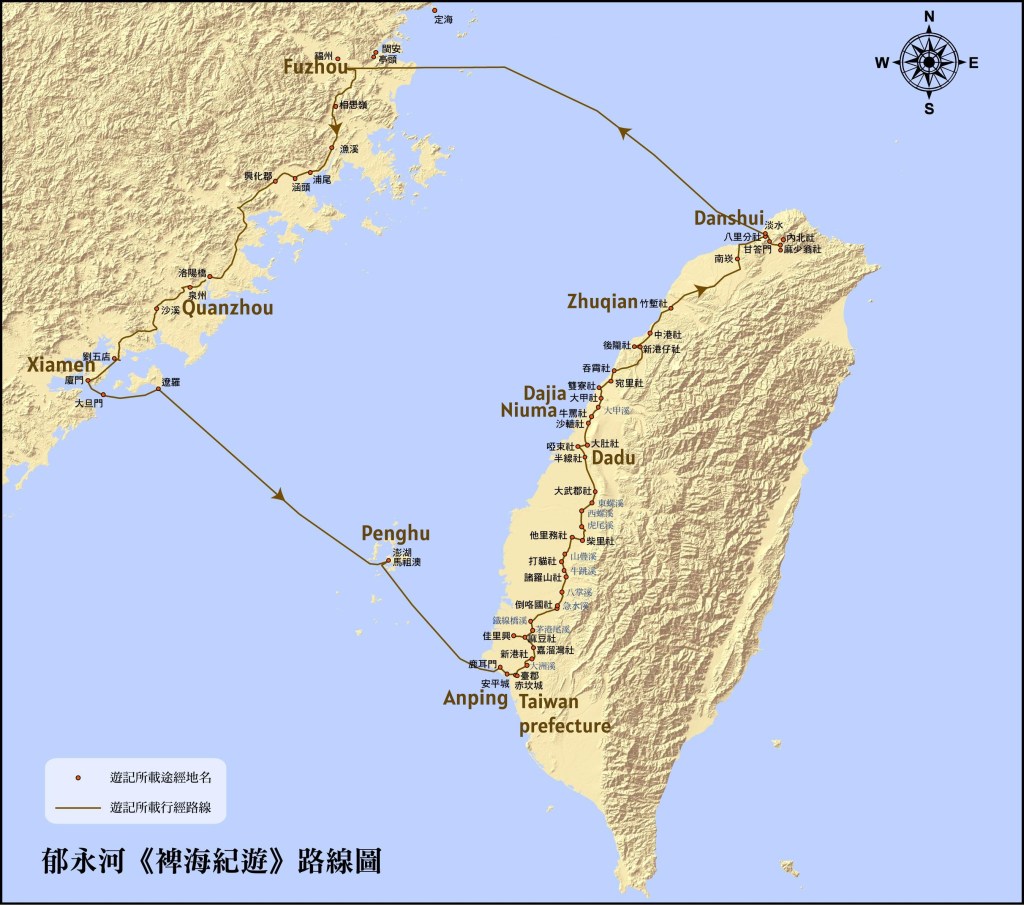
Yu Yonghe, an adventurous scholar from Hangzhou, was working and traveling in Fujian in late 1696 when all the gunpowder in the Fuzhou arsenal was destroyed in an accidental explosion. Yu volunteered to lead an expedition to Taiwan to procure sulfur, an essential ingredient for producing a new batch of gunpowder. The expedition left Xiamen in the spring of 1697 and spent nine to ten months in Taiwan, traveling to the island’s northern end to buy sulfur from the sulfur mines in Beitou, before returning to the mainland. In 1698, Yu wrote an account of his journey and published it as the Pihai jiyou. It is one of the earliest Chinese descriptions of Taiwan, which the Qing dynasty had conquered just fifteen years earlier.1
The treacherous currents in the Taiwan Strait and the indigenous Taiwanese peoples’ reputation as headhunters had deterred Chinese people from venturing to the island until the late Ming period, when pirates began operating there to evade the Ming authorities. In the 1620s, the Dutch and Spanish established colonies on Taiwan to gain access to trade with China. Chinese migrants then arrived in larger numbers to work for the European colonists. The Dutch overran the Spanish colony in 1642 and in turn lost their colony to the Ming loyalist warlord Zheng Chenggong (known to them as Koxinga) in 1662. The Zheng family, who ran a maritime trade organization and possessed strong naval forces, ruled Taiwan until the Qing invaded and conquered them in 1683. Taiwan then became part of a mainland Chinese empire for the first time.
In the passages translated below, Yu Yonghe argues from Taiwan’s wealth and strategic location that the Qing has no choice but to continue ruling and colonizing it to deny it to foreign powers like the Japanese and the Dutch. He cites the long history of “Sinicization” in south China as evidence that the same is possible for Taiwan, provided that the local government can be reformed to ensure continuity in policies. Yu also expresses an unusually strong sense of empathy for the native people, who are being abused and exploited by the “village bullies”: opportunistic fugitives from the mainland who have made themselves indispensable intermediaries between the other Chinese on the island (including officials and merchants) and the “barbarians.”
~~~~~
Since I came to this land across the sea, I have personally trodden in remote and desolate places uninhabited by man. As for all of Taiwan’s mountains and rivers, its rough and dangerous terrain, its strategic passes, and the customs and sentiments of the local barbarians (Fan 番) and imperial subjects (min 民), it is as if I visited every household and set foot in every spot.2 How could I not write about it, so that those who watch over this world and its people may know what I have learned? ….
[On the island of Taiwan], only [the seat of] Taiwan prefecture (modern Tainan) appears wealthy. In the markets, prices for all goods are double that on the mainland, yet buyers show no sign of reluctance to pay. In the trading shops, there is no violation of contracts. Servants earn about a hundred cash per day, but even so, they hesitate and are not quick to respond when called. Butchers and cattle herders always carry several dozen taels of silver at their waists and, whenever they play dice games, stake the whole sum and lose it in a single toss, remaining nonchalant as though it were nothing. I found this quite strange, but after staying in Taiwan for some time, I finally understood the reason.
Ever since the Zheng clan seized the island, the people have accumulated wealth for many years. When the imperial forces conquered Taiwan, the locals defected or surrendered with no need for a lengthy siege, and the city was spared from destruction and burning. After pacifying the land, the government stationed 3,000 soldiers in the prefectural garrison, 2,000 auxiliary troops on the northern and southern routes, 3,000 naval troops in Anping, and 2,000 naval troops in Penghu. The tax revenue from the three counties [of the prefecture] is distributed locally, and the provincial treasury annually issues over 140,000 taels of silver to pay the soldiers. Each soldier receives twelve taels per year to spend on food and clothing, and still finds it barely enough, so how could he have any surplus savings? In fact, all the wealth disperses back to the common people [through consumption by the troops].
Moreover, sugarcane is planted here for making sugar, yielding five to six hundred thousand stalks annually. Merchant ships buy this sugar to trade with Japan, Luzon, and other countries. In addition, rice, millet, hemp, beans, deerskin, and dried venison are shipped to surrounding regions and traded in quantities exceeding a hundred thousand units. In all, the region of Taiwan collects seven to eight hundred thousand taels in annual taxes. Since peace was restored in the kuihai year of the Kangxi era (1683), over fifteen or sixteen years have passed, and the total revenue intake has reached twelve or thirteen million taels. Income is high while expenses are low. Compared with the mainland provinces, which send out most of their taxes and receive little in return, how could the mainland not become poorer while Taiwan grows richer?
Furthermore, Taiwan’s land is suitable for cultivation, with harvests several times larger than the norm. One thousand mu of farmland3 can support tens of thousands of people, with ample daily food supplies. Maritime trade with foreign nations keeps people’s financial resources abundant. The people are wealthy, the land is fertile, and the island is surrounded by accessible sea routes in all directions. Now, even people from the mainland come here in droves; everyone wishes to reside and trade here. Who among the bandits and pirates would not wish to seize and possess this place? Were there once more someone like the former Zheng clan, who seized a chance and coveted the island, he would indeed become a real threat. The coastal regions of the mainland would know no peace!
Some people say: “A ball of mud beyond the sea is not worth adding to the territory of the Central Lands. These naked and tattooed barbarians (Fan 番) are not worth guarding. Rather than squander the gold and coins in the imperial treasury daily to no good purpose, why not resettle the inhabitants and leave the land empty?”4 They do not know that if we abandon [Taiwan], someone else will surely take it. If we can resettle the inhabitants, it will not be hard for others to bring in their own people to populate it. Alas! They are careless and short-sighted indeed! After the Zheng family seized and occupied [Taiwan], they repeatedly sailed their fleets across the sea to raid our dynasty. The coastal commanderies and counties in Jiangsu, Zhejiang, Fujian, and Guangdong have nearly all been ravaged. The fighting raged for nearly forty years without pause, to the point where we had to adopt a scorched-earth strategy and evacuate the population along a ten-thousand-li stretch of the coast. We repeatedly had to send large armies in, but still could not destroy them because they had Taiwan as their base. Now that we have taken this land, if we decide to abandon it, then countries like Liuqiu (the Ryukyu Kingdom on Okinawa), Riben (Japan), the Red Hairs (the Dutch), Annan (central and south Vietnam), and Dongjing (north Vietnam) will surely occupy it!5
Liuqiu is the smallest and weakest and has never been a threat to the Central Lands; even if they gained Taiwan, they would not be able to hold it for long as a defensive barrier for the Central Lands. Annan and Dongjing are constantly at war with each other and are too busy to make long-term plans. Riben is the biggest and is the only one that can be called a military power. The Red Hairs are cunning and deceitful and especially skilled at making warships and firearms. Moreover, they are a vassal state of the Great Western Ocean. The people of the Western Ocean are given to long-range planning and their intentions are firm and unfathomable. Fortunately, they are a great distance from the Central Lands and it is not easy for them to spy on us and seek an opportunity to strike. If they were to have Taiwan as a foothold, then they could come and go as they please. Would there be any limit to their depredations? The mirror (i.e., precedent) of the Zheng family is still recent. [If we gave up Taiwan], how would it be any different from destroying our own defensive barrier and offering it up as a den for bandits? No wise person would do this! …
Among the barbarians, there is a distinction between the native barbarians (tufan 土番)6 and the wild barbarians (yefan 野番). The wild barbarians live deep in the mountains which rise, range after range, like screens, with peak after peak jutting up to the heavens. They are covered with dense forests and thickets of bamboo, such that one looks up and cannot see the sky. With every step, one is obstructed by thorny brambles and entwining vines. Since the beginning of time, no axe has ever entered these mountains, and the wild barbarians live in them, dwelling in tree houses and caves, eating their meat raw along with blood and fur. Their kind are very numerous, climbing heights and scaling cliffs and crossing bamboo thickets and tall grass so swiftly that they can chase after startled gibbons and other wild beasts. The barbarians of the plains areas have always feared them, and none dare to enter their territory.
The wild barbarians rely on their ferociousness and from time to time emerge to plunder, burning houses and killing people. Then they return to their tree houses, and no one can get close to them. When they kill someone, they remove the head and go back and cook it. They scrape the flesh from the skull and apply red plaster to it. They place it in the doorway, and people of their kind regard those with the most skulls as heroes. They live as if in a dream, as if drunk. They don’t know how to turn to civilization. They are really no more than beasts! But they are just like tigers and leopards; if you come across them, they will bite. Like snakes and vipers, if you run up against them, they will bite you. If you don’t approach their caves, they have no intent of harming you, and you can then leave them alone to live and die in the rain and dew….
Their ancestors knew nothing of rulers, but when the Red Hairs occupied them, the native barbarians of the plains areas all came under the restraint of law. They dared not disobey demands for unpaid labor and taxes. Any tribes who broke the law and killed people were utterly exterminated. Next came the Zheng family, whose laws were especially harsh. Any offenders had their entire clans wiped out, not sparing even babies, and their fields and homes were destroyed. In fact, when the native barbarians kill people, it is not out of criminal intent, but due to the evil influence of alcohol. When they engage in communal drinking, each man brags about his strength and none is willing to accept another as his better. A man has not even put down his wine cup before a blade sinks into his throat. Sometimes two men are on bad terms in daily life, and one settles scores after getting drunk, but when he wakes up in the morning, he doesn’t even know what he has done, but an army sent to punish his crime is already at his door. That is why to this day, the Dadu, Niuma, Dajia, and Zhuqian villages lie in a state of desolation, overgrown with forests and weeds, with not one man to be seen.7 The barbarians take this as a warning and say to each other, “The Red Hairs were powerful, and any who offended them were wiped out. Then the Zheng family came, and the Red Hairs were afraid of them and fled. Now the Zheng family has been destroyed by the Emperor and we have all become his subjects and slaves. The Emperor truly has divine power!” Hence these people are not only stupid but also very law-abiding….
If we could transform [the native barbarians] with ritual propriety and moral duty, change their customs with the Odes and Documents, teach them to store up supplies for times of want, and regulate them with the rules for proper clothing and diet and the rites for proper capping ceremonies, weddings, funerals, and ancestral sacrifices; if we could teach them to all understand the principles of loving their kin and superiors and respecting their elders and ruler; if we could inspire in them a spirit of cherishing their lives and eliminate their obstinate natures; then in no more than a hundred years and as little as thirty, we would see their customs change entirely and they would all be following the teachings of ritual propriety. How would they be any different from the people of the Central Lands? In ancient times, people spoke of the Man barbarians of Jing (Chu), who had customs of cutting their hair and tattooing their bodies. Those people lived in the regions close to Wu and Yue (Jiangsu and Zhejiang), which today have become a center of culture and civility. As for the land of Min (Fujian), it wavered constantly between rebellion and submission, and the Han dynasty twice abandoned it before reoccupying it. But ever since Master Daonan 道南 (“Way Goes South”) arose, the great scholars of Song-dynasty Neo-Confucianism (lixue 理學) all came from the south.8 Surely human beings cannot be limited by their habits and customs; it is just a question of how those with authority over them encourage, transform, and guide them!
Now the imperial court regards service as an official in the prefecture of Taiwan as a hardship posting across the sea and promotes and reassigns the officials here after a term of three years. An official has only just begun to carry out his policies and the people’s hearts have not yet grown used to them before he is replaced with someone else. How can we be sure that his successor will follow his policies and standards to the letter, not making any change? Moreover, if each official does not remain in his seat long enough to warm it and sees his post like a hotel, how would he be willing to adopt policies that are difficult to see through and will only produce results in the long run? I say that to transform the barbarians (Fan 番), we must use the model of the Zhou dynasty enfeoffing its aristocrats with states and that of ministerial houses with their own fiefs, passed down through the generations. Or we could take the example of Wei Gao in the Tang and Zhang Yong in the Song, who governed Shu (Sichuan) for long tenures lasting decades.9 It will only work if an official is not expected to produce results overnight. Alas! That is easier said than done!
But there are also some who secretly obstruct and disrupt our efforts: namely, the “village bullies” (shegun 社棍). Those of their ilk are all miscreant lawbreakers from the interior10 who, as fugitives from the death penalty, have hidden themselves in this remote and unpopulated place. They scheme to get hired locally as managers and translators, and after a long time, they become familiar with life among the barbarians and conversant in the barbarian language. When they die, their sons inherit their positions, so their malign influence continues. The local merchants simply live comfortably up in the commandery capitals, requisitioning supplies and paying taxes. Matters in the villages are left to [the bullies] to manipulate. As a result, the local merchants keep on making losses while these people reap the profits. The local merchants are rotated out every one or two years, while these people (the bullies) never move as long as they live.
These people profit from none other than the barbarians’ stupidity and are extremely invested in keeping the barbarians poor. As long as the barbarians remain stupid, then they are ignorant enough to be robbed and swindled at will; as long as they remain poor, then they are easy to beat up and threaten, being too weak to dare to resist. These bandits not only do not teach them anything but even trick and entrap them time and again. Even when one of them goes to the authorities to seek redress for an injustice, the barbarian language is an incomprehensible babble and [the official] hearing the case cannot understand what has happened. He has to ask the translator, who then twists the facts when translating so that the barbarian gets rebuked [by the official] instead. The translator then tells [the barbarian], “The county official got angry and rebuked you because you disobeyed the translator-manager.” As a result, the barbarians fear the village bullies even more and serve them as if they were emperors or Heaven itself. They have nowhere to take their grievances, and the authorities have no way of knowing it.
Because of this, the barbarians are the most pitiful things in the world. Yet we discriminate against them because they are of a different kind (lei 類). We see them without clothes and say, “They cannot feel cold.” We see them walking in the rain and sleeping out in the open and say, “They are immune to illness.” We see them carrying heavy loads and running long distances and say, “They are by nature used to hard labor.” Alas! These are human beings too! How are their limbs, bodies, skin, and bones any different from those of other humans, that we would say such things? We don’t ride our horses through the night or harness our oxen improperly, lest they suffer illness. If this is true of horses and oxen, how much more so for human beings? Surely we should know that if they had enough silk, they too would be clothed in thick layers of it; why would they choose to be cold? If they were not made to work, they too would be resting happily in their homes; why would they choose to be out under the sun? If they could be spared from hard labor, they too would have much time for leisure; why would they choose to be running to and fro, carrying loads in the village bullies’ homes? To enjoy eating one’s fill and staying warm and to feel miserable when hungry or cold; to hate doing hard labor and to be happy when at leisure—that is human nature. We may find these people strange, but why should we see their nature as any different from ours?
- A full translation of the Pihai jiyou can be found in Macabe Keliher, Small Sea Travel Diaries: Yu Yonghe’s Records of Taiwan (Taipei: SMC Publishing, 2004). Some of the passages translated above are also translated in Emma Jinhua Teng, Taiwan’s Imagined Geography: Chinese Colonial Travel Writing and Pictures, 1683-1895 (Cambridge: Harvard University Asia Center, 2004), 278-280. The translation above is my own. ↩︎
- This is clearly an exaggeration, since Yu Yonghe mostly remained in the plains areas of western Taiwan and did not venture into the mountainous areas to the east. ↩︎
- In the Qing, a mu of land was equivalent to 614.4 square meters. ↩︎
- Yu Yonghe is actually quoting words attributed to the reigning Qing emperor Kangxi, but he tactfully elides their origin to avoid offending the imperial court. ↩︎
- Because Vietnam was politically divided between the Nguyễn lords in the south and the Trịnh lords in the north, Yu Yonghe distinguishes between Annan (Annam, the south) and Dongjing (Đông Kinh or Tonkin, the north). ↩︎
- The indigenous peoples of the plains areas in western Taiwan. ↩︎
- For the locations of these villages, see the map above. ↩︎
- Master Daonan was a title given to Yang Shi 楊時 (1053-1135), a man of Fujian who studied Daoxue (or Lixue) Neo-Confucianism in the north under the Cheng brothers (see source 3.5) and then spread its teachings in his home region. The saying “Our Way now goes to the south” is credited to Cheng Hao, who reportedly uttered it when Yang Shi took his leave to return to Fujian in the early 1080s. ↩︎
- Wei Gao 韋皋 (745–805) governed Sichuan for twenty years from 785 to his death, masterminding the region’s defense against Tibetan attacks and forging a new anti-Tibetan alliance with the Yunnan kingdom of Nanzhao. Zhang Yong 张咏 (946–1015), on the other hand, only governed Sichuan for four years from 994 to 998, so Yu Yonghe’s use of him as an example was probably due to faulty memory. ↩︎
- That is, non-coastal regions of mainland China. ↩︎

