
[with Appendix: Excerpts from the Qing shigao (Draft History of the Qing), 1928]
The two memorials translated below were composed by Ortai, a powerful Manchu minister at the court of the Yongzheng emperor (r. 1722-1735). After being appointed governor of Yunnan in 1725, with concurrent responsibility for Guizhou and eventually Guangxi, he spearheaded an aggressive expansion and escalation of the frontier policy known as “replacing native chieftains with rotating officials” (gaitu guiliu 改土歸流), effectively a transition from indirect rule to direct rule via the forcible removal of hereditary autonomous chieftaincies. Ortai viewed this as a necessary and long overdue solution to the problem of a chronically unstable southwestern frontier, though he also proposed to increase administrative efficiency by redrawing provincial boundaries between Sichuan, Yunnan, Guizhou, and Guangxi.
Orati’s gaitu guiliu program initially targeted three native chieftaincies (Wumeng, Zhenyuan, and Zhanyizhou [or Zhanyi]) in Yunnan whose leaders he saw as particularly rebellious or oppressive, thus providing a moral pretext for stripping them of their hereditary positions. But neighboring chieftains and chiefs perceived that the ultimate goal was to eliminate them all, and therefore rallied to the ruling clans of Wumeng and Zhenyuan in armed resistance to the Qing state. In the short term, therefore, the gaitu guiliu program failed to achieve Ortai’s ideal of establishing direct rule with minimal violence, and instead necessitated the mobilization of thousands of troops to crush the indigenous rebels. This setback did not deter Ortai from using the same military forces in an attempt at extending the centralization program to Tai polities in the far south of Yunnan, as far as the eastern bank of the Upper Mekong River. This was apparently aimed at gaining control over the famed tea plantations of Chiang Hung (Sipsongpanna, known to the Chinese as Cheli).
Ortai also extended gaitu guiliu to Guizhou and Guangxi, but the program went even further in Guizhou, establishing administrative units where none had previously existed, rather than simply replacing native chieftaincies. In other words, it became a project of colonization and not just centralization. In the Guzhou 古州 area of southeastern Guizhou, for example, five frontier subprefectures (ting 廰) were established in “Raw Miao” territory by 1730, each effectively a Chinese colony administered by a rotating official. A major Miao revolt broke out in this area in early 1735, by which time Ortai was no longer Governor-general. The minister Zhang Zhao, whom Yongzheng sent to Guizhou with the task of handling the crisis, blamed it on native resentment caused by gaitu guiliu and advocated a reversal of Ortai’s program. The Qianlong emperor, who succeeded Yongzheng later that year, firmly rejected Zhang’s argument and sided with Ortai, dispatching the general Zhang Guangsi to quell the rebels. This he achieved within a year through a ruthless strategy of encircling and destroying more than 1,200 Miao villages one by one. So many Miao were slaughtered by the Qing troops (estimated at 18,000) that large-scale Miao resistance ceased for nearly sixty years.
The Appendix consists of two excerpts from the Qing shigao, a traditional dynastic history of the Qing that was compiled by a large team of historians from 1914 to 1928 but never officially completed due to political reasons. These excerpts narrate the history of Ortai’s gaitu guiliu program in Yunnan, including the indigenous resistance that it triggered in 1727-1730 and the military campaigns used to suppress it.
~~~~~
- Memorial on replacing native chieftains with rotating officials
[Translator’s note: The translation below is based on the version of Ortai’s memorial found in Chapter 7 of Wei Yuan’s Shengwu ji 聖武記 (1842). The Qing shigao contains a slightly abridged version of the memorial, but introduces its context more fully as follows:
In the third year [of the Yongzheng era] (1725), [Ortai] was appointed as Governor (xunfu 巡撫) of Guangxi, but he had only just assumed office when he was transferred to Yunnan to serve as governor and acting Governor-general (zongdu 總督) [for Yunnan and Guizhou].
The Zhongjia Miao 仲家苗1 in Guizhou had been in rebellion for more than twenty years. The provincial governor Shi Liha 石禮哈2 and the provincial military commander (tidu 提督) Ma Huibo 馬會伯 requested permission to use military force, but the emperor did not grant it. [Guizhou] provincial governor He Shiji 何世璂 submitted a memorial stating that the Zhongjia Miao’s poisoned arrows were sharp and deadly, and the terrain was treacherous, making military action difficult.3 The emperor then ordered Shiji to pacify them through negotiation, but after a long time there was still no resolution, so an edict was issued to seek advice from Ortai. In the spring of the fourth year (1726), Ortai submitted a memorial saying:]
The greatest troubles in Yunnan and Guizhou are the Miao and the Man. To secure the populace, one must control the barbarians (Yi); to control the barbarians, it is necessary to replace native chieftains with rotating officials (gaitu guiliu). The Miao frontier (Miaojiang 苗疆) overlaps with neighboring provinces in many places, so it is necessary to centralize authority over it in order to solve the problem once and for all.
For example, Dongchuan 東川 (Huize county, Yunnan), Wumeng 烏蒙 (Zhaotong, Yunnan), and Zhenxiong 鎮雄 (Zhenxiong county, Yunnan) are all native chieftain-administered prefectures (tufu 土府) of Sichuan. Dongchuan is only separated from Yunnan by a mountain range, and is just over four hundred li from Yunnan’s provincial capital, but is one thousand eight hundred li from Chengdu in Sichuan. Last winter, the native prefecture of Wumeng attacked and plundered Dongchuan, and by the time soldiers from Yunnan repelled them, deployment orders from Sichuan had only just arrived.
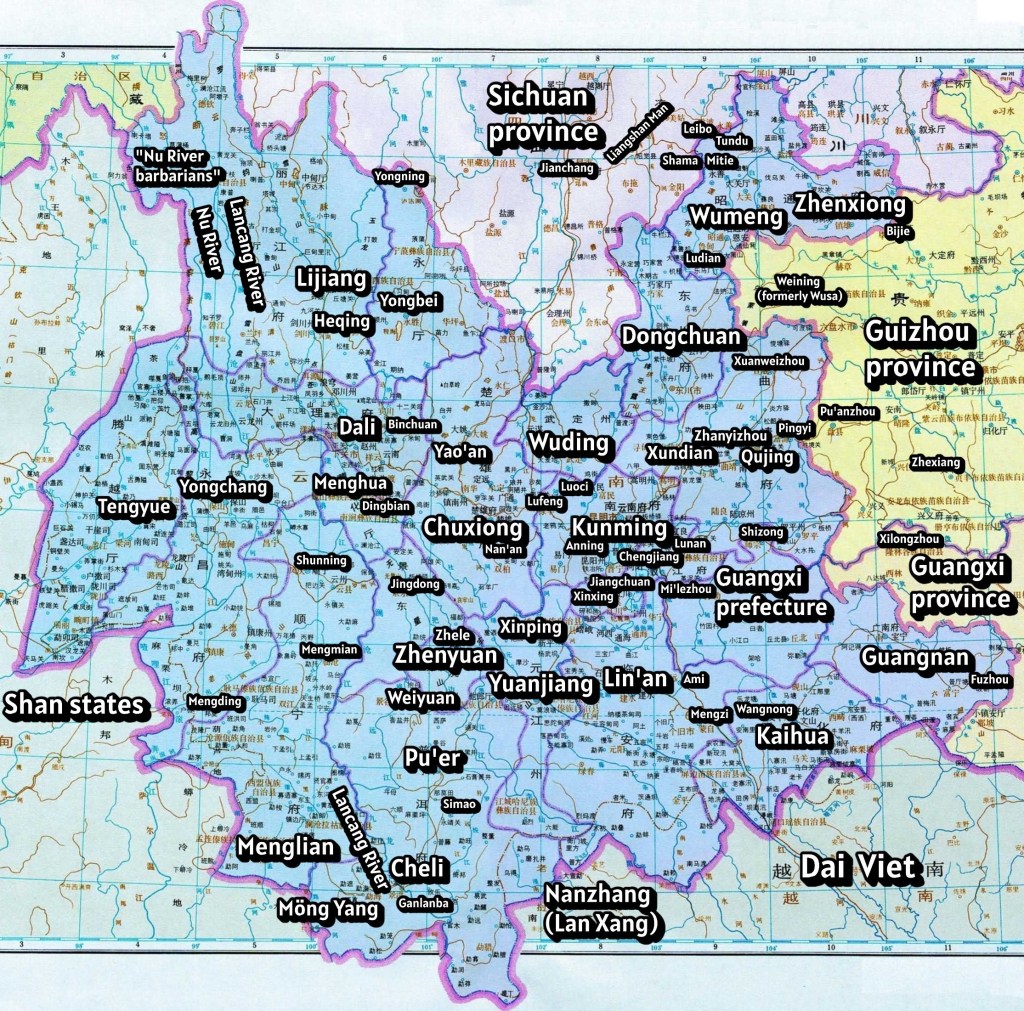
Wumeng is just over six hundred li from the provincial capital of Yunnan. Since the fifty-third year of the Kangxi era (1714), the native official Lu Dingqian 祿鼎乾 has behaved lawlessly. When the Imperial Commissioner (qinchai 欽差), the Governor-general, and the Governor [of Sichuan] summoned him to a hearing at Bijie 畢節, he only agreed to attend after a rotating official (liuguan 流官) was handed to him as a hostage. Since then he has been increasingly brazen.
Wumeng’s tax quota in money and grain is just over three hundred taels, yet it extracts more than a hundred times that amount from commoners. Each year, there are four minor levies, and every three years a major levy—minor levies are calculated in cash, major ones in silver. When a native chieftain marries off a son, the native commoners (tumin 土民) dare not wed for three years. If a native commoner is executed for a crime, his relatives still must pay dozens of taels as a fee to the executioner, remaining in darkness their whole life.
Though Dongchuan has already been converted to direct administration by rotating officials (gailiu 改流), for thirty years it has remained dominated by native chiefs (tumu 土目).4 Its civil and military officials reside in the [Sichuan] provincial capital, and no one dares to cultivate its four hundred li of fertile land. If Dongchuan were reassigned to Yunnan, I could use the opportunity to implement [true] direct administration by rotating officials, establishing three prefectures and one garrison and permanently stabilizing the situation on the frontier. This is my proposal concerning Sichuan.
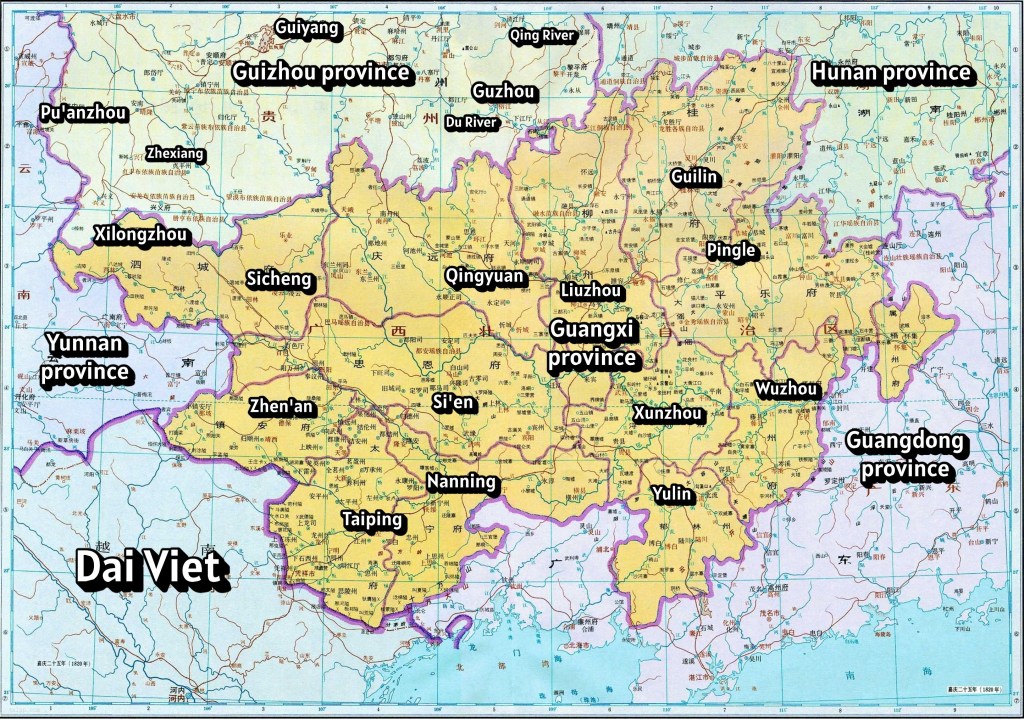
In Guangxi, there are more than fifty native chieftain-administered prefectures (fu 府), subprefectures (zhou 州), counties (xian 縣), settlements (dong 峒), and stockaded villages (zhai 寨), distributed between Nanning 南寧 (Nanning, Guangxi), Taiping 太平 (Chongzuo, Guangxi), Si’en 思恩 (Wuming district, Nanning), and Qingyuan 慶遠 (Yizhou district, Hechi, Guangxi) [prefectures]. These were mostly established when [the Song general] Di Qing campaigned against Nong Zhigao [in 1054] and [the Ming official] Wang Shouren campaigned against Tianzhou 田州 (Tianyang, Guangxi) [in 1528].5
Apart from Sicheng 泗城 native prefecture (Lingyun county, Guangxi), those who pose a threat on the frontier are all native chiefs (tumu 土目), who are even more intractable than the native chieftains (tusi 土司). Qian 黔 (Guizhou) and Yuè 粵 (Guangxi) provinces are divided by the Zangke 牂柯 (Nanpan) River; Xilongzhou 西隆州 (under the jurisdiction of Yuè) and Pu’anzhou 普安州 (under the jurisdiction of Qian) both straddle the river, encroaching on each other’s territory.6 The Miao stockaded villages are sparse and distant, and generals and officials excuse themselves from responsibility for them. It would be best to assign all territories north of the river to Qian, and all those south of it to Yuè, while increasing the number of prefectures and military garrisons, thus enforcing control and restricting disorder. This is my proposal concerning Guangxi.
The southwestern border of Yunnan is defined by the Lancang 瀾滄 (Upper Mekong) River, beyond which lie Cheli 車里 (Sipsongpanna/Chiang Hung), Miandian 緬甸 (Burma), and Laowo 老撾 (Laos). On our [eastern] side of the river are the barbarians of Zhenyuan 鎮沅, Weiyuan 威遠 (Jinggu Dai and Yi Autonomous County), Yuanjiang 元江, Xinping 新平, Pu’er 普洱 (Ning’er Hani and Yi Autonomous County), and the Tea Mountains (Chashan 茶山), who are deeply entrenched in their dens and caves, roaming among the Lukui 鲁魁7 and Ailao 哀牢 mountains. When we are at peace, they pose a threat to our interior; when we are at war, they form alliances with foreign countries. Since the Yuan and the Ming, they have ravaged the frontier in every generation. Some say that territories beyond the [Lancang] river should be left under native chieftain administration, while those on our side of the river should be brought under rotating officials (論者謂江外宜土不宜流,江內宜流不宜土). These are the frontier barbarians (bianyi 邊夷) of Yunnan that it is appropriate for us to establish governance over.
The Guizhou native chieftains have never had responsibility for restraining the Miao, and the Miao threat is greater than that of native chieftains alone.8 The Miao frontier covers nearly three thousand li, comprising over thirteen hundred stockaded villages, with Guzhou 古州 (Rongjiang county, Guizhou) at its center and the other villages surrounding it. To the left, the Qing River 清江 provides a route north to Chu 楚 (Hunan); to the right, the Du (Duliu/Liu) River 都江 gives access south to Yuè (Guangxi). Occupying these strategic barriers, the recalcitrant Miao cut off communications between three provinces and remain outside the reach of civilization (huawai 化外). If one wishes to open river routes to Qian and Yuè, the only way to do so is through mounting a military campaign deep into these lands to pacify every area by force. These are the frontier barbarians (bianyi 邊夷) of Guizhou that it is appropriate for us to establish governance over.
When I consider the distinction between rotating officials and native officials in the preceding Ming dynasty, it was due to the fact that [our officials and troops] coming to this miasmic (malarial) new frontier were unfamiliar with local customs, so measures suited to the locality were adopted, relying on native personnel to serve as guides and suppress rebellion. Now, after several centuries, using barbarians to govern barbarians amounts to governing thieves with thieves. Among the Miao and Luo 猓, there is no fear of losing their lives if found guilty of corruption, and the native chieftains are not punished by dismissal or loss of territory. Whenever their crimes are serious enough to be reported to higher authorities, they engage in bribery to escape punishment. The authorities do not investigate deeply, claiming that this is necessary for stability, leaving frontier commoners with no channel for complaint. If the roots are not eradicated and the sources cut off, then even if military, penal, financial, and fiscal matters are meticulously managed, the problem will not fundamentally be solved.
The method of replacing native chieftains with rotating officials is as follows: capturing the chieftains via stratagem is better than doing so via military action; inducing voluntary surrender is better than forced submission. But if we have to pacify the barbarians by force, disciplined troops are essential, and to achieve disciplined troops, capable generals must be chosen. If rewards and punishments are strict and clear, and officers and soldiers serve dutifully, then we can first stabilize the interior and then repel external threats—this will truly benefit frontier defense in Yunnan and Guizhou for a hundred generations to come.
2. A memorial regarding the arrest and suppression of native officials with long records of wrongdoing
[Translator’s note: This memorial is preserved in the Yongzheng zhupi yuzhi 雍正硃批諭旨, compiled under the supervision of Ortai and Zhang Tingyu 張廷玉 (1672-1755), and published in 1732 and revised in 1738. It consists of more than 8,000 memorials to the throne annotated by the Yongzheng emperor in vermilion or red ink (zhupi).]
On the ninth day of the seventh month, in the fourth year of the Yongzheng era (1726), the Governor of Yunnan and Acting Governor-general of Yunnan and Guizhou, Ortai, respectfully reported:
I respectfully submit that among the great troubles of Dian (Yunnan) and Qian (Guizhou), none surpass those caused by the Miao and Luo 猓 peoples, and that these troubles are, in fact, mainly due to the native chieftains. Since my arrival in office, whenever issues involving the barbarians (Yi 夷) have arisen, I have made careful and thorough inquiries.
The native chieftain Dao Han 刀瀚9, Native Prefect (tu zhifu 土知府) of Zhenyuan, and the native chieftain An Yufan 安于蕃, Native Subprefect (tu zhizhou 土知州) of Zhanyi 霑益 (Zhanyi district, Qujing, Yunnan), held significant power and possessed large territories. This made them especially difficult to govern among the native chieftains in Dian. Upon investigation, Dao Han was found to be innately violent and deceitful, by nature addicted to greed and licentiousness. Ever since the Weiyuan salt wells were transferred to state control10, he had harbored unlawful intentions, forcibly seizing land, obstructing the collection of firewood, intimidating salt well workers, physically abusing soldiers at the salt wells, and spreading misery across his jurisdiction. He was likely to pose a serious threat in the future.
Previously, when Yang Tianzong 楊天縱, the General (zongbing 總兵) of Linyuan Garrison 臨元鎮11, was newly promoted and visited the provincial capital, I personally discussed these matters with him. Then, on the second day of the sixth month, I secretly instructed the Colonel (youji 游擊) of the Front Regiment, Yang Guohua 楊國華 and others to proceed as the law required to apprehend Dao Han. According to their report, on the nineteenth day they successfully captured him, confiscated his official seal and papers, and escorted him to Lin’an 臨安 (Jianshui county, Yunnan) for further transfer.
As for An Yufan, he relied on his power and strength, was greedy and predatory, treated killing and banditry as trivial matters, relied on bribery and corruption for his livelihood, and arbitrarily appropriated land and imposed unlawful levies. He allowed his subordinates to engage in extortion, and his relatives and associates were given free rein to engage in similarly lawless acts. There are many records of his misdeeds, but we had not previously been able to hold him accountable to the law. His offenses surpassed even Dao Han’s.
I repeatedly received complaints [about Yufan] and verified their truth. On the twenty-ninth day of the sixth month, I secretly ordered Zhu Xiyao 朱希堯, Colonel of the Left Regiment and Brigadier General (canjiang 參將) of the Xunzhan Garrison 尋霑營12, to devise means to apprehend him. According to his report, [Yufan] was successfully captured on the fourth day of the seventh month and escorted to Qujing 曲靖 for further transfer.
Regarding these two native chieftains: once their transfer to the provincial capital is complete and their interrogation and confessions are verified, I will submit a detailed memorial for their prosecution.
Appendix: Excerpts from the Qing shigao (Draft History of the Qing), 1928
From Qing shigao Chapter 288: The biography of Ortai
In the fifth month [of 1726], Ortai dispatched troops [against the Zhongjia Miao] along three routes: one from Gulong 谷隆, one from Jiaoshan 焦山, and one from Maluokong 馬落孔. They captured thirty-six stockaded villages and secured the submission of twenty-one others, pacified more than five hundred Miao households comprising over two thousand people, and surveyed thirty thousand mu 畝 of cultivated and uncultivated land.
Ortai also determined that Dao Han, the Native Prefect of Zhenyuan, and An Yufan, the Native Subprefect of Zhanyi, had long been violent and treacherous, and had them seized by stratagem. Dao Liandou 刀聯鬥, the native chieftain of Zheledian 者樂甸 (modern Enle 恩樂 town, Zhenyuan county), begged for his life to be spared, whereupon his domain was converted from native chieftain administration to regular administration by rotating officials (gaitu guiliu). Ortai memorialized that the Zhongjia Miao had been completely pacified. The emperor commended the speed of his success and ordered that rewards be considered. Shortly thereafter, Ortai submitted a detailed memorial on the administration of the Zhongjia Miao, all of which was approved. In the tenth month, he was officially appointed as Governor-general of Yunnan and Guizhou.
The native chieftain of Wumeng in Sichuan, Lu Wanzhong 祿萬鍾, rebelled and invaded Dongchuan.13 Ortai requested that Dongchuan be transferred from Sichuan to Yunnan, and the emperor agreed. He was further ordered to cooperate with the Governor-general of Sichuan, Yue Zhongqi 岳鍾琪, in suppressing the rebellion, and to induce Lu Dingkun 祿鼎坤, one of the [Wumeng] leaders, to surrender. Ortai instructed Dingkun to persuade Wanzhong to submit, but after repeated attempts failed, he ordered General Liu Qiyuan 劉起元 to lead an army against him. They captured the stockaded village where Wanzhong lived. Wanzhong fled and hid with Long Qinghou 隴慶侯, the native chieftain of Zhenxiong. In the fifth year (1727), Wanzhong surrendered to Zhongqi, and Qinghou likewise appeared before Zhongqi to request that his domain be converted from native chieftain administration to regular administration by rotating officials. The emperor ordered Zhongqi to hand Wanzhong and Qinghou over to Ortai for investigation and judgment. In recognition of his achievements, Ortai was granted the hereditary [Manchu] noble rank of Baitala Burehafan 拜他喇布勒哈番.
In the third month [of 1727], Dao Ruzhen 刀如珍 and other Luo people of Zhenyuan murdered officials and burned and plundered settlements. Ortai dispatched troops to suppress them, and Ruzhen was captured. Cen Yingchen 岑映宸, the Native Prefect of Sicheng 泗城 [in Guangxi], allowed his followers to carry out raids, and also stationed troops at Zhexiang 者相 (Zhexiang town, Zhenfeng county, Guizhou), establishing seven military camps. Ortai impeached him in a memorial, and troops from various commands were ordered to await his instructions before advancing. Yingchen begged that his life be spared so that the ancestral sacrifices to his lineage might continue, and his territory was converted from native chieftain administration to regular administration by rotating officials. Ortai requested that Yingchen be sent back to his ancestral home in Zhejiang, while allowing his younger brother Yinghan 映翰 to remain to continue the family sacrifices.14
In the seventh month, Ortai sent troops together with an army from Hubei to subdue the Miaochong Flower Miao 謬衝花苗, capturing their leader and securing the surrender of the remaining followers. Luo groups under Zha Tiejiang 札鐵匠 of Weiyuan and Li Baidie 李百疊 of Xinping joined Dao Ruzhen’s rebellion. In the ninth month, Ortai ordered General Sun Hongben 孫宏本 of Linyuan [Garrison] to lead troops against them. Zha Tiejiang was captured, Li Baidie surrendered, and both Weiyuan and Xinping were pacified.
From Qing shigao Chapter 514: Native chieftains, Part 3 (Yunnan)15
At the beginning of the Yongzheng reign, the policy of replacing native chieftains with rotating officials (gaitu guiliu) was proposed. In the summer of the fourth year (1726), after first removing the native chiefs (tumu 土目) of Dongchuan, plans were advanced to bring Wumeng under central control. At that time, Wumeng’s Native Prefect Lu Wanzhong and Zhenxiong’s Native Prefect Long Qinghou were both young, with real military power held by their uncles Lu Dingkun and Long Lianxing 隴聯星. Ortai ordered General Liu Qiyuan to station troops in Dongchuan and offer Lu Dingkun terms of surrender. However, Lu Wanzhong was manipulated by Han miscreants (Hanjian 漢奸16) and conspired with Zhenxiong troops, three thousand strong, to attack Dingkun at Ludian 魯甸. Ortai dispatched Colonel Ha Yuansheng 哈元生 to defeat them; he also ordered Adi 阿底 native troops, who were enemies of the conspirators, to launch a joint attack on Wumeng, breaking through the passes and causing the rebels to flee to Zhenxiong. Ortai then offered Long Lianxing terms of surrender while sending Dingkun, with three thousand troops, to attack Zhenxiong. Both chieftains (Lu Wanzhong and Long Qinghou) fled to Sichuan, and within ten days, the two native prefectures were subdued.
A new prefecture was established at Wumeng, and a subprefecture at Zhenxiong, with an additional garrison set up in Wumeng, to control the three former territories. Their administrative affiliation was changed from Sichuan to Yunnan, centralizing authority over them. However, the Dongchuan native chief of Fajia 法戛 [village], Lu Tianyou 祿天祐, and the Wumeng native chief of Mitie 米貼 [village], Lu Yongxiao 祿永孝, continued to control their strongholds and cause trouble on the frontier. In the spring of the sixth year (1728), troops were dispatched to defeat and capture Fajia. Lieutenant General (fujiang 副將) Guo Shouyu 郭壽域 led three hundred men to pursue the Mitie rebels, who crossed the Little Jinsha River 小金沙江 and rallied several thousand barbarian Luo forces from Sichuan’s Shama 沙馬 chieftaincy17 and the Jianchang 建昌 (Xichang, Sichuan) and Liangshan 涼山 regions, returning secretly to ambush government troops.
Ortai then sent General Zhang Yaozu 張耀祖 and Brigadier General Ha Yuansheng18 on three fronts to hunt them down. A decree instructed the military forces in Sichuan’s Jianchang and Yongning 永寧 to act under Ortai’s direction. From beyond the Little Jinsha River through the native chieftain areas of Shama, Leibo 雷波, Tundu 吞都, and Huanglang 黃螂19, stretching to Jianchang for over a thousand li, camps and garrisons were established, forming a mutually supporting network of control. Leibo’s native chieftain Yang Mingyi 楊明義 was also captured. Meanwhile, Ha Yuansheng returned and defeated the Alu 阿盧 native chieftain’s forces of several thousand. He established a military agricultural colony in Dongchuan, harvesting over twenty thousand shi of grain annually, and taxed local [silver] mines over ten thousand taels of silver yearly to support military needs.
Barely had order been restored when Lu Dingkun, who had been promoted to Brigadier General of Henan 河南參將 for his meritorious act [of surrendering peacefully], became disgruntled. His son Lu Wanfu 祿萬福 requested permission to return to Ludian to manage his family estate, but when he found General Liu Qiyuan’s military discipline lax, he conspired with his old subordinates to revolt.20 At that time, Wumeng was home to tens of thousands of merchants and civilians and was strategically defensible, and the rebels only had crossbows, not cannons. However, Liu Qiyuan was negligent and corrupt, seeking peace through bribery, so the rebels captured the town, killed all the soldiers and civilians, and incited a rebellion among tens of thousands of Man in Dongchuan and Zhenxiong, as well as Sichuan’s Liangshan 涼山.21
Ortai reported: “I made poor choices in personnel, leading to disaster; please urgently appoint another high official [to replace me] as Governor-general for these two provinces. For the time being, please allow me to serve as Provincial Military Commander and suppress the rebels, clearing my shame.” Emperor Shizong (Yongzheng) consoled him and retained him [as Governor-general].
Ortai mobilized over ten thousand regular troops, with native troops half as many, launching a three-pronged attack. He ordered General Wei Zhuguo 魏翥國 to rush two thousand troops to Dongchuan within seven days, which was thus saved from falling. But Wei Zhuguo was soon wounded [in an assassination attempt] by [the native chief] Lu Dingming 祿鼎明, so Guan Lu 官祿 replaced him as commanding general.22 Wumeng was entrusted to General Ha Yuansheng and Lieutenant General Xu Chenggui 徐成貴; Zhenxiong was entrusted to Brigadier General Han Xun 韓勛, who, with four hundred troops, defended Kuixiang 奎鄉, defeating four thousand rebels and capturing four stockaded villages. Ha Yuansheng, with over a thousand troops, attacked Wumeng, first arriving at Desheng Slope 得勝坡 where he encountered twenty thousand rebels. Their leaders Heigua 黑寡 and Mumo 暮末 were each a match for ten thousand men. Heigua, armed with a long spear, charged at Yuansheng; Yuansheng parried the spear with his left arm, drew an arrow with his right, and killed him instantly. He also shot and killed Mumo, and had the two men’s severed heads raised on poles when advancing so as to break the enemy’s morale.
He won another engagement, advancing to Yina Ridge 倚那岡, where tens of thousands of rebels had encamped in a line stretching over ten li. There were three thousand government soldiers and a thousand native troops on our side. That night, they set ambushes on both sides of the rebel camp and stood ready for battle. At dawn, several waves of rebels attacked but our troops remained calm. When they pressed in, our cannons fired, our troops shouted and charged, and ambushers stationed behind the hill struck from the flanks, causing the rebels to rout and breaking more than eighty of their camps, seizing great heaps of armor and supplies. That same day, they reached Wumeng, and the rebels, seeing Yuansheng’s flag, fled. Three enemy strongholds were captured. Lu Wanfu and his brothers, as well as Lu Dingkun, were all executed.
In the sixth year (1728), Ortai was appointed as Governor-general over three provinces (Guizhou, Yunnan, and Guangxi).23 He successively impeached and dismissed the Native Subprefect [of Zhanyi] An Yufan, the Native Prefect of Zhenyuan Dao Han, as well as the native chieftain of Zhele[dian] chieftaincy, and various native chiefs in Weiyuan subprefecture and Guangnan prefecture. However, native chiefs who were members of the Dao clan incited the Black Luo[luo] of Weiyuan to rebel again, resulting in the murder of [the new Zhenyuan] prefect Liu Hongdu 劉洪度.24
Consequently, all the deposed native chieftains and chiefs and their families were relocated and resettled in other provinces. Moreover, the Luo rebels in Weiyuan and Xinping were hunted down and ruthlessly suppressed: despite the threat of miasmic (malarial) conditions, our troops drove deep into rebel territory, capturing and executing thousands of rebels.25 More than two hundred of our own officers and soldiers died from miasma as well.
Further military campaigns advanced into the areas within (i.e., east of) the Lancang (Upper Mekong) River, suppressing the native barbarians of Mengyang 孟養 (Möng Yang) and Chashan (the Tea Mountains).26 This campaign, the first since Ming general Wang Ji’s 王驥 expedition [in 144927] involving 120,000 troops, led the Man to exclaim in shock, “Han troops have never reached here since ancient times!” Ortai first commanded the native troops of Cheli (Sipsongpanna/Chiang Hung) to cut off the barbarians’ retreat across the [Lancang] river, while government troops, equipped with axes and spades, cleared paths, burned barricades, and filled ditches, breaking through fortified passes one after another and advancing straight to Mengyang, securing control of strategic Man hills and opening up supply routes. As for the forty-plus stockaded villages in the Six Tea Mountains, Ortai employed surrendered barbarians as local guides and used former rebels to attack current ones, enabling the troops to penetrate thousands of li with no strategic position left unsearched. Only the lands beyond the [Lancang] river remained under the administration of the Cheli native chieftains; all territories within the river were converted to direct administration by rotating officials.
Pu’er was elevated to prefecture status, and a Lieutenant General from Yuanjiang was redeployed to guard it. At Simao 思茅 and Ganlanba 橄欖壩 (Moeng Han or Menghan town 勐罕镇, Jinghong), government officials and troops were posted to guard the entrances to Mengmian 孟緬 (Burma) and Laowo (Laos).28 Furthermore, the native vice prefect of Guangnan prefecture 廣南府 (Guangnan county) and the native subprefect of Fuzhou 富州 (Funing county) agreed to increase their annual tax quotas of grain, two to three thousand shi more each, and to contribute funds to build new city walls for their prefecture and subprefecture.29 The Menglian 孟連 native chieftaincy gifted a silver mine to the court, the wild barbarians of the Nu River 怒江野夷 paid a tribute of animal skins30, and the kingdoms of Laowo (Laos) and Jingmai 景邁 (Chiang Mai=Lan Na) both sent tribute elephants, causing even Miandian (Burma) to be alarmed.31
- A Tai-speaking people now called the Bouyei or Buyi, who inhabited areas in southern and southwestern Guizhou. Chen Ding 陳鼎 (b. ca. 1650), a Chinese literatus and writer who migrated to Yunnan at the age of 10, married a native chieftain’s daughter, and traveled around Yunnan and Guizhou, described the Zhongjiao Miao in the following terms: “Among all the Miao groups, the Zhongjia 狆家 are the most vicious and dangerous. They speak the Han (Chinese) language and understand Han writing, and members of their kind (zhong 種) are found everywhere. Among the various Miao groups, they occupy the same position as Huizhou 徽州 and Shaoxing 紹興 merchants do in the Central Plains (i.e., they serve as traders and middlemen). Their character, however, is far from good. They specialize in manufacturing poisoned crossbows, cultivating gu poison, and forming alliances with the Raw Miao to rob and plunder the common people, causing greater harm than any other group. Whenever the authorities attempt to arrest them, they flee into the deep mountain forests, where pursuit becomes impossible. As for the Raw Miao, they have no hereditary chiefs and are not subject to the control of the native officials (tuguan 土官). Whichever man is strongest and most formidable becomes their leader. Sometimes he gathers several hundred followers and, in presumptuous imitation, proclaims himself emperor. Solemnly attired in an imperial crown and a yellow robe, he sits with folded hands upon the summit of a remote mountain, receiving the homage of several hundred followers, who salute him and cry, ‘Long live the emperor!’ When government forces surround them on all sides and attack, they can be annihilated. Yet before long another band gathers, and once again they burn and plunder. The Zhongjia, moreover, can speak the languages of the various Miao groups, and many among them are literate in the script of the Bo (Bai) people (Bo wen僰文). They therefore entice [the other Miao] into the interior, where they rob and murder merchants. The devastation they inflict is beyond description.” (Chen Ding, Dian Qian ji you [A Record of Travels in Yunnan and Guizhou] 滇黔紀游)
For an in-depth study of Zhongjia resistance to Qing expansion, see Jodi L., Empire and Identity in Guizhou: Local Resistance to Qing Expansion (Seattle: University of Washington Press, 2015). ↩︎ - The Qing shigao is in error here: Shi Liha served as General (zongbing 總兵) of the Weining 威寧 garrison in Guizhou, not the provincial governor. The governor at this time was He Shiji. ↩︎
- He Shiji served as governor of Guizhou in 1725-1727. ↩︎
- Dongchuan had been nominally governed by a centrally-appointed prefect since 1699, as its ruling chieftain clan had become extinct. But the real authority still lay in the hands of native chiefs. ↩︎
- On Wang Shouren’s (Wang Yangming’s) pacification of the western Guangxi native chieftaincy of Tianzhou, which was achieved via diplomacy rather than military force, see Leo K. Shin, “The Last Campaigns of Wang Yangming,” T’oung Pao 92 (2006), 101-128. ↩︎
- Xilongzhou was in the area of modern Longlin county, Guangxi, while Pu’anzhou was in the area of modern Panzhou, Guizhou. ↩︎
- Christian Daniels has analyzed the “internal frontier” of the Lukui Mountains, describing it as follows: “Lukui lay in the Ailao mountain range that skirts the border of Xinping county. Situated at the margins, it constituted an internal frontier at the boundary of land directly administered by imperial bureaucrats and territory under the jurisdiction of native officials. It had been renowned as a hotbed of agitation since the early seventeenth century, if not earlier. The Luoluo leaders of Lukui raided lowlands under imperial administration to the north, east and west of their mountain. When imperial bureaucrats launched attacks, they slipped away south into territories under the jurisdiction of native officials, and other non-Han leaders, where imperial bureaucrats could not track them down.” See Christian Daniels, “Upland leaders of the internal frontier and Ming governance of western Yunnan, fifteenth and sixteenth centuries,” in Christian Daniels and Ma Jianxiong (eds.), The Transformation of Yunnan in Ming China: From the Dali Kingdom to Imperial Province (London: Routledge, 2019), 162. ↩︎
- Here, Ortai proposes that the approach taken in Guizhou should go beyond gaitu guiliu and involve frontier expansion and colonization. ↩︎
- This surname is written as Diao 刁 in some sources. ↩︎
- The state takeover of the Weiyuan salt wells in 1724 was achieved via removing the native subprefect of Weiyuan (on a charge of sheltering bandits) and replacing him with a rotating official. This profited the Qing court while damaging Dao Han’s financial interests significantly. As Ma Jianxiong explains: “In 1724, Governor Ertai [Ortai] took over the salt wells along the Weiyuan River, including the Anbang, the Engeng, the Baomu and the Xiangyan, and commissioned special salt officials at Weiyuan to control salt production at an annual rate of about 4,500,000 jin (2,250 tons), which provided the needs of the southern Yunnan salt markets. It accounted for about 20 per cent of the yearly provincial salt production. Through the official salt-selling system, based on certain quota coupons for the salt trade, the control of salt in these wells could generate additional salt revenue, more than 22,000 Iiang (1 liang = 50g) in silver.” Note that Ortai only took office as governor of Yunnan in 1725, so Ma is incorrect in ascribing the takeover to him. See Ma Jianxiong, “Salt and Revenue in Frontier Formation: State Mobilized Ethnic Politics in the Yunnan-Burma Borderland since the 1720s,” Modern Asian Studies 48.6 (2014), 1657-1658. ↩︎
- A garrison unit of the Green Standard Army, stationed in Lin’an 臨安 prefecture (Jianshui county, Yunnan). ↩︎
- A garrison unit of the Green Standard Army, stationed in Zhanyi. ↩︎
- Lu Wanzhong was the young son of Lu Dingqian, who had recently died. He was under the thumb of Dingqian’s younger brother Dingkun. ↩︎
- According to Chapter 7 of Wei Yuan’s Shengwu ji, Ortai also took this opportunity to transfer all land north of the Zangke (Nanpan) to the jurisdiction of Guizhou, as he had previously proposed. A part of Xilongzhou (including Zhexiang) was thus carved out and established as a new prefecture, Yongfengzhou 永豐州. ↩︎
- Note that the Qing shigao editors adapted most of this narrative from Chapter 7 of Wei Yuan’s Shengwu ji. ↩︎
- In Qing usage on the southwestern frontiers, “Han miscreants” referred to Han migrants and fugitives who joined indigenous frontier communities to escape the reach of the imperial state. As Donald Sutton explains: “Later to be used of the Cantonese who helped the British and French after the first Opium War, and of Chinese collaborators in the second anti-Japanese war (1931-45), in the eighteenth century southwest, Hanjian was commonly applied to Han who had moved beyond the reach of official power and made their living among Miao and other non-Han…. Such men had generally slipped out of local systems of mutual supervision; they were socially and culturally liminal, and thus politically suspect…. Crossing ethnic categories and adopting Miao ways, they acted as agents of the Miao in legal matters, even directly challenging yamen authority on their behalf, and were potential collaborators in the event of revolt.” See Donald S. Sutton, “Ethnicity and the Miao Frontier in the Eighteenth Century,” in Pamela Kyle Crossley, Helen F. Siu, and Donald S. Sutton (eds.), Empire at the Margins: Culture, Ethnicity, and Frontier in Early Modern China (Berkeley: University of California Press, 2006), 193. ↩︎
- Shama was a “Luoluo” polity in the Liangshan region of Sichuan that preserved its autonomy as a native chieftaincy until the 1950s. ↩︎
- Ha Yuansheng rose through the ranks steadily during this campaign, starting as a Colonel and ending as a General. ↩︎
- Tundu and Huanglang are villages in Liangshan and Leibo respectively. ↩︎
- This revolt actually took place in 1730, while Ortai was in Guizhou engaged in campaigns against the Miao. ↩︎
- The Liangshan Man were the same “Luo” of Liangshan who had already been supporting the Mitie resistance in Wumeng. ↩︎
- Lu Dingming was a younger brother of Lu Dingkun who volunteered to guide Wei Zhuguo’s army and then used the opportunity to stab Zhuguo with a knife. Dingming was killed by Zhuguo’s guards; Zhuguo was wounded in the left leg and later died of his wound. ↩︎
- The narrative becomes chronologically confused here, as it shifts from the 1730 revolt in Wumeng, Dongchuan, and Zhenxiong to events in 1727-1728, including Dao Ruzhen’s revolt in Zhenyuan and the expedition to the northern bank of the Lancang (Mekong) River. ↩︎
- This was the rebellion of Dao Ruzhen in 1727, later joined by Zha Tiejiang and Li Baidie. ↩︎
- This refers to the defeat of the rebels led by Zha Tiejiang and Li Baidie. ↩︎
- According to other sources, this campaign was in response to an anti-Qing revolt in the Ganlanba 橄欖壩 (Moeng Han or Menghan town 勐罕镇, Jinghong) area after the Qing court arrested and executed the native chieftain Dao Zhengyan 刀正彦. See Kato Kumiko, “Qing China’s View of the Sipsonpanna in the 1720s,” The Journal of Humanities, Nagoya University Vol. 1 (2018), 167-176, downloadable here. ↩︎
- The text seems to confuse the Mong Yang near Sipsongpanna with another Shan state called Möng Yang, which was further north and was invaded by the Ming during the Luchuan-Pingmian wars. ↩︎
- Kato Kumiko argues that in fact, this project of annexing Sipsongpanna was soon abandoned due to heavy losses of Qing personnel to malaria. See Kato, “Qing China’s View of the Sipsonpanna in the 1720s.” ↩︎
- These native leaders were evidently viewed as reliable and loyal enough, and thus not replaced by rotating officials, but had to commit to contributing more resources to the Qing state. ↩︎
- The upper Salween River was known to the Chinese as the Nu River. The “wild barbarians” here were probably the Nu people or Lisu people; for more discussion, see source 5.25, note 2. ↩︎
- This sentence is meant to suggest that Ortai’s expedition awed foreign states and peoples beyond the Lancang River into paying tribute to the Qing. Ortai himself encouraged this celebratory interpretation and may well have staged the tribute of elephants in 1729 as a publicity coup for Yongzheng to make up for the troubled rollout of gaitu guiliu in Yunnan. See Wang Lianming, “Walking Elephants To Beijing: Manipulation, Local Bureaucracy, and the Forging of Peace in the Qing Southwest Frontier, 1700–1800,” Monumenta Serica 74.1 (2026), 147-190. ↩︎

