
This essay was written by a brilliant and ambitious young Hunanese scholar named Wei Yuan (1794-1857) in the early 1820s, apparently as the preface or introduction to a longer work on the history of the management of Miao raids and revolts in Hunan. The full text is lost, but the preface survived through inclusion in a chapter on “Defense against the Man” 蠻防 in a massive collection of documents relevant to Qing statecraft, the Huang Qing jingshi wenbian 皇清經世文編 (Collected Texts on the Governance of the August Qing), that Wei Yuan compiled together with his superior, the scholar-official He Changling 賀長齡 (1785-1848), in 1825-1826. After the Opium War of 1839-1842, Wei Yuan became a leading expert in the geography and technology of the new Western powers and an advocate of using Western industrial technology to modernize the Qing military. His most important work was the Haiguo tuzhi 海國圖志 (Illustrated Gazetteer of the Maritime States) of 1843, which completed a project initiated by Qing minister Lin Zexu to improve and update the Qing court’s understanding of the West by translating English texts into Chinese.
Wei Yuan’s preface begins by addressing a question that puzzled him: If the Miao peoples of Hunan were descended from the ancient Three Miao (as most Ming and Qing ethnographers believed), why are the Miao not mentioned in imperial Chinese texts before the Ming period? Wei’s answer is that earlier Chinese empires focused on controlling the Man 蠻 because these peoples were better organized than the Miao and could be used to control the Miao indirectly. The Miao only became a problem after the Man became too soft and “civilized” to keep them in check effectively.
The real answer is most likely that certain peoples had been “renamed” or reclassified by Chinese officials and ethnographers over time, and that the Miao of Ming and Qing times were previously known to the Chinese as Man or Yao. The Miao 猫 (with dog radical) were originally a small and obscure group of Hunan “barbarians,” but Zhu Xi’s (1130-1200) theory that they were descendants of the Three Miao (see source 5.19, note 1) apparently gained so much influence by Ming times that a wide variety of peoples in Hunan, Guizhou, and beyond came to be labeled as Miao. In fact, Wei Yuan adopts a very expansive definition of “the Miao,” encompassing every indigenous group in the south that had not (unlike the original “Man”) been eliminated or assimilated by Chinese colonists.
The second part of the preface presents a celebratory narrative of the Qing empire’s gaitu guiliu 改土歸流 program, asserting that it has been an unqualified success in Hunan, liberating the Miao from the tyranny of their native chieftain rulers. Wei can only sustain this narrative by downplaying the Miao rebellion that had ravaged Hunan and Guizhou in 1795-1806; this he does by using the fact that some Miao groups fought for the Qing against the rebels to dismiss any notion of general Miao resentment against Qing rule.
Wei Yuan’s glowing praise of his own time as a golden age of peace and stability probably reflects a desire to advance his entry into officialdom by flattering the emperor and his ministers. But it also reflects a general spirit of triumphalism and complacency in the Qing elite that would first be challenged by defeat in the Opium War, and then shattered by a wave of rebellions across the empire in the 1850s and 1860s, including another major Miao revolt in Guizhou.
~~~~~
Throughout history, every dynasty has suffered from troubles caused by the Man 蠻, but it was only under the Ming that there arose troubles caused by the Miao 苗. The Miao of the southern barbarians (Nan Yi 南夷) disappeared from the historical record after the dispersal following the Great Flood. Thereafter, the peoples subdued by the Shang and Zhou dynasties, and those states such as Jing 荊 (Chu 楚), Yong 庸, and Gouwu 勾吳 (Wu 吳) that adopted [Chinese] robes and caps, were all Man states. South of the Yangzi, civilization gradually spread its influence. Thus, in the Han they were called the Wuling Man, and in the Tang the Man of the Five Rivers. Their territory extended from Yuezhou 岳州 (Yueyang, Hunan), Lizhou 澧州 (Li county, Hunan), and Changde 常德 westward into the basins of the Chen 辰 and Yuan 沅 rivers, drawing ever closer to what is now Miao country. Yet where, in all this, do we find any record of people called Miao? The names of their clans, whether rebellious or submissive, likewise did not include any of the Miao clan names.
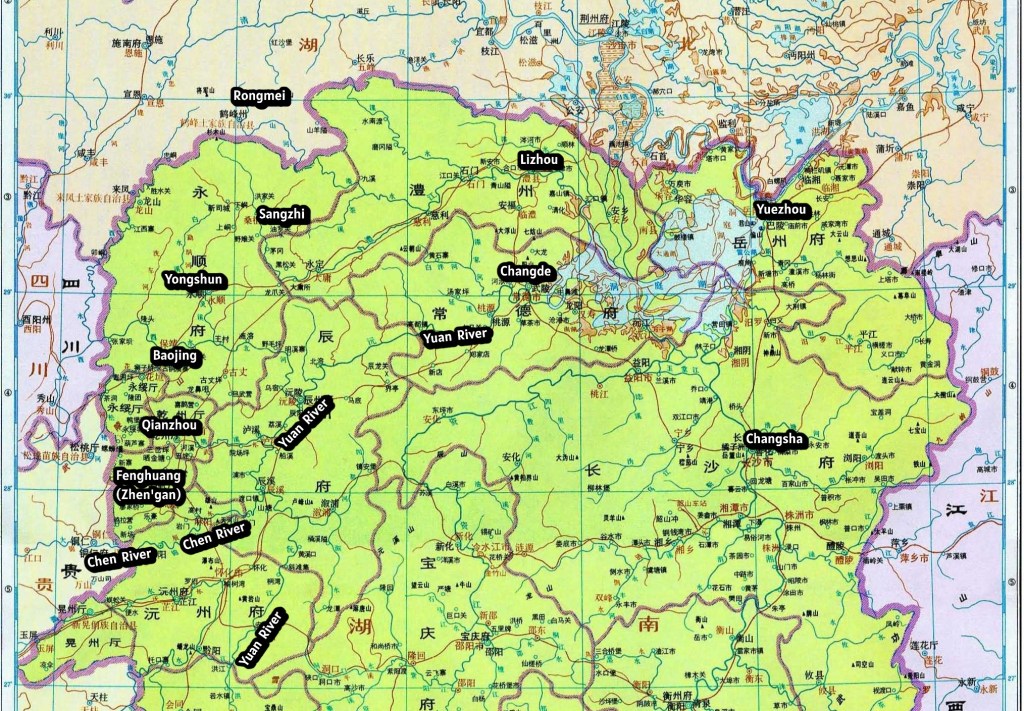
Having examined the matter, I find that the customs and tastes of the Man [groups] were not greatly different from each other. The crucial distinction lay elsewhere: Every Man settlement (dong 峒) possessed its own chief, and the hierarchical relationship between ruler and followers was as clearly defined as that between the head and feet or the arms and the fingers. Among the Miao, however, there is absolutely no overarching authority. There are distinctions of wealth and poverty, but none of noble and base; distinctions of strength and weakness, but none of noble and base; distinctions of large and small numbers, but none of noble and base. Formerly, when the Man chiefs were powerful, times of peace found them capable of controlling the Miao and serving as a protective barrier for the interior. When disturbances arose, the Miao merely acted at their instigation, swarming together like bees gathering to a hive, foxes howling in concert, or ants clustering in swarms. Those responsible for frontier administration therefore sought above all to conciliate the Man in order to restrain the Miao. This was the origin of the [bridled (jimi 羈縻)] prefectures under the Song and of the native chieftain (tusi 土司) system under the Ming.
Later, however, the Man chiefs settled securely into hereditary succession. Like wolves that had become tame, they no longer leapt about causing trouble; like hawks that had been well fed, they no longer exerted themselves in the hunt. Thus the Man problem disappeared, while the Miao problem flared into prominence. Those explicitly called “Miao” included only the Wukai Miao 五開苗 in Qian 黔 (Guizhou) and the Nine Rivers Miao 九溪苗 in Chu 楚 (Hunan). In reality, however, the Luo 玀 and Luo 猓 of Dian 滇 (Yunnan), the Bo 僰 of Shu 蜀 (Sichuan), and the Zhuang 獞, Yao 猺, and Li 黎 of eastern and western Yuè 粵 (Guangdong and Guangxi) all belong to the category (lei 類) of Miao peoples.
Under the Ming, Dian and Shu were filled with native chieftains who raised troops, whereas in Yuè, Qian, and Chu, the Zhuang and Miao themselves gathered in armed bands. Under our dynasty, however, all native chieftainships were converted into direct administration by rotating officials (guiliu 歸流). The Miao and Zhuang of Qian and Yuè have remained peaceful ever since. Even during the Miao revolt in Chu at the end of the Qianlong era, the native Man of Yongshun 永順, Zhen’gan 鎮筸 (Tuojiang town, Fenghuang county, Hunan), and Qianzhou 乾州 (Jishou, Hunan) either shouldered crossbows as the vanguard for government forces or served as guides, leading troops to capture the principal rebels. The contrast between past and present, between obedience and rebellion, was as great as the distance between Yan 燕 [in the far north] and Yue 越 [in the far south].
Alas! How did this come about? I have gathered together an account of the changing strategic situation, the evolution of frontier administration, and the successes and failures of policies toward these peoples, in order to provide a bronze mirror (source of lessons and warnings) for later generations. My conclusions are these:
The highest method by which a true king governs the barbarians (Yi) of the four quarters is to transform them through moral influence; the next best is to control and direct them. The Song relied exclusively upon conciliation in dealing with the Man. Consequently, no matter how exalted the titles or generous the rewards bestowed upon them, their desires were never satisfied. The Ming relied exclusively upon defensive measures against the Miao. Consequently, no matter how many guard posts were built or troops garrisoned, outbreaks could never be prevented. Thus throughout the Song, imperial authority never became firmly established, and throughout the Ming, the Miao never truly submitted.
How great is our Qing dynasty’s authority and moral charisma! No other dynasty since antiquity has attained it. In the forty-second year of the Kangxi era (1703), when frontier inhabitants came to present their grievances, the emperor was greatly enraged. He dismissed the Governor-general [of Hunan and Hubei] Guo Xiu 郭琇 from office1 and proclaimed:
“The Three Miao have defied imperial authority since ancient times. Even now they continue to ravage our frontier, plunder our people and livestock, and provide refuge for criminals and fugitives. How can such people be allowed to behave with impunity in territory lying close to the heartland? Dispatch Manchu and Han troops during the winter to press into their strongholds and place them under regular prefectural and county administration.”
Accordingly, the Minister of Rites, Silda 席爾達, was appointed to oversee the campaign.2
The following year, in the first month, the frontier subprefectures (ting 廳) of Fenghuang 鳳凰 and Qianzhou were established, although the Six Li Miao 六里苗 of Zhenxi 鎮溪 (in Qianzhou) remained under native chieftain administration.
Soon afterward, [Hunan] Governor Zhao Shenqiao 趙申喬 memorialized the throne requesting the abolition of the Wuzhai Native Chieftaincy 五寨長官司 (in Fenghuang county, Hunan). As a result, the Six Li Miao once again came forward to present their grievances [against the native chieftain]. The next year, one hundred and forty stockaded villages (zhai 寨) of Raw Miao collectively submitted.
At the beginning of the Yongzheng era, the court undertook a comprehensive campaign to pacify the southwestern barbarians, and its power and authority shook Qian and Yuè alike. At that time, the [native chieftain] Pacification Commissioners 宣慰使 of Rongmei 容美 (Rongmei town, Hefeng county) in Hubei and of Yongshun, Baojing 保靖, and Sangzhi 桑植 in Hunan were all accused [of abuses] by frontier inhabitants and, one after another, their jurisdictions were converted to regular administration by rotating officials. Thus Huguang 湖廣 (Hunan and Hubei) was left without any native chieftaincies.
Alas! Those who have long lived upon the sustaining earth do not recognize the benevolence of its sheltering embrace. Those accustomed to the comfort of their mats and cushions do not appreciate the hardships endured in times of crisis and calamity. Today, Rongmei and Sangzhi amount to no more than the territory of a single county each. Yet the single prefecture of Yongshun in fact encompasses the lands formerly ruled by the two native chieftaincies of Yongshun and Baojing. The land is barren and poor, so officials assigned there are invariably disappointed with their appointments. But in former times the four great native chieftaincies were wealthy, powerful, and formidable through successive generations. How much of the people’s very flesh and blood must they have squeezed dry?
After the Han dynasty succeeded the Qin, the net of the law was made so lax that even boats (major offenders) could slip through it. Thus the surviving subjects of these native chieftains have largely learned to value their own integrity and to fear the law. Was this not because they had long been cowed by accumulated tyranny, and had for so long hung suspended in a state of extreme oppression?
Alas! This is an age in which the people scarcely feel the weight of imperial power, growing old and dying without witnessing oppressive government or the calamities of war. Only under such conditions could scholars sit at ease and indulge in learned debates about restoring the ancient [decentralized] fengjian system!
- The Qing shigao explains the reasons for Guo Xiu’s dismissal as follows: “In the forty-first year (1702), Li Ding 李定 and other scholars from Zhen’gan 鎮筸 appealed directly to the emperor with a memorial about the killing and pillaging by the Red Miao 紅苗, which the governor-general and governor had covered up and not reported to the throne… Previously, the Red Miao had raided Zhen’gan, and the colonel (youji 游擊) Shen Changlu 沈長祿 proceeded to suppress them. When they arrived at Dameishan 大梅山, the lieutenant colonel (shoubei 守備) Xu Bangyuan 許邦垣 and the captain (qianzong 千總) Sun Qing 孫清 were captured by the rebels. Shen Changlu privately ransomed them from the rebels and returned, but covered this up in his report. Lieutenant General Zhu Fu 硃紱 reported that the Miao had accepted amnesty, and Guo Xiu reported this to the court [without further investigation].” ↩︎
- Silda, a Manchu bannerman, served as Minister of Rites in 1699-1700 and again in 1702-1706. ↩︎

