
The Dongying shilue is a detailed description of Taiwan by Ding Shaoyi (1815–1884), a Chinese man from Wuxi, Jiangsu province. Ding first visited Taiwan in 1847, accompanying his younger sister to her wedding to a Chinese man in Zhanghua county. He stayed for eight months, assisting with financial and clerical matters in the prefectural office and keeping a written record of what he heard and saw. He made a second visit in 1871, visiting his son (who had been posted to Taiwan as an official in 1868), and updated his account to include observations about how Taiwan had changed since his first visit, as well as comments on more recent events, such as the Rover Incident of 1867. In the first passage translated below, Ding describes the customs of the Chinese settlers on Taiwan. In the second passage, he criticizes the Taiwan Chinese population’s prejudice against the “wild barbarians” 野番 of the mountains, arguing that they too can become “civilized” like the indigenous peoples of the plains areas. In the third passage, he describes the customs of indigenous groups in various parts of Taiwan, and uses the example of the Christianization of indigenous peoples in North America (based on information from a seventeenth-century Jesuit-authored text) to reiterate his point that the “barbarians” of Taiwan, too, are capable of becoming civilized under Confucian influence.1
~~~~~
From the section “Local Customs” 習尚
The people of Taiwan have all migrated from Zhangzhou 漳州 and Quanzhou 泉州 in Fujian, and from Chaozhou 潮州 and Jiayingzhou 嘉應州 in Guangdong. In their daily life, clothing and food, religious observances, marriages, and funerals, they follow the customs of their native regions, and in these respects they differ little from the people of the mainland. Their temperament, however, is strong and fierce, impetuous, and easily stirred. This is because, under the initial rule of the Zheng family, soldiers were maintained among the farming population: whenever they had leisure, they occupied themselves with warfare and contests of strength, and at a single call they could all assemble. Although nearly two hundred years have now passed under the gradual influence of humaneness and moral duty, the habits of loving bravery and violent fighting have still not been completely eradicated.
Often, even the slightest personal grievance must be avenged before a person feels satisfied. If two people disagree over a few words, they immediately fight; at a more serious level, they engage in fights with weapons; and at the most serious level, they divide themselves into factions. Sometimes the divisions are between Fujianese and Cantonese, and sometimes between people from Quanzhou and Zhangzhou. Once such a division occurs, even close relatives and intimate friends will attack one another with drawn blades and refuse to recognize each other. Even wealthy families and great households must contribute money to assist their own side, and in consequence some people are driven to migrate elsewhere. At first, when confronted with armed force, they boldly refuse to yield and pay no heed. When their anger has somewhat subsided and the authorities gradually bring the law to bear upon them, they then merely lower their heads and obey orders.
There are, however, qualities worthy of praise. They regard wealth lightly and esteem righteousness. When they see people wandering destitute and without means, they provide relief and make sure that such people are properly settled. They place particular importance on fellow townsmen and people of the same clan name. If one of these suffers humiliation or oppression, they may exhaust their family fortunes to rescue and assist him, and they do not care even if doing so brings them into conflict with the law. In this respect, they quite resemble the spirit of Zhu Jia 朱家 and Guo Xie 郭解.2 Yet among close relatives and brothers, there are occasionally cases in which people stand by indifferently while their kin fall into distress. There are even cases of brothers quarreling, informing against one another, and bringing lawsuits that continue year after year. The reason for this is particularly difficult to understand.
Taiwan is rich in products, and goods from all places are gathered together there. Apart from scholars and farmers, merchants and traders are especially numerous, while wages for craftsmen are particularly high. Among those scholars who have just begun studying literature, on the first and fifteenth days of each month they are tested by being required to compose the opening portions of essays. On the following day they are ranked in first-class and second-class lists, with prizes and rewards varying according to rank. This is called a “Little Lecture Gathering” (xiao jianghui 小講會).
The seventh day of the seventh lunar month is regarded as the birthday of Kuixing, the God of Literature. Sacrificial animals and wine are arranged and displayed, and after the sacrifice, men drink heavily together. This is called the “Kuixing Gathering” (kuixing hui 魁星會). On that evening, women set incense, flowers, fruits, and seven duck eggs in the courtyard to worship the Weaving Maid (the star Vega), an observance called the “Qiqiao Gathering” (qiqiao hui 乞巧會).
Farmers who rent land for cultivation are said to “rent fields” (pu tian 贌田), paying their rent in grain rather than silver. There is also a practice in which silver, without interest, is paid in advance under a contract specifying a term of years. When the term expires, the landowner returns the original amount of silver, while the tenant rents other land. This is called “pledging land” (qi di 磧地).
The people customarily call the season when grain ripens “winter.” There are early-winter and late-winter harvests, and when both are obtained, it is called “double winter,” just as the ripening of wheat is referred to as “autumn.” Besides rice and wheat, many other crops are planted, including hemp, beans, sugar cane, greens, sweet potatoes, and ramie. When crops are sold before they have ripened or harvested produce is sold before it has been gathered, this is called “selling the green” (mai qing 賣青). When merchants set a price and advance funds beforehand, then take possession of the crop at the appointed time, this is called “buying the green” (mai qing 買青).
In cities, small-scale sellers of goods are called “shops” (dian 店). Those who gather goods together and distribute them among the various shops are called jiao 郊. Those engaged in trade with Fuzhou and the regions of Jiangsu and Zhejiang are called the “Northern Jiao”; those trading with Quanzhou are called the “Quan Jiao”; and those trading with Xiamen are called the “Xia Jiao.” Together, these are known as the “Three Jiao.” The term jiao refers literally to the outskirts or countryside, while also carrying the meaning of exchange.
Each year, when it is a household’s turn to take responsibility for the affairs of the jiao, the person is called the “stove master” (lu zhu 爐主). The name derives from the burning of paper offerings and silk at a furnace during ceremonies to repay the gods. The community selects one person to take charge of these affairs. This is similar to the positions of director (dongshi 董事), manager (sishi 司事), or chairman for the year (zhinian 值年) among traveling merchants on the mainland.
Skilled craftsmen, whether they wield a trowel or a needle, must be paid two or three silver cash per day. Even laborers who carry loads on their shoulders or backs are calculated at a hundred cash per day, yet they are still hesitant to accept the work; only when offered two or three hundred wen 文 will they agree to undertake it.
People call those who live in the mountains and wilderness “grassy land men” (cao di lang 草地郎), mocking them as if they lived among the deer. There is also another class of idle and disreputable men who wander the streets and make a living by deception and extortion. They are called “Arhat Feet” (luohan jiao 羅漢腳).3 When winter comes and they lack sufficient clothing and food, they often gather bands of followers and lie in wait to rob travelers. The local authorities must therefore regularly recruit and assign constables and able-bodied men to patrol and apprehend them; this has become an annual routine.
In earlier times, there was a practice of driving such people back to the mainland, a punishment called “chasing to the water” (zhu shui 逐水). Yet they would soon return. Nowadays, the authorities cannot drive them away fast enough to keep them away, and the practice of “chasing to the water” is no longer known.
…
From the section “Barbarian Villages” 番社
It has long been said that the various barbarian (Fan) peoples are wild by nature and difficult to tame, and that burning houses and killing people are their customary skills. Yet this fails to recognize that their feelings of cherishing life and fearing death, of enjoying ease and disliking toil, are in the beginning no different from those of anyone else. In recent years, the cooked barbarians (shufan 熟番) have adopted the food, clothing, and ways of life of registered commoners, while the raw barbarians (shengfan 生番) have already been half transformed into cooked [barbarians]. Among them, those who regard killing people as an act of martial valor, and who decorate human heads with gold to display their wealth and boast of their elite status, number no more than one or two villages out of ten. The rest are simply wild barbarians (yefan 野番) living in remote mountains, who have suffered only from the lack of anyone to civilize and guide them and bring about their transformation. When local inhabitants see these wild barbarians come out, they invariably form a mob and kill them. Yet they turn around and claim that the barbarians are addicted to killing people. Why do they not instead turn back and reflect upon their own conduct?
The barbarians are all greedy for profit and, having seen little of the world, are prone to being suspicious [of new things]. If one were to make use of what they understand and remove what obscures their understanding; to treat them with kindness and guide them with ritual propriety; and gradually change their fierce and unruly habits, bringing them toward trustworthiness and morality—then, in time, the wild barbarians would become raw [barbarians], and the raw barbarians would become cooked [barbarians]. There is absolutely no reason to believe that they would isolate themselves forever and never wish to become good subjects of a flourishing age.
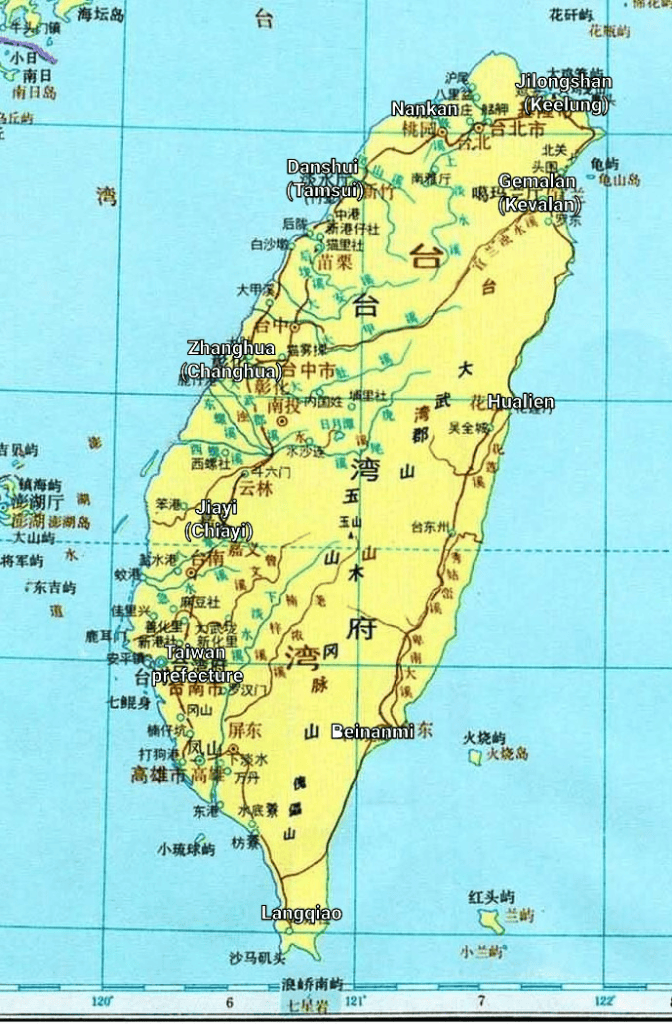
During the Kangxi era (1662–1722), a military officer from Zhangzhou named Zhu Wenbing 朱文炳 was blown by the wind to Kapalan 蛤仔難 (Kevalan, modern Yilan). His boat was wrecked and he went ashore. The barbarians suspected that he was a bandit and at first intended to attack him with weapons. Once they learned that this was not the case, however, they gave him lodging and food and escorted him to Jilongshan (Keelung), allowing him to return home. These were the barbarians of Gemalan 噶瑪蘭 (Kevalan).
There was also a man named Lai Ke 賴科, who traveled with seven companions. By day they hid themselves, and by night they traveled, crossing through the territory of the wild barbarians toward the eastern side [of Taiwan]. The eastern barbarians guided them on a tour of the various villages, saying: “It is because the wild barbarians block the way that we cannot communicate with people to the west of the mountains. If ten thousand men could be sent to cut a road through the mountains and establish a passage, so that we could all contribute tribute and taxes, then we would become subjects of the Celestial Court.” This too happened during the Kangxi era. Their sentiments are evident from these examples. Yet we discriminate against them as a different kind (lei 類) [of people]. I fear that one day the situation will be as described in Lan Dingyuan’s 藍鼎元 Brief Account of the Pacification of Taiwan (Ping Tai jilüe 平臺紀略): “If this land [of Taiwan] does not belong to our subjects (min 民), then it will belong to rebels (zei 賊). Even if internal rebels do not arise, there is still the danger that enemies may come from outside.”4 If we simply abandon and cast these people aside, there will certainly be someone who comes along and takes possession of them. Can we afford not to prepare for such dangers well in advance?
…
From the section “Barbarian Customs” 番俗
The barbarian peoples of Taiwan generally have deep-set, glaring eyes, with high, pointed noses. Their speech consists of sounds such as dulu and gulu. They call liquor dalasu and tobacco danbagu, which are rather similar to the sounds of Mongolian.5 Neither men nor women shave their heads.6 Some cut their hair evenly so that the fringe falls over the forehead, resembling the appearance of a Buddhist mendicant (toutuo 頭陀, dhutanga); among the men, some shave off half their hair while leaving the other half. Many men pierce their ears and insert bamboo plugs into them, gradually enlarging the openings until they are as large as coins, then filling them with circular pieces of giant clam shell or conch shell two or three inches across.
They tattoo their chests and arms with patterns of flowers, grasses, tigers, and leopards, saying that they are following the customs of their ancestors and dare not depart from them. The barbarians of the northern circuit 北路 sometimes tattoo their faces.7 The Gemalan (Kevalan) barbarians all tattoo the character 王 (“king”) between their eyebrows. Some smear deer fat over their bodies to protect themselves from wind and rain. Their feet are all covered with thick calluses, allowing them to traverse steep and dangerous mountains as easily as level ground. They bind their abdomens with woven rattan or strips of bamboo in order to make themselves more nimble when walking and running; when they marry, however, they remove these bindings.
Barbarian women are rarely fair-skinned. Those north of Jiayi (Chiayi), however, are comparatively attractive and clear-complexioned. They tattoo the skin around their lips and apply dark pigment to the marks, making themselves look as though they had the whiskers of an Arhat statue; they regard this as beautiful. Women commonly pierce their ears in as many as six or seven places.
After marriage, both men and women must have the two teeth beside their front teeth (lateral incisors) knocked out. Women who have tattooed faces are exempt from this practice. The ancients spoke of [southern barbarians] cutting their hair, tattooing their bodies, tattooing their foreheads, and filing their teeth—all these customs can still be seen among the Raw Barbarians.
When a child is born, the mother takes the infant with her to bathe in a stream. When someone is ill, they likewise go into the stream and wash themselves, using the warmth of their bodies as the measure: if the body is not warm, they bathe again; once it becomes warm, the illness is considered cured.
Small children are often placed in a strip of cloth suspended from the fork of a tree, where they are left to swing in the breeze. Consequently, once grown, they are unafraid of wind and cold and remain naked throughout the year. They climb among trees on the mountain ridges as though they had practiced doing so all their lives.
The barbarians’ dwellings have different names in different regions. In the southern circuit 南路 they are called tun 囤 and lang 朗; in the northern circuit, they are called dalao 達勞, nongmi 濃密, and biduhun 必堵混. Whenever a house is to be built, all the barbarians join together in constructing it. They raise a foundation of packed earth, set up bamboo and timber for beams and pillars, thatch it with grass, and weave bamboo into walls. The resulting structure resembles an overturned boat. The entire family lives together in a single room. Only when a son takes a wife or a daughter marries a husband do they establish a separate dwelling.
Among the barbarians of Zhanghua (Changhua), however, the arrangement is different. Unmarried men and women live separately. Small huts are built for the women, called longzai 籠仔 or maolin 貓鄰. The dwellings of the men are called gongxie 公廨; this is how the Gongxie Barbarians got their name.
Among the barbarians beyond the mountains (houshan 後山8), in secluded and dangerous hollows they sometimes build stone walls and cover them with slabs of stone, so that from a distance they look like stone houses. Others dig into the mountainside, making dwellings resembling caves. In general, they prefer to live in high and steep places, which makes it convenient to keep watch. There are small entrances on both sides, and livestock are kept inside as well.
North of Danshui (Tamsui), the climate is damp. Some people therefore lay boards above the ground, three to five feet high, and climb up to their houses by ladders. The houses are spaced far apart. Bamboo, trees, and flowers are often planted around them, making the surroundings quiet and secluded, as though cut off from the human world. When a house is completed, they invariably invite the whole barbarian community to drink and celebrate to their hearts’ content.
Men and women among the barbarians all bind their heads with a loop of grass, like a hat but not quite a hat. Some use strips of bamboo wrapped with silk ribbons; others make them from blue cloth or gauze. They delight in wearing wildflowers in their hair, often surrounding the head almost completely with them. Barbarian men who work for the government officials wear a chicken feather as a distinguishing mark. They wear copper bracelets or iron rings around their wrists, and some string agate beads into rings. Their ankles, too, are encircled with copper rings. Their clothing is made of hemp cloth or of a self-woven fabric called Dagewen 達戈紋 (Dagobun).9 The upper garment does not reach the navel and has no sleeves; its lapels are left hanging loosely. Women add a fastening at the front. Around the lower body they wrap two pieces of cloth, called chaoyin 抄陰 or tuwu 突勿.
Among the barbarians of beyond the mountains of Zhanghua (Changhua), some merely tie a strip of cloth about a foot long on the front of their bodies; when the wind blows, their entire bodies are exposed. In hot weather, they may tie strands of hemp or ramie around the body, leaving the threads hanging down over the lower body, to keep cool. In winter, they drape deerskins over themselves. Some even cover their heads with deerskin, leaving only the two eyes exposed. Others wear felt cloaks or cover their bodies with Zhuogewen 卓戈文 (Dagobun). They all go barefoot and have no knowledge of socks or shoes.
Each year, in the second lunar month, when the time comes to work the fields, there is a celebration called “changing the year” (huannian 換年). Men and women alike put on silk and ramie garments of various colors. They gather together to drink, join hands, stamp their feet, and sing for pleasure. The native chiefs often wear the imitation court robes and black boots of opera costumes for actors playing officials. Outside the band around their hats, they add a gold ring as an ornament, or they insert two pheasant feathers.
The barbarians commonly eat sweet potatoes and taro as their staple food. Only about three or four out of ten eat rice. Rice is usually rolled into balls and eaten by hand. Sometimes glutinous rice is steamed, pounded into a floury cake, and called dudu 都都; this is prized as a delicacy of the highest quality. Since they do not know how to cultivate fields, millet and other grains are scarce among them. When the grain ripens, they often simply pluck it by hand. They also do not cultivate vegetable gardens, so there are no scallions, chives, or lettuce.
Their chickens are especially abundant. When a guest arrives, a chicken is killed and served to him in place of vegetables. Winter melons are particularly favored among them. When they go to meet a government official, they carry a melon and present it as a gift; chickens, meanwhile, are used to feed the official’s attendants. They place fish, shrimp, deer, muntjac, and similar animals directly over the fire and eat the meat while still half-cooked and bloody.
They are extremely fond of alcohol. They have two kinds of liquor. In the first, a barbarian woman chews rice and places it on the ground; after a night, it ferments into a starter. This is mixed with cooked rice to make liquor. When it is drunk, water is added. It is white in color and sour in taste and is called gudai wine 姑待酒. The second kind is made by pounding millet together with fresh grass and flowers. The mixture is wrapped in grass and leaves and boiled for several days. The clear liquid is then strained off and stored in jars. This is called laowu liquor 老勿釀. When drinking, they use either wooden ladles or coconut-shell bowls. They sit together on the ground, repeatedly drawing liquor and passing it from one person to another. They consider a sour taste to be a sign of good, mature liquor.
Some also preserve fish in salt and preserve venison by drying. All their salt is obtained from outside [through trade]. It is traditionally said that in Chongyao 崇爻 (Hualien) beyond the mountains, there is a salt spring resembling the salt wells of Sichuan; consequently, the barbarians on the far side of the mountains have no need to obtain salt from outside.
The barbarians’ custom is to first have sexual relations and only afterward marry. There is no exchange of betrothal gifts and no matchmaker. When a young man and woman reach marriageable age and are mutually attracted, they simply form an illicit union. Afterward, each tells their parents, and the two families arrange the marriage. This is called “joining hands” (qianshou 牽手). The families exchange sea clam shells, blue and red cloth, and copper or iron bracelets as gifts. When the appointed day arrives, the two families give livestock and wine to each other. The man is led to the woman’s house, where they are married, and the whole village drinks together in celebration. In other cases, the woman is brought into the man’s house; the village is likewise invited to drink, just as when a husband marries into his wife’s household.
Recently, when barbarian women “join hands” with Han (Chinese) men, the betrothal gifts and ceremonial procedures have become roughly similar to those of the Han.
Among the various peoples of Langqiao 瑯嶠 (the Hengchun peninsula) and Beinanmi 卑南覓 (Beinan, Taitung), the barbarian chiefs intermarry with one another’s clans and do not intermarry with other barbarian families. The barbarians often allow women to inherit the household, with a sister’s son being adopted as a grandson, thereby continuing the family line. They have no clan names.
The children of paternal uncles and aunts may marry one another. If husband and wife are incompatible, they simply separate, a practice called “releasing hands” (fangshou 放手). A woman may not marry another man if her former husband has not yet remarried; if she remarries first, she must pay a fine of wine or a cow or pig. If adultery is discovered, the offender is publicly denounced before the community and fined in the same manner. Those who are not yet married are exempt from punishment. Among the barbarians north of Nankan 南嵌 (the Taoyuan plateau) in the northern circuit, however, even if husband and wife turn against each other and separate, they do not divorce even after growing old.
When a husband dies, after one month, three months, or a full year, the widow tells her parents and chooses another partner for a new “joining of hands.” This custom is observed throughout the various villages.
When parents die, the survivors wail in mourning and wear black clothing. The corpse is buried inside the house. The wealthy use a coffin; the poor place the body on stone slabs or a grass mat laid over the earth before burial. Half of the deceased person’s possessions are buried with the body. After the burial, the living immediately move to another dwelling. Occasionally, however, they do not move, or they bury the body beside the house instead. The mourning period varies: sometimes a year, sometimes several months, and sometimes as little as ten days. At the beginning of the mourning period, the entire village abstains from drinking alcohol and singing. In this respect, their custom is rather like that attributed to the people of [Chinese] antiquity, when neighbors would cease singing when pounding grain to show respect to a household in mourning.
Each village makes common use of shell money, called meidala 眉打𡃤. These are all made by Han people, who grind and polish them into shape. They are round, about three inches across, with a hole drilled through the middle. The pure white ones are considered the most valuable. Each shell is worth approximately four or five fen 分 of silver.
For farming, they use small hoes and short knives to dig into the earth and plant their crops. Sometimes they heat hardwood in a fire and fashion it into a digging implement, using it in place of agricultural tools. More recently, some also drive oxen and use plows and rakes.
For hunting deer, they use throwing spears, knives, bows, and arrows. The throwing spear is called wuluo 武洛, the knife jiaojie 礁傑, and the bow and arrows mula 木拉. For fishing, they also use throwing spears. A bamboo shaft, about five feet long, is fitted with a sharp iron point approximately two inches long, furnished with two barbs. A long cord is attached to it. The knife is a little over one foot long and is kept in a wooden sheath. Both bows and arrows are made entirely of bamboo. Hemp fiber is twisted into bowstrings, which are soaked in deer blood; they then become firmer and more resilient than silk or leather.
For drawing water, they use gourds. For cooking, they use three stones, placing a pot upon them. Some use a pottery vessel called a mukou 木扣, with a rounded bottom and narrowed mouth, and a slightly raised lip to support the steamer basket.
For eating utensils, they use coconut shells and conch shells, as well as porcelain bowls. For trading with others, they weave bamboo into xialan 霞藍 baskets. The smaller round ones hold one or two dou 斗, and they are used as a measure for determining the quantity of rice or wheat.
For storing things, they weave vines into baskets with bottoms and lids, in various square and round shapes. They also fashion gourds into travel containers, the larger ones holding several dou. They do not become wet when it rains, and when crossing water, they float.
For sleeping, they lay bamboo strips upon the ground, covering them with deer hide or Zhuogewen (Dagobun), and use a piece of wood shaped like a small stool as a pillow. The wealthy arrange beds in their rooms for the sake of appearances, but at night they still spread their mats on the floor and sleep there.
The barbarians do not know how to read and write. They keep numerical records by tying knots in cords, as in ancient times.
They have no implements for milling rice. They use a large piece of wood as a mortar and a straight piece of wood as a pestle. They pound the grain only until the husk comes off and then cook and eat it.
When crossing water, they do not use boats. They hollow out the middle of a single log, and attach boards like wings along its sides with vines [to stabilize it]. It is called a mengxia 艋舺, and it holds only two or three people.
The barbarian women make a large wooden frame resembling a kaolao 拷栳 (round-bottomed wicker basket), boring holes through it and passing bamboo horizontally through them so that it can rotate. They wind warp threads around it, carve wood into an axle, and fasten it to the waist. By opening and closing it and passing the shuttle through, they weave cloth, which is quite strong and finely made.
The barbarian children cut a length of bamboo and bore four holes in it, like a flute. It is up to two feet long. Small holes are opened through the bamboo joints, and the instrument is held horizontally and blown through the nose. It is called a nose flute (bixiao 鼻簫). Its sound is not particularly loud and resembles that of the transverse flute (xiao 簫)….
Nowadays, among the Cooked Barbarians, more men marry patrilocally than matrilocally, and clan names are passed down through the paternal line. In their dress, diet, and daily conduct, they are generally no different from registered [Chinese] commoners. Among those barbarians who have submitted and become subjects, marriage is conducted with betrothal gifts, and husband and wife are buried separately after death. They are able to discern good food from bad, and women wear trousers and short jackets; they have also largely adopted Hua [Chinese] customs. The main differences are simply that their clothing has narrower collars and sleeves, they rarely wear shoes, they have not yet established clan names, and they do not know written characters.
The customs of the barbarians differ from one village to another, and there are also differences between the present and the past. I have therefore selected and recorded only the general features here. After several more decades, I fear that these too will no longer accurately describe the customs of the barbarian peoples of that time….
It is also recorded in the Record of Foreign Regions (Zhifang waiji) by the Westerner Giulio Aleni:
“The farther north one goes in North America, the more savage the people become. There are no cities or walls, no rulers or chiefs, and no written language; several families form a settlement. They are accustomed to drinking wine and spend their days making war and killing. Whenever they go out to fight, one family observes a fast and prays for victory. When they return victorious, they cut off the heads of their enemies and use them to build a wall. If they fight again, the elders of the household will point to the skulls on the wall and encourage the younger ones by them: such is their esteem for bravery and love of killing. Recently, European missionaries came among them and urged them to reverence and serve the Lord of Heaven, exhorting them not to kill one another. They thereupon changed completely. Moreover, they are resolute and steadfast: once they have reformed, they never again transgress. Their custom is such that the rich are generous in giving. Each household commonly prepares cooked food and places it outside the door, allowing passersby to take whatever they wish.’”
What he describes are the native barbarians (tuman 土蠻) inhabiting the remote northernmost regions of the newly explored continent of America. Their primitive and uncivilized condition was no different from that of the barbarians of Taiwan, yet they were especially fierce and warlike. Westerners instructed them in their incoherent and illusory religion10, and they actually changed their customs. Yet people claim that although the raw barbarians possess human form, they are entirely devoid of the principle of humanity (renli 人理) and cannot be transformed through the [humane] governance of a [Confucian] sage-king.11 How could such a claim possibly be just?
- The third passage is also translated in Emma Jinhua Teng, Taiwan’s Imagined Geography: Chinese Colonial Travel Writing and Pictures, 1683-1895 (Cambridge: Harvard University Asia Center, 2004), 281-284. The translation above is my own. ↩︎
- Famous folk heroes (youxia 游俠) of the early Han period renowned for chivalry and generosity, and readiness to take the law into their own hands. ↩︎
- In 1827, a Qing official described the “Arhat Feet” as follows: “He is single and roams the land, forming bands wherever he goes, never owning both shirt and trousers at one time, remaining barefoot his entire life. In large cities and villages they number no less than several hundred; in small cities and villages they number at least several tens. This is why Taiwan is difficult to govern.” Quoted in David Ownby, Brotherhoods and Secret Societies in Early and Mid-Qing China: The Formation of a Tradition (Stanford University Press, 1996), 20. ↩︎
- The Ping Tai ji lue, written by Qing official Lan Dingyuan (1680-1733) in 1723, is a first-hand account of the quelling of the rebellion of Zhu Yigui on Taiwan in 1721–1722. The relevant passage by Lan reads: “Taiwan was unknown to us in ancient times, but it became known during the middle of the Ming dynasty. At that time, island barbarians (i.e., the Dutch) and rebels (i.e., the Zheng family) successively occupied it secretly, causing persistent border troubles. Only after [Qing] prefectures and counties were established did it gradually become a land of peace and prosperity. From this we can see that no territory should be left without people to inhabit it. If a region is properly developed and administered, it becomes an area with a registered taxpaying population. If neglected and left empty, however, it inevitably becomes a breeding ground for banditry and rebellion. Taiwan has high mountains and fertile soil, making it most suitable for land reclamation and cultivation. Where there is profit, people will inevitably be drawn to it. If the land does not belong to our subjects, then it will fall into the hands of barbarians (Fan) or bandits. Even if internal rebels do not arise and the wild barbarians remain peaceful, there is still the danger of external invasion from threats like Helan (the Dutch) and Riben (Japan). It is therefore essential to prepare for such dangers well in advance.” ↩︎
- Danbagu is actually derived from the Portuguese or Spanish word tabaco. Ding Shaoyi refers to tobacco by its Chinese name yan 煙, meaning “smoke.” ↩︎
- Ding is presumably referring only to the “raw” and “wild” indigenous peoples in the mountains. The Qing state required men from the “cooked barbarian” groups of the plains areas to adopt the Manchu hairstyle, where the front half of the head is shaved and the hair on the rear half is tied into a pigtail. This hairstyle was mandated for Han Chinese men as well. ↩︎
- The northern circuit encompassed all Qing-controlled territory in Taiwan north of the prefectural capital (Tainan). ↩︎
- This was a Chinese term referring to the indigenous peoples of Taiwan’s eastern coast. ↩︎
- Dagobun was an indigenous fiber woven with a combination of ramie, tree bark, feathers, and dog hair. ↩︎
- Ding, being a traditional Confucian, clearly does not think highly of Christianity, hence his astonishment that it was possible to “civilize” Native Americans with it. ↩︎
- This alludes to a passage in a letter about the raw barbarians that Lan Dingyuan wrote to a colleague during the Zhu Yigui rebellion. The letter is found in the Dongzheng ji 東征集 (Eastern Expedition Anthology), which compiles Lan’s miscellaneous writings from Taiwan. The passage reads: “Raw barbarians killing people is a common occurrence in Taiwan. Although these people possess human form, they are entirely devoid of the principle of humanity. They move through the forests and mountain thickets like birds, beasts, and monkeys. They cannot be brought under control, yet one cannot bear to exterminate them; thus, there is simply nothing to be done about them.” ↩︎

