
For information on Ban Gu and the Hanshu, see source 2.8.
Although it had produced a sophisticated Bronze Age culture, the Sichuan Basin remained outside the Hua-Xia cultural sphere until the state of Qin conquered the Shu and Ba states in 316 BCE. The fertile Chengdu plain in Sichuan thereafter became an economically significant part of the Qin and Han empires but was considered a frontier backwater until the mid-to-late Western Han period, when it produced the great poets Sima Xiangru (ca. 179-117 BCE) and Wang Bao (ca. 84-53 BCE), the scholar Zhuang Zun (or Yan Zun, fl. first century BCE), and Zhuang’s most accomplished student, Yang Xiong (see source 1.9). In the Hanshu, Ban Gu credits the “civilizing” of Sichuan mostly to a governor named Wen Weng who promoted education by sending promising local men to the imperial capital for training as officials and by founding a local school.
~~~~~
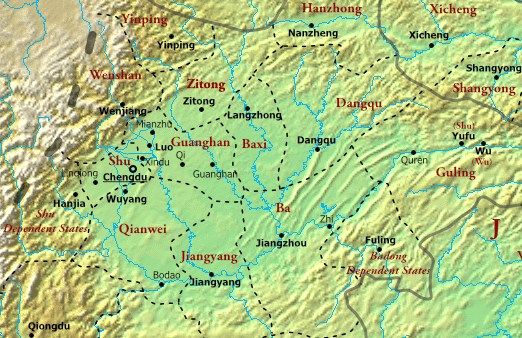
- From “Treatise on Geography”
Ba, Shu, and Guanghan were originally southern barbarian (Yi) [lands].1 The Qin state annexed them as commanderies (jun 郡). Their land is fertile and irrigated by rivers, making their mountains and forests rich in bamboo, vegetables, and fruits…. During the reigns of emperors Jing (r. 157–141 BCE) and Wu (r. 141–87 BCE), Wen Weng served as governor of Shu commandery and taught the people to read and to understand the laws. They did not sincerely believe in the Way and its moral authority, however, and mocked his fondness for civility while reserving their admiration for powerful men. But when Sima Xiangru went to the capital and the kingdoms to serve as an official and gained fame in his time through his literary works, then the people of his home region followed his example out of admiration.2 Later came men [of Shu] like Wang Bao, Yan Zun, and Yang Xiong whose literary brilliance was unrivaled in the whole subcelestial realm.3 This was due to Wen Weng, who first promoted literary education, and Sima Xiangru, who served as a model for it. That is why Confucius said, “When it comes to education (jiao), there are no distinctions (lei).”4
2. From “Biographies of Worthy Officials”
Wen Weng was a man of Shu county in Lujiang commandery.5 In his youth, he was fond of learning and versed in the Annals. He was recommended to the court for appointment as a commandery or county clerk. In the later part of Emperor Jing’s reign, he served as governor of Shu commandery. He was humane and compassionate, and loved teaching and transforming the people. Seeing that the Shu region was remote and benighted and practiced barbarian (Man-Yi) ways, Wen Weng wished to entice its people toward [civilization]. He selected more than ten junior clerks from the commandery’s counties, including Zhang Shu, who were intelligent and showed promise. After personally exhorting them, he sent them to the capital to study [the classics] under the Academicians or to study the legal system. To avoid placing a strain on the commandery’s revenues, he bought locally-made book knives and hemp cloth in Shu [with his personal funds] and let the clerks bring them [to the capital] as gifts for the Academicians.6 Several years later, these Shu scholars completed their studies and returned. Wen Weng appointed them to top positions and used them to recommend others for office. Some of them rose to the rank of commandery governor or regional inspector.
He also founded a school in the marketplace of Chengdu and recruited young men from the surrounding counties to be its students, exempting them from corvée duty. The ones who performed best were directly appointed as clerks in the commandery’s counties. Students a step below them in ability were recommended to the imperial court as “good sons and younger brothers and hardworking farmers.”7 He often selected boys from the school to assist him in his duties outside the governor’s office. When he went out to inspect the counties, he would take with him many of the students who were versed in the classics and who showed good conduct, and let them relay his orders and come in and out of his office freely. The clerks and common people of the county towns saw this and considered it an honor to be given such work. Within a few years, they were vying to enroll in the school as students, to the point where wealthy men offered cash for a place in the school. As a result, a great transformation took place and the number of Shu men who went to study in the capital was comparable to those from Qi and Lu (Shandong). During Emperor Wu’s reign, the court ordered all commanderies and princely states in the subcelestial realm to establish schools. This practice began with Wen Weng.
Wen Weng died in Shu, and the clerks and people built a shrine to him where they have made offerings every New Year’s Day since then. To this day, the Ba and Shu regions (Sichuan) are fond of civility and refinement due to the transformation wrought by Wen Weng.
- These Han commanderies were centered, respectively, on modern Chongqing, Chengdu, and Mianyang in Sichuan. ↩︎
- Sima Xiangru was a talented poet from Shu commandery who achieved literary fame around 137 BCE due to patronage by Emperor Wu. ↩︎
- The Hanshu refers to Zhuang Zun as Yan Zun (yan being a synonym of zhuang, meaning “solemn”) to observe a taboo on Han Emperor Ming’s (r. 58–75 CE) given name, Zhuang. Zhuang Zun made a living as a professional diviner but was also an expert on the Daodejing, attributed to Laozi. Although Yang Xiong came to embrace Ru ideals and reject the worldview of the Daodejing, he continued to regard his former teacher with respect, as seen from remarks in the Fayan. ↩︎
- Analects 15.39 (see source 1.3). ↩︎
- This county was located in modern Lujiang county, Anhui, corresponding to the city of Hefei. Its name was written as 舒, and should not be confused with the Shu 蜀 of Sichuan. ↩︎
- The alternative was presumably to pay the Academicians tuition in grain or cash. At this time, texts were written with ink on bamboo slips, and small “book knives” were used to scrape away mistakes so that the graph could be rewritten. ↩︎
- This was a category that the Han imperial court used for screening and recruiting candidates for local office, on the basis of moral character and work ethic. ↩︎
 Ethnic Identity in Imperial China
