
The Hou Hanshu is a “dynastic history” of the Eastern Han modeled on the Hanshu. Its author, the fifth-century historian Fan Ye (398-446), composed the text by synthesizing materials from numerous earlier accounts of Eastern Han history (most of which are no longer extant).
The first two excerpts below reflect efforts by Eastern Han officials to impose Chinese cultural practices on the Luo-Yue (Lạc Việt) people of north and central Vietnam and adjoining parts of Guangxi and Guangdong. This region had been incorporated into the Southern Yue (Nanyue) kingdom (ruled by the Chinese Zhao family) around 180 BCE and then conquered by the Han empire in 111 BCE. Under Han rule, the former territory of Southern Yue was divided into several commanderies and collectively called Jiaozhi after the commandery headquartered at Longbian (Long Biên), in the Red River delta. Longbian became the Chinese empire’s main port for trade with Southeast Asia and the Indian Ocean, and grew over time into the city of Hanoi. Based on the Hou Hanshu account, exiled Chinese convicts may have been the first to introduce Chinese ways to the native population of Jiaozhi. But the text gives the lion’s share of the credit for Jiaozhi’s “Sinicization” to two governors who served there in the early first century CE.
The second excerpt also narrates the Trưng (Zheng) sisters revolt of 40-43 CE, which indicates that the native chieftain elite’s resentment toward Han domination was not easily defused by “Sinicizing” measures and may even have been exacerbated by them. Tellingly, the account ends with a restoration of “peace and order” via the literal and metaphorical decapitation of the native elite, as the revolt’s leaders are executed and hundreds of other native chiefs are forcibly moved to Hunan to separate them from their people. Evidently, the “civilizing” of Jiaozhi was not all a peaceful and benign process. But it finally resulted in the emergence of a literate local elite with a partly “Sinicized” culture that would break away from the empire and begin building its own Chinese-style state nine hundred years after the Trưng sisters.
The third excerpt narrates the tragic story of the Yunnanese Ailao kingdom’s integration into the Han empire in 69 CE, which began with an unusual voluntary submission to Han rule but descended into a violent revolt within less than ten years. The Han crushed the Ailao revolt using both Chinese troops and native auxiliaries, and then abolished the autonomous kingdom. Similar stories probably transpired along the southern frontiers over the centuries, as indigenous leaders sought benefits from association with the Chinese empire, only to realize too late that they could not trust the empire’s agents to honor previous agreements that had preserved their autonomy and way of life.
~~~~~
- From “Biographies of Worthy Officials”
Ren Yan, whose byname was Zhangsun, was a man of Wan in Nanyang commandery. At the age of eleven sui (twelve years), he was educated as a student in Chang’an and became versed in the Odes, Changes, and Annals. He was nicknamed “Little Sage Ren” by his schoolmates….
At the beginning of the Jianwu era (25-56 CE), Ren Yan submitted a memorial requesting to retire from office and came to the imperial court to take his leave. But the emperor issued an edict appointing him as governor of Jiuzhen commandery. Emperor Guangwu (r. 25-57 CE) summoned him to an audience, granted him gifts of a horse and assorted silk textiles, and allowed his wife and children to remain in Luoyang (the capital).
The local custom in Jiuzhen was to hunt with bow and arrows, and the people did not know how to plow their fields with oxen. The people often had to buy grain from Jiaozhi commandery, leading to frequent shortages of food. Ren Yan therefore instructed them to forge farming implements and taught them how to open up land for agriculture. Each year, the amount of arable land increased and the people now had enough to provide for themselves. The Luo-Yue (Lạc Việt) people did not have ritual practices for contracting marriages. Each followed their own promiscuous desires and did not enter into lasting matches, knowing nothing of the bonds between fathers and sons and the way of husbands and wives. Ren Yan wrote letters to the counties under his jurisdiction, ordering each to ensure that men between the ages of twenty and fifty sui (nineteen and forty-nine years) and women between the ages of fifteen and forty sui (fourteen and thirty-nine years) get married to a spouse of a similar age. If a man was too poor to afford the bride price, he ordered the local clerks to take a reduction in their pay to subsidize it. Over two thousand people entered into marriages all at once.
That year, the seasonal (monsoon) winds and rains were timely and there was a bumper harvest. Women who bore sons knew for the first time which lineage and surname the child belonged to. They all said, “It was Mr. Ren who brought me this son,” and many of them named their sons “Ren.” As a result, Yelang and other barbarian peoples beyond the frontier admired [the Han empire’s] morality and offered to live along the frontier and guard it.1 Ren Yan then abolished the [Han] garrisons that had been stationed to guard the frontier.
Earlier, during the reign of Han Emperor Ping (1 BCE-6 CE), Xi Guang of Hanzhong commandery served as governor of Jiaozhi. He taught both the [Han] subjects and the barbarians and gradually guided them toward ritual propriety and moral duty, acquiring a reputation for transformative influence equal to Ren Yan’s. Toward the end of Wang Mang’s reign (i.e., around 20-23 CE), he sealed off the territory under his jurisdiction and guarded it [against rebels.] At the beginning of the Jianwu era, he sent an envoy to present tribute [to the Han court] and was enfeoffed as the Noble of Yanshui. The Lingnan region’s adoption of Hua customs began with these two governors.
…
2. From “Account of the Southern Barbarians”
The Liji says, “Those to the south were called Man. They tattooed their foreheads and had mating sites (jiaozhi 交阯).”2 Their custom is that men and women bathe in the same river, thus it was called a mating site.3 …
The lands governed under Jiaozhi [province] were divided into commanderies and counties, but they each spoke different languages that could only be understood after multiple stages of indirect translation. Their people were like animals, making no hierarchical distinction between old and young. They tied their hair into buns behind their necks, went barefoot, and clothed themselves in a single sheet of cloth with a hole for the head. Later, many convicted criminals from the Central Lands were resettled there and made to live dispersed among the local people. The people then acquired some understanding of [Chinese] speech and were gradually transformed by ritual propriety.
When the Han dynasty was restored under Emperor Guangwu [of Eastern Han], Xi Guang served as the governor of Jiaozhi commandery and Ren Yan served as the governor of Jiuzhen commandery. They then taught [the people] to practice agriculture and introduced caps and shoes. For the first time, there were matchmakers and [the people] knew how to conduct proper weddings. Schools were established to guide them in ritual propriety and moral duty.
In the twelfth year of the Jianwu era (36 CE), Zhang You, a Man-Li 蠻里 from beyond the frontier of Jiuzhen commandery, led the people of his clan to submit [to the emperor’s rule] out of admiration for our civilization. He was ennobled as Li Leader who Submitted to Han (gui Han Lizhang 歸漢里長). The next year (37 CE), barbarians (Man-Yi 蠻夷) from beyond the frontier of Southern Yue paid a tribute of white pheasants and white rabbits.
[Translator’s note: Tang prince Li Xian‘s (655-684) commentary to the Hou Hanshu explains that Li 里 was a label for southern peoples, similar to Man, and that in Tang times it was written as 俚. However, the form 俚 is already found in a fragment from the early third-century Nanzhou yiwu zhi by Wan Zhen (see source 4.18), which describes the indigenous people of the Lingnan region in highly negative terms: “To the south of Guangzhou there are bandits (zei 賊) called Li 俚. These bandits live in the middle of five commanderies south of Guangzhou, namely Cangwu, Yulin, Hepu, Ningpu, and Gaoliang, occupying territory several thousands of li across. They usually have their own villages, each with its own chief or leader, and do not recognize any ruler. They hold out in inaccessible mountainous lands and reject our kingly laws. For many ages, from antiquity to the present, their people have been stupid by custom, knowing only to covet profit, with no understanding of humaneness, duty, and the principles of morality. The local custom is to not love one’s own flesh and blood and instead be greedy for precious goods and cattle. If they see a merchant with trade goods and water buffaloes, they immediately use their sons to pay for these. Some husbands sell their wives, and some elder brothers sell their younger brothers.”]
In the sixteenth year [of the Jianwu era] (40 CE), a woman of Jiaozhi, Zheng Ce (Trưng Trắc) and her younger sister Zheng Er (Trưng Nhị) rebelled and attacked the commandery capital. Zheng Ce was the daughter of a Luo (Lạc) chieftain of Miling (Mê Linh) county. She was the wife of Shi Suo (Thi Sách), a man from Zhuyuan (Chu Diên), and was an extremely brave warrior. The governor of Jiaozhi, Su Ding, prosecuted them under the law, enraging Zheng Ce, so she rebelled. The Man-Li 蠻里 of Jiuzhen, Rinan, and Hepu then all rose in her support and captured sixty-five walled towns in all.4 Their leaders set themselves up as kings (wang 王).5 The regional inspector of Jiaozhi circuit and the various governors could only defend their capitals.6
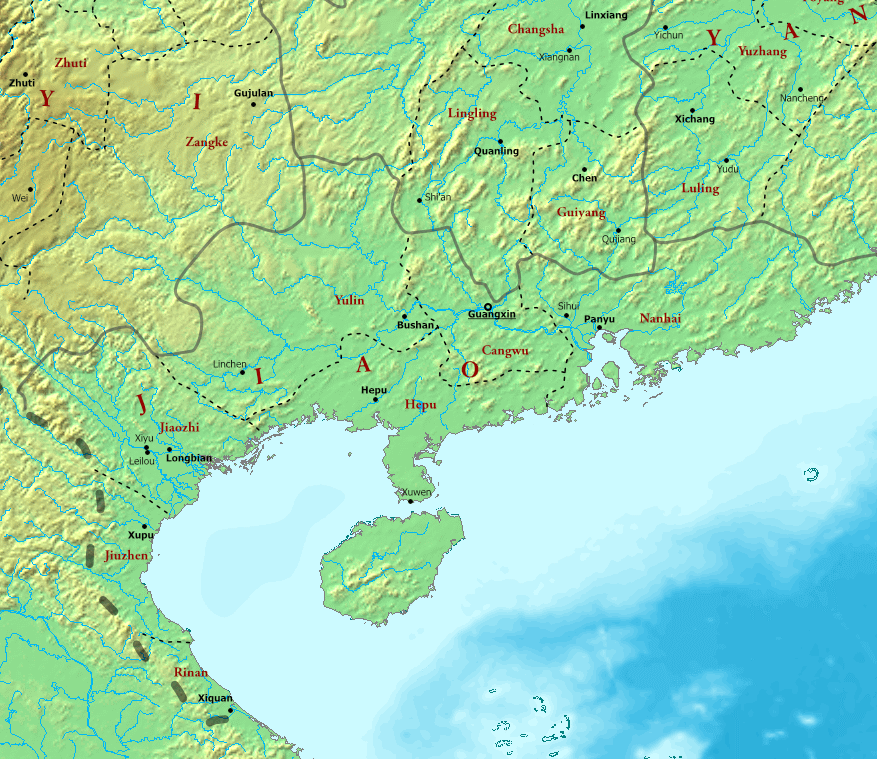
Emperor Guangwu then issued an edict commanding Changsha, Hepu, and Jiaozhi commanderies to prepare carriages and boats, repair the roads and bridges, open up mountain passes, and store up grain supplies. In the eighteenth year (42 CE), he dispatched the Wave-quelling General, Ma Yuan, and the General of Tower Ships, Duan Zhi, to mobilize more than ten thousand troops from Changsha, Guiyang, Lingling, and Cangwu commanderies to attack the rebels.7 In the summer of the following year, during the fourth month, Ma Yuan captured Jiaozhi and beheaded Zheng Ce, Zheng Er, and other [rebel leaders], and the remaining rebels all surrendered or dispersed. He advanced further to attack the Jiuzhen rebel Duyang and others, defeating them and receiving their surrender.8 He resettled more than three hundred of the local chiefs in Lingling commandery.9 As a result, peace and order were restored to the Lingnan region.
…
3. From “Account of the Southwestern Barbarians”
The Ailao barbarians are descended from a woman named Shayi who lived on Mount Lao. Once, she was fishing in a river and bumped into a log in the water. She had a strange sensation and became pregnant. Ten months later, she gave birth to ten sons. She went back to the sunken log, which transformed into a dragon and rose out of the river. Shayi suddenly heard the dragon speaking: “You bore sons for me, where are they now?” Nine of the boys ran away in fear upon seeing the dragon. Only the youngest could not escape and sat with his back turned to the dragon. The dragon went over and licked him. In the mother’s bird-like language, the word for “back” is jiu and the word for “sit” is long, so she named this son Jiulong. After he grew up, his elder brothers elected him as their king, as he had been licked by their father and was the most intelligent. Later, a man and his wife living at the foot of Mount Lao had ten daughters, and Jiulong and his brothers married them. The numbers of their progeny gradually increased. The people of their kind all tattoo their bodies with dragon-scale patterns and have tails on their clothing.10 After Jiulong died, his descendants ruled as kings generation after generation, and also appointed junior kings. They usually live in towns dispersed among streams and valleys. Theirs is a remote land at the edge of the world, where the mountains are inaccessible and the rivers deep. From the time of the first human beings, it did not have contact with the Central Lands.
In the twenty-third year of the Jianwu era (47 CE), the [Ailao] king Xianli sent an army on rafts and boats down to the Yangzi River and Han River to attack the Luduo barbarians, who were our frontier vassals. The Luduo, being weaker, were captured, but just then a thunderstorm broke out and the south wind rose. The river flowed backwards, rushing for a distance of more than two hundred li, and the rafts and boats all sank. Several thousand men in the Ailao army drowned. Xianli next sent six of his kings with ten thousand men to attack the Luduo. The Luduo king fought them and killed all six kings. The elders of the Ailao buried the six kings, but in the night tigers dug up their bodies and ate them. The rest of the army fled in shock and fear. Xianli was terrified and said to the elders, “We have raided the frontier since ancient times, but now when we attack the Luduo, we are immediately punished by Heaven. Is this because the Central Lands have a sagely emperor? How clear it is that Heaven is protecting and helping him!” In the twenty-seventh year (51 CE), Xianli led his people (2,770 households, 17,659 individuals) to surrender to Zheng Hong, the governor of Yuesui commandery (Xichang, Sichuan), and request to come under imperial rule. Emperor Guangwu formally appointed Xianli and the other [Ailao kings] as chiefs over their people. From that time on, they began paying tribute annually.
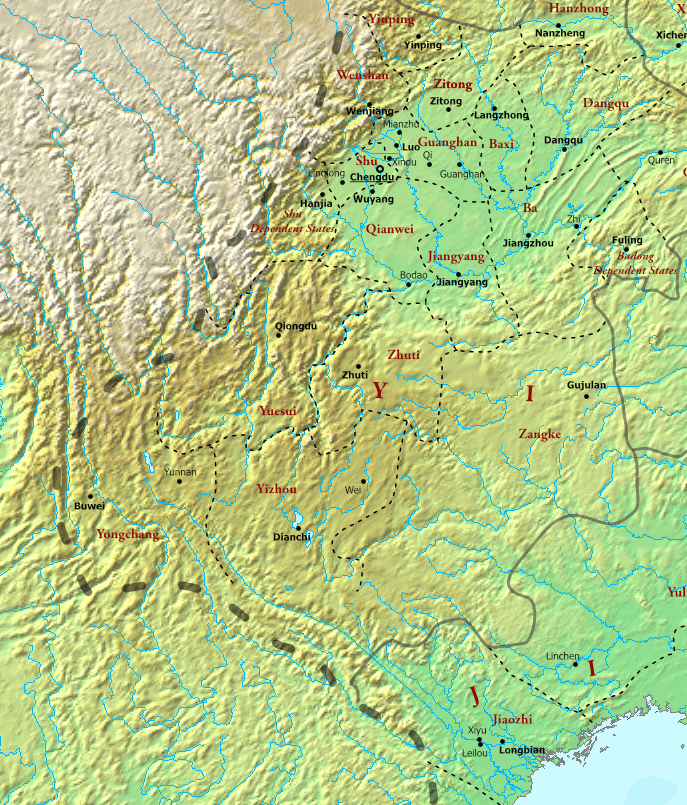
In the twelfth year of the Yongping era (69 CE), the Ailao king Liumao sent his son to lead their people to submit to imperial rule. Their kind consisted of 77 kings of towns, 51,890 households, and 553,711 individuals.11 Their kingdom was seven thousand li to the southwest of Luoyang. Emperor Xianzong (Emperor Ming, r. 57-75) established two counties, Ailao and Bonan, on their land, and carved out six counties from Yizhou commandery (Kunming, Yunnan) that had been under the authority of the Commandant of the Western Division12, combining them with the two new counties into Yongchang commandery. The empire began establishing a transportation route across the Bonan Mountains and the Lancang (upper Mekong) River, but travelers on the route found it arduous13, and sang:
The Han’s moral charisma has spread afar,
Bringing new countries to submission.
We cross the Bonan
And ford the Lancang,
But crossing the Lancang
Is for others, not ourselves.
The Ailao people all wear rings in their noses and use earrings to lengthen their earlobes. Their chiefs, who call themselves kings, all have earlobes that extend three inches below their shoulders. Commoners’ earlobes only extend down to their shoulders. Their land is fertile and suited to growing grains and mulberry trees for rearing silkworms. They know how to dye and embroider their cloth, make clothing out of wool, fur, silk, and cotton, and weave fine cloth in the langan 蘭干 style, with patterns similar to twill and brocade. They spin wutong bark fibers into cloth, each sheet as much as five feetin width; this cloth is pure white and does not stain. They first use it to cover the bodies of the dead and then wear it themselves. Their bamboo has joints ten feet apart, and it is called pu bamboo. They produce copper, iron, lead, tin, gold, silver, amber, crystal, opaque glass, cowries, freshwater pearls, peacocks, kingfisher feathers, rhinoceroses, elephants, monkeys, and tapirs.14 ….
Previously, Zheng Chun, the Commandant of the Western Division, was honest and uncorrupt in his administration and was able to civilize the barbarians (Yi-Mo). The chiefs admired his virtue and all offered up their valuable native products, singing his praises. The emperor commended him and appointed him as governor of Yongchang. Zheng Chun made an agreement with the Ailao barbarians, under which the leaders of each town would submit two tunics and one hu 斛 of salt annually as their regular tax.15 The barbarians were content with this. Zheng Chun served as Commandant and Governor for ten years and died in office.16 In the first year of the Jianchu era (76 CE), the Ailao king Leilao got into a dispute with the [Ailao] county magistrate.17 He killed the magistrate and rebelled, attacking the capital of Suitang county.18 The [new] governor Wang Xun fled to Yeyu county (Xizhou, Dali, Yunnan).19 More than three thousand Ailao men attacked Bonan county and burned down the homes of [Han] commoners (i.e., settlers). Emperor Suzong (Emperor Zhang, r. 75-88) issued a recruiting call for nine thousand barbarian and Han troops in Yuesui, Yizhou, and Yongchang commanderies to go on a punitive expedition. In the spring of the following year (77 CE), Lucheng, a Kunming barbarian from Xielong county (Weishan county, Yunnan), answered the recruiting call and led his clan and the troops from the commanderies to attack Leilao at Bonan. He routed and killed Leilao and sent his head to Luoyang. The emperor rewarded Lucheng with ten thousand bolts of silk and ennobled him as Caitiff-Defeating Subsidiary Town Noble.
[Translator’s note: The rest of the Hou Hanshu entry on the Ailao lists tribute missions from other “barbarian” peoples “beyond the frontier” (jiaowai 徼外) in 94-120 CE, but says nothing about the subsequent history of the Ailao. This silence implies that the punitive expedition of 77 CE marked the end of Ailao’s royal dynasty, and that the Ailao people were then annexed to direct Han rule and subject to the regular taxation regime.]
- Yelang was a kingdom in modern Guizhou. In fact, it had been invaded and annexed by the Han empire in 27 BCE after rebelling against Han suzerainty, so this narrative’s account of Yelang’s submission is disingenuous. ↩︎
- This is an alternative interpretation of the Liji document “Wangzhi” (The True King’s Institutions) (see source 1.6), where jiaozhi was written as 交趾 and most likely meant “pigeon-toed.” ↩︎
- The insinuation seems to be that Man men and women engaged in sexual activity while bathing together, and that the region of Jiaozhi was named after this practice. ↩︎
- Hepu commandery was in a part of modern Guangxi adjacent to north Vietnam. ↩︎
- The phrasing here is ambiguous; it could also mean that the Trưng sisters set themselves up as kings. ↩︎
- Jiaozhi circuit (or province) encompassed the commanderies of Jiaozhi, Jiuzhen, Rinan and four commanderies in the adjacent regions of Guangxi and Guangdong. The regional inspector’s role was to tour the circuit’s commanderies and report on the work of the governors. ↩︎
- These commanderies were located in modern Hunan, Guangdong, and Guangxi. Ma Yuan’s biography in the Hou Hanshu states that Duan Zhi died of an illness at Hepu commandery, en route to Jiaozhi, after which Ma Yuan assumed command of his fleet. ↩︎
- Ma Yuan’s biography in the Hou Hanshu states that the expedition against Duyang included over two thousand warships of various sizes and over twenty thousand troops. It killed or captured more than five thousand rebels. ↩︎
- Lingling was located in southern Hunan. ↩︎
- Li Xian’s commentary to the Hou Hanshu notes that the Ailao origin myth is first recorded in Ying Shao’s second-century Fengsu tongyi (see source 1.10). ↩︎
- This was a much larger population than the one under Xianli, suggesting that Liumao had used the prestige gained from recognition by the Han emperor to unify many more Ailao communities under his authority. Liumao may have hoped to achieve an even greater consolidation of local power by seeking closer association with the Han empire, but this strategy backfired under his successor Leilao. ↩︎
- In the Han empire, larger frontier commanderies were divided into a western division and an eastern division, each under a commandant who assisted the governor with military affairs and law enforcement. ↩︎
- The transportation route was meant to bring Han officials, troops, and settlers to Yongchang. The “travelers” here were apparently traveling the route on official orders, rather than voluntarily. ↩︎
- Some of these commodities probably came to the Ailao through trade with South Asia and Southeast Asia. ↩︎
- A hu was a unit of measurement equivalent to ten dou 斗 (pecks). ↩︎
- The ten years evidently includes his term as Commandant of the Western Division of Yizhou before 69 CE, since he had died by 76 CE. ↩︎
- It is strongly implied that the magistrate had tried to increase the Ailao people’s tax burden above that agreed upon with Zheng Chun. ↩︎
- Suitang was in modern Yunlong county, Yunnan, and was also the capital of Yongchang commandery. It had previously been the headquarters of the Commandant of the Western Division of Yizhou. ↩︎
- Yeyu was one of the six counties that had been merged into Yongchang commandery in 69 CE. ↩︎
 Ethnic Identity in Imperial China
