
Liu Kezhuang (1187–1269), a noted Southern Song poet and statesman, probably wrote this essay after retiring to his hometown in Putian, Fujian province in 1264. It is one of the earliest extant sources on a people known as the She who lived in the mountains of Fujian, Guangdong, and Jiangxi. The essay was composed for a commemorative inscription honoring Zhuo Deqing (1206-1277), an official who succeeded in pacifying a She rebellion in Zhangzhou, Fujian. The story of the She revolt is a familiar one in which Chinese fugitives and migrants bolstered their numbers and skills, while Chinese encroachment on their interests and livelihoods provoked them to violent resistance. Also familiar is the combination of military action (or threat thereof) and conciliation and co-optation used to induce the She to submit.
For an in-depth discussion of the history of the She and their controversial relationship with the Hakka people, see Wing-Hoi Chan, “Ethnic Labels in a Mountainous Region: The Case of She ‘Bandits’”, in Pamela Kyle Crossley, Helen F. Siu, and Donald S. Sutton (eds.), Empire at the Margins: Culture, Ethnicity, and Frontier in Early Modern China (Berkeley: University of California Press, 2006), Chapter 9. Although the Hakka are today classified as a subgroup of the Han Chinese, while the She are classified as a separate ethnic group, this distinction is quite arbitrary, as the languages spoken by the two groups are closely related. Perhaps the most important distinction is that the She share the Yao origin myth of descent from Panhu, while the Hakka claimed descent from Chinese migrants from the north.
~~~~~
Ever since our dynasty moved its capital to the lower Yangzi region1, Min (Fujian) has been called a part of the imperial core, and Zhangzhou is the core region of Min. Its people are honest and their lives are simple; theirs is a happy land. Yet since the Jianyan (1127-1130) and Shaoxing (1131-1162) eras, troops have always been stationed here, and this is clearly because its territory is connected to the mountain valley settlements (xidong 溪洞), filled with reeds and rushes and dense thickets that obstruct passage, with prefectural subjects and Mountain Yue2 often living mixed together. The previous emperors were farsighted indeed in recognizing the danger and taking precautions against it. The peoples of the settlements are of different kinds (zhonglei 種類): there are Man, and Yao, and Li, and Dan, but those in Zhangzhou are called She 畲.3
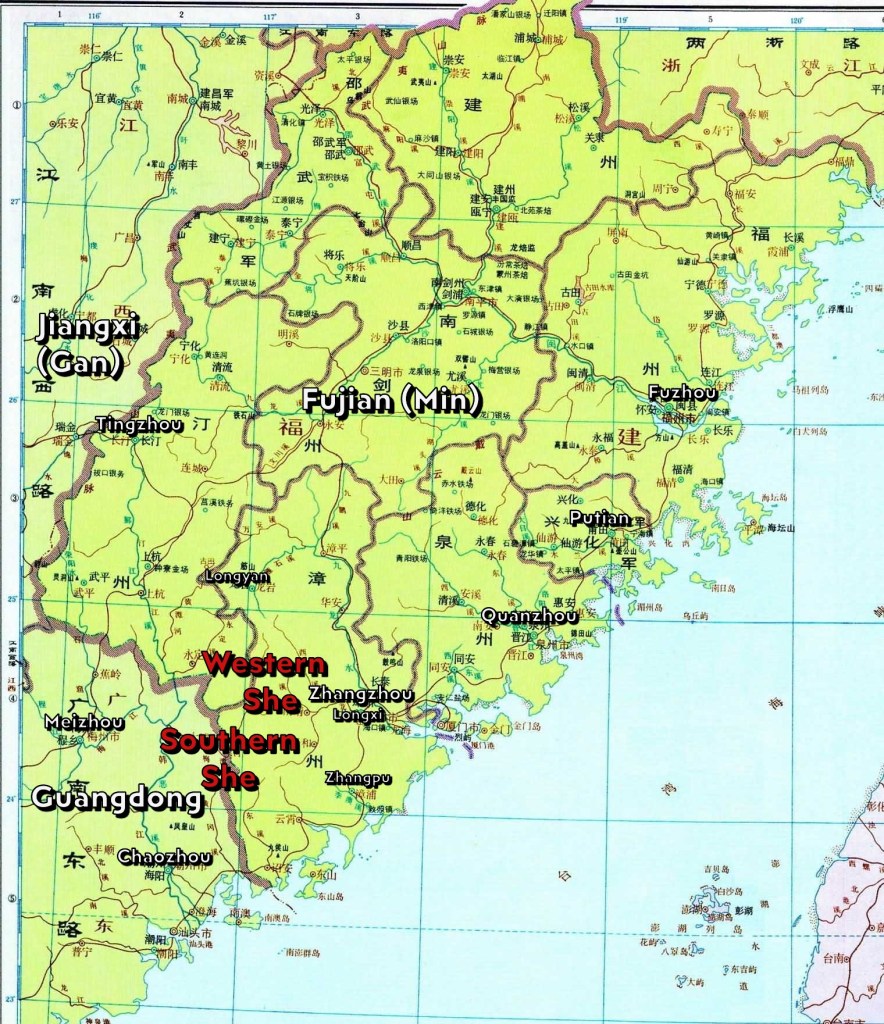
The western She are under the jurisdiction of Longxi county (Longhai, Zhangzhou), and are treated as people of Longxi. The southern She are under the jurisdiction of Zhangpu county, and their land connects to Chaozhou and Meizhou in the west and to Tingzhou and Gan 赣 (Jiangxi) in the north.4 It is a den for scoundrels and fugitives [from all these places]. The She people’s special skills [in war] were once limited to poisoned arrows, but bandits from Tingzhou and Gan took refuge with the She and taught them how to fight at close quarters. As a result, the harm done by the southern She is especially great. The two kinds of She practice slash and burn cultivation, living on cliffs and in valleys, like climbing monkeys and crouching mice. Rulers of states govern them through non-governance.5
The She people have a long history of not doing corvée labor or paying taxes on their farmland. Later on, the rich and powerful began intruding on their territory, and rapacious profit-seeking merchants began to compete with them for resources. Officials also began levying their local products, such as beeswax, tiger skins, and monkey pelts. The She people could not bear this and sought redress from the prefecture, but were ignored. They then gathered into mobs, occupied the strategic heights, and raided and pillaged the lands under state jurisdiction.
In the twelfth month of the renxu year (January-February 1263), the former prefect of Zhangzhou, Marquis Enze6, took office with great enthusiasm, but failed to perform his duties well. In the autumn of the following year, he was dismissed. Two deputies assumed responsibility for the prefecture one after the other, but the raids intensified until they got within twenty li of the city walls. The prefecture was in great peril. The provincial governor deployed soldiers from various stockades, as well as Chen Jian, the commander of the Left Wing Army [of Zhangzhou], and Xie He, the general of the Left Wing Army of Quanzhou, to combine their units and exterminate and capture [the bandits]. But they achieved only two victories. The bandits retreated temporarily but continued to raid at will, such that no one dared to travel within an area several hundred li across.
The situation was reported up to the imperial court, which appointed a new prefect. The man chosen for this task was the Editorial Director and Vice Director of the Left Section [of the Ministry of Revenue], Lord Zhuo. When the edict was issued, someone asked him, “You, sir, placed first in the civil service examinations and have a fine reputation. When you served as prefect of a major city, the people missed you after your term ended.7 But now you are tasked with resolving a crisis and ending a conflict. Are you able to do that?” He sighed and said, “This is the emperor’s command, so how can I avoid it?”
When Lord Zhuo arrived [at Zhangzhou], the city was deserted, while the countryside was full of [bandits wearing] red headscarves. The state of siege had dragged on for a long time, and men of intelligence and courage were exhausted. Lord Zhuo issued an announcement at the foot of the mountains, saying: “The She people are my people as well. I will not pursue events of the past and will give them a chance to reform their ways. Among them are men who are literate, and local people who have been captured by the She, and if they can come and submit on their own accord, they will be given a place to stay and live in peace on this land.8 If a She chief is able to lead his followers to submit, he too will be appointed to a regular official post. But if they do not repent, then I will send a large army against them and will not stop until I have destroyed all their nests and dens.”
He ordered Chen Jian to go among the She and communicate this to them. Within five days of the announcement being made, the She chief Li De surrendered. Li De was the most inconstant and crafty of the chiefs, and so the nine chiefs of the western She all accepted the invitation to submit. Once the west was pacified, he focused his attention on the south, ordering the commander Peng Zhicai to exterminate and capture the bandits, and the County Secretary (zhubu 主簿) of Longyan, Gong Tang, to persuade them to surrender. Using this dual strategy of capture and persuasion, Peng Zhicai achieved three victories, while Gong Tang went deep into She territory (Lord Zhuo also selected the jinshi graduates Zhang Jie, Zhuo Du, Zhang Chunsou, and Liu […]9 to go with him.) More than thirty of the southern She chiefs, whose followers totaled more than three thousand households, agreed to become registered subjects. The two kinds of She were thus pacified, and only then did the people of Zhangzhou know the joy of living.
I have read the documents of surrender from the various She, and some of them claim to be descendants of Panhu.10 How could these She have read Fan Ye’s history (the Hou Hanshu) to know that their ancestor was Panhu? They must have learned this from Hua people.11 Is this not also a result of our lax enforcement of bans on travel to the settlements? …
Lord Zhuo, when speaking with me about the She revolt, always said, “They were provoked [into rebelling]; this was not their original heart.” Alas! Is this idea of returning to the original [heart] not the reason why he could gain the submission of the She? … Lord Zhuo was named Deqing, his style name was Shanfu, and he was a man of Puyang (Putian).12
- After losing north China to the Jurchen Jin empire in 1127, the Song dynasty relocated its capital to the lower Yangzi, with its capital in Hangzhou after 1138. ↩︎
- “Mountain Yue” 山越 was a term that the third-century Sun Wu state used to label various mountain communities within its territory that resisted its authority. Liu Kezhuang uses it anachronistically here to refer to the upland indigenous people of Fujian. ↩︎
- The word she means swidden (slash and burn) cultivation in Chinese, and appears to be an exonym. The She people’s name for themselves in the Song period is not known; the She of today call themselves Shanha 山哈, which means “Mountain Guests” in their language (generally classified as a dialect of Hakka). ↩︎
- The southern She were probably connected to Tingzhou (and indirectly to Jiangxi) through the Ting River, to Meizhou through the Mei River, and to Chaozhou through the Han River (of which the Ting and Mei were both major tributaries). ↩︎
- This alludes to a famous line from Su Shi’s essay “Wangzhe buzhi Yi-Di lun” (On “The True King Does not Seek to Govern the Barbarians”); see source 3.4. ↩︎
- This was Xie Yimao, who served as prefect in 1263-1264. ↩︎
- We know from other sources that Zhuo passed the examinations in 1232, and had previously served as magistrate of Dexing county in Jiangxi. ↩︎
- Zhuo Deqing was effectively offering amnesty to the Chinese fugitives who had joined the She. ↩︎
- There is a lacuna in the text, which suggests that one of Liu Kezhuang‘s sons or grandsons was part of this party, but Liu omitted his full name out of modesty. ↩︎
- See source 5.3. ↩︎
- For the Hou Hanshu, see source 5.2. Its account of Panhu is essentially the same as that in the earlier Soushen ji, though slightly less detailed. Liu Kezhuang’s assumption that the She could only gain knowledge from books (a typical attitude of the Chinese literatus) ignores the possibility that oral traditions about Panhu had been transmitted among the Man or Yao peoples for centuries, and that the She were descended from one of these groups that migrated to Fujian. ↩︎
- A local gazetteer of Putian states that Zhuo Deqing was posted to Zhangzhou after offending the powerful chancellor Jia Sidao, and was recalled to the capital after pacifying the She. He resisted the Mongol conquest of Fujian, and was captured and executed in Putian in 1277. ↩︎
 Ethnic Identity in Imperial China