
The Songshu is an official history of the fifth-century Song dynasty (420-479) in south China, typically referred to as Liu Song (Liu 劉 being the surname of its emperors) to differentiate it from the later and longer-lived Song dynasty of 960-1276. The author of the Songshu, Shen Yue (441-513), was a prominent scholar who served the Liu Song, Southern Qi (479-502), and Liang (502-557) dynasties in succession.
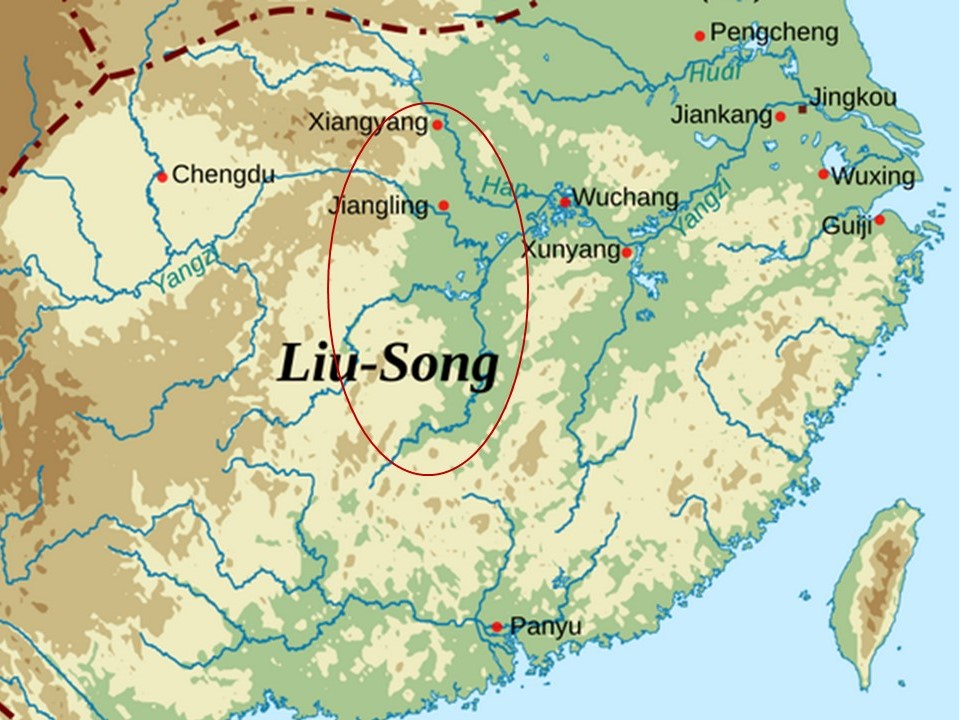
During the Eastern Han period, the Man of the Five Rivers (see source 5.3) periodically rebelled and attacked Chinese towns and cities, forcing the Han state to mobilize armies against them. The Hou Hanshu (see source 5.2) records the causes of these revolts in two cases (115 and 136 CE), both of which show that the trigger was the Han imperial state’s attempts at subjecting the Man to the same obligations in taxation and corvée labor as Han subjects, contrary to the customary practice of exempting them from taxes. The Songshu excerpts translated below show that this tense dynamic continued into the fifth century, expanding westward and northward from Hunan into Hubei, where Man populations had also settled. The scale of resistance even increased as many Chinese people fled to the mountains and joined the Man as a means of evading harsh taxation. When the Man rebelled and raided the Chinese settlements (framed by the imperial state as “banditry”), they would capture even more Chinese settlers to use as slaves. But they, too, risked being enslaved in the thousands when defeated and captured by the better armed and coordinated imperial forces. The excerpts from the biographies of generals Liu Yuanjing and Shen Qingzhi illustrate the kinds of tactics and strategies that Liu Song armies used to defeat Man revolts.
~~~~~
- From “Account of the Yi and Man”
The Man of Jingzhou and Yongzhou provinces are descendants of Panhu.1 They are divided into clans and settlements (zhongluo 種落) and dispersed among the commanderies and counties. The Commandant of the Southern Man in Jingzhou and the Commandant for Pacifying the Man in Yongzhou were established to manage them.2 During the reign of Emperor Shizu (Emperor Xiaowu of Liu Song, r. 453-464), the Commandant of the Southern Man was abolished and merged into the regular prefectural bureaucracy. Man subjects (min 民) who have submitted [to imperial rule] pay several hu 斛 of grain per household and are not subject to any additional taxes.3 Regular [Liu} Song subjects, on the other hand, suffered from heavy burdens of taxation and corvée, and as a result many impoverished subjects who could no longer bear such burdens fled and joined the Man.
The Man do not owe corvée labor, and the powerful ones among them do not pay taxes to the state. They form bands that can quickly grow to several hundred or a thousand men in size. When the prefectures and commanderies are too weak [to control them], then they rise up as bandits (i.e., rebel). Their clans and chiefdoms (zhonglei 種類) are quite numerous, and the size of their population cannot be known. They mostly dwell deep in the inaccessible mountains. Those who reside in Wuling include the Man of the Xiong River, the Man River, the Chen River, the You River, and the Wu River; these are collectively called the Man of the Five Rivers. As for the Man of Yidu, Tianmen, Badong, and Jianping commanderies, north of the Yangzi River, they all live deep in the mountains, behind many barriers of difficult terrain, where people rarely venture. Since ages past, they have repeatedly been a threat to the people (min 民, i.e., imperial subjects)….
Zong Qiaozhi, the magistrate of Louzhong county in Tianmen commandery, imposed overly heavy levies of corvée labor and taxation, and the Man could not bear them. In the eighteenth year [of the Yuanjia era (441), the Man [leader] Tian Xiangqiu and others engaged in banditry and overran Louzhong, taking imperial subjects (baixing 百姓) as captives. Liu Yiji, the Prince of Hengyang and governor of Jingzhou, sent his Acting Advisor Cao Sunnian to attack and defeat them, capturing and enslaving more than five hundred.
In the twenty-fourth year (447), the Man of Linju and Dangyang counties in Nan commandery rebelled and captured the magistrate of Linju, Fu Sengji, tying him up. The governor of Jingzhou, Liu Yixuan the Prince of Nanqiao, sent the Chief Army Advisor Wang Zhan to attack and defeat them.
Previously, the governor of Yongzhou, Liu Daochan was skilled at building good relations with the Man groups. Those who had not accepted the authority of the state all submitted one after another, and all were induced to move [from the mountains] to the plains, mostly settling along the Mian River (i.e., the Han River). When Daochan died [in 442], the Man again rebelled. Shizu was sent out as [governor of] Yongzhou [in 445], and the Man cut off the [postal] road, but he attacked and routed them.4 The imperial court sent the general Shen Qingzhi to attack the Man for several years, and he suppressed and exterminated them wherever he campaigned. The details are found in Qingzhi’s biography.5 …
Liu Dan, the Prince of Sui, also sent troops to attack the Man groups north of the Mian River.6 They carried out raids on the stockades (chai 柴) of Zhuoshan, Rukou, and Shusong, capturing all three, and also besieged other stockades including Shengqian and Baiyi.7 The Man fought back with all their strength. Our army used armored horses to shoot arrows on them from both sides and thus routed them.8 Two hundred [Man] heads were taken, and a thousand Man were captured alive, as well as eighty cattle and horses.
During Emperor Shizu’s Daming era (457-464), the Jianping [commandery] Man [leader] Xiang Guanghou raided the Yangzi River gorge.9 The prefect of Badong, Wang Ji, and the governor of Jingzhou, Zhu Xiuzhi, sent armies to attack him, and Guanghou fled to the Qing River. The Qing River is more than a thousand li from Badong.10
At that time, the Man in the four commanderies of Badong, Jianping, Yidu, and Tianmen were engaged in banditry, and the subject households (minhu 民戶) of these commanderies dispersed as refugees. Not even one household out of a hundred was left. It was especially bad during the reigns of Taizong (Emperor Ming, r. 465-472) and Emperor Shun (r. 477-479). Even though armies were sent against [the bandits], they could not put a stop [to the banditry] in the end. Jingzhou was reduced to poverty and exhaustion as a result.
2. From the biography of Liu Yuanjing
Previously, Liu Daochan had implemented generous policies [as governor] in Yongzhou, and the distant Man all submitted to his embrace. All came out [of the mountains] and settled along the Mian River in villages, and their populations grew large. When Daochan died [in 442], the Man groups engaged in large-scale banditry and violence. When Shizu was sent to garrison Xiangyang [as governor of Yongzhou], Liu Yigong appointed Liu Yuanjing as a commanding general, with the posts of General for Extending Awe and prefect of Sui commandery.11 When he arrived [in Yongzhou], the Man had cut off the postal road and were planning to attack the commandery. The commandery had little grain left and was also short of weapons. Yuanjing formulated a strategy and recruited six to seven hundred soldiers, five hundred of whom he assigned to guard the postal road. Some said, “The Man are about the threaten the city [of Xiangyang], so we shouldn’t divide our forces.” Yuanjing replied, “When the Man hear that the commandery has deployed a strong garrison [to the postal road], how would they realize that there are few troops left in the city? Moreover, a combined attack from within and without is the best strategy.” Later, when the Man were about to arrive, he ordered [the troops] on the postal road to stand ready and then led [the other troops] to maneuver secretly and get behind [the Man]. He issued the order: “When you see torches raised, charge at the enemy.” The front and the rear attacked in concert, and the Man army panicked. More than a thousand fell into the Yun River and drowned. Several hundred were beheaded or captured. Throughout the commandery, [the Man] were cowed into submission and no longer engaged in banditry and raiding.
3. From the biography of Shen Qingzhi
In the nineteenth year of the Yuanjia era (442), the governor of Yongzhou, Liu Daochan died, and the Man groups rose up in a great revolt. Zhu Xiuzhi, the Commander for Western Expeditions, attacked the Man but was defeated. Shen Qingzhi was appointed as General for Establishing Awe and led his army to reinforce Zhu Xiuzhi. Zhu Xiuzhi failed to enforce discipline in his army and was jailed for it. Qingzhi then assumed sole command of the army and advanced to attack. He routed the Man groups living along the Mian River and took seven thousand prisoners. He advanced to Huyang and captured another ten thousand or more….
He was appointed to serve Shizu, then General for Encouraging the Army, as Chief Army Advisor.12 When Shizu was appointed governor of Yongzhou [in 445], Qingzhi followed his headquarters in its westward journey [to Xiangyang]. At the time, the Man bandits were rampant and both river and land transportation had been obstructed. Shizu halted at the Great Dyke and could not advance further. He divided his forces and sent Qingzhi to lead a surprise attack [on the Man], which routed them. Twenty thousand of them surrendered. Shizu arrived at his garrison (i.e., Xiangyang), but the Man on the postal road rebelled and killed Shen Shi13, so he sent Qingzhi to attack them again. He was joined by Wang Xuanmo, commanding troops from Jingzhou, and Wang Fanghui, commanding troops from the imperial capital. They pacified the mountains and took more than seventy thousand prisoners. The Man of the Yun Mountains were the strongest, and Lu Zongzi attacked them repeatedly without success. Qingzhi pacified them and captured more than thirty thousand. He returned to the imperial capital and was appointed as Chief Army Advisor under Liu Dan, Prince of Guangling and General of the Northern Imperial Guards. He further received the posts of General for Establishing Awe and prefect of Southern Jiyin commandery.
The Man of Yongzhou again engaged in banditry. Qingzhi, holding the ranks of general and prefect, again accompanied Liu Dan, Prince of Sui, to the Mian River region.14 When they arrived at Xiangyang, he led more than twenty thousand troops including Liu Yuanjing (the Chief Army Advisor to the General of the Rear), Zong Que (the prefect of Sui commandery), Liu Yong (the General for Inspiring Awe), Lu Shangqi (the Advisor to the Minister of Works), Gu Bin and Ma Wengong (Advisors to the General for Pacifying the North), Xiao Jingsi (Chief Army Advisor to the General of the Left Army), Cui Mulian (former Administrative Aide of Qingzhou prefecture), Liu Yongzhi (Advisor to the General for Pacifying the Man), and Wang Jingshi (the General for Invigorating Awe) on an attack on the Man of the mountains north of the Mian River.15 Zong Que advanced to Mount Taihong via the Xin’an Road. Liu Yuanjing occupied Five Rivers Ridge by advancing from the Jun River. Ma Wengong marched out from Caiyangkou and captured Chixi Fort. Wang Jingshi advanced down from Mount Yan toward Chiqi Slope. The armies under Cui Mulian and Lu Shangqi advanced simultaneously along eight routes. Shen Qingzhi captured Wuqu and Dunpo forts, serving as the overall commander of these armies.
Previous campaigns against the Man had all encamped at the foot of the mountains to approach them, so the Man were able to use the mountains as their defensive barrier and rain arrows and rocks down on the attackers. For this reason, the campaigns repeatedly failed. Qingzhi assembled the armies at the foot of Mount Ruqiu and told them, “If we now raise our banners around the mountains and attack them, we will surely lose many troops and horses. Last year, the Man fields had a bumper harvest, and they have accumulated large stores of grain in the mountains. They have not suffered from hunger or exhaustion, so it will be difficult to capture and eliminate them. Now, I order you to each lead your troops to encamp in the mountains. Caught by surprise, the Man are sure to become fearful, and we can then exploit their fear and capture them without fighting.” Thus, the armies all hacked out paths into the mountains but did not fight the Man. They went up the mountains, beating their drums and yelling, driving straight for the “stomach and heart” (i.e., home base) of the Man, and preemptively occupying strategic terrain. The Man were shocked and thrown into confusion. The armies then exploited their fear and surrounded them, and all collapsed in retreat. From winter into spring, the troops lived off grain captured in the Man valleys.
Soon afterwards, Tian Yansheng, a Man leader from Nanxin commandery, led more than six thousand of his followers in a revolt, attacking and surrounding the commandery capital. Qingzhi sent Liu Yuanjing to relieve the city with five thousand men. Before the troops arrived, the commandery capital fell, and the Man burned down all the storehouses and offices in the city. They also took the captured households [from the city] to their base on Mount Baiyang. Yuanjing pursued them to the foot of the mountain, and the various armies assembled and encircled the mountain in multiple layers. Zong Que, commanding his troops, charged first, and the other armies launched a furious attack together. They routed the Man, striking awe in the other mountains, and the various Man groups all kowtowed in submission.
Qingzhi was prone to migraines and liked wearing a fox skin hat [to keep his head warm]. The Man hated him and called him “Old White Head” (cangtou gong 倉頭公). Whenever they saw Qingzhi’s army, they would immediately become terrified and say, “Here comes Old White Head again!”
Qingzhi led his armies from Mount Ruqiu to Jiancheng and routed the [Man of the] various mountains. Three thousand Man were beheaded, more than 28,000 were captured alive, and 25,000 surrendered. Also taken were more than seven hundred cattle and horses and more than 90,000 hu of rice and millet. Liu Dan, Prince of Sui, had two cities, called Naxiang (Accepting the Surrendered) and Shoufu (Receiving the Captives), built at Baichu.16
Qingzhi next led his armies to attack the “Dog and Sheep” Man of Mount Xinzhu. He built several layers of forts along the strategic heights, with very tall watchtowers at the gates. There was an abundance of lumber and rocks on the mountain, which the troops gathered and stacked into ramparts. Qingzhi established new military units, issued banners to them, and appointed commanders over them. There was a large host of iron-clad horses (armored cavalry). Qingzhi established a network of camps on the mountain, so well-connected that one could walk from one camp gate to the next. He also ordered the armies to dig ponds in each camp so that they need not leave their camps in search for water at any time. This was also a countermeasure against the Man using fire [to attack the camps]. Soon after, the wind grew strong and the Man came down from the mountain at night, each man carrying a torch to set fire to the camps. The camps had many tents and thatched huts, but when they caught fire, the flames could immediately be extinguished using water from the ponds. Many of the troops took out bows and crossbows to shoot at the Man from every side, and the Man dispersed and fled. Qingzhi ordered the armies to hack out paths in the mountain and attack the Man, but the mountain was tall and the roads were treacherous, especially with the heavy summer rains. Therefore he established six garrisons (named Eastern Ridge, Shu Mountain, Good for the People, Western Stockade, Yellow Fort, and Upper Mound) and withdrew. The Man, after being besieged for many days, became hungry and demoralized, and they gradually came out and surrendered.
The Man that Qingzhi captured in his various campaigns were all resettled in the imperial capital as camp households (yinghu 營戶).17
- Jingzhou prefecture was located in southern Hubei, centered on the city of Jiangling (also known as Jingzhou). Yongzhou prefecture was located in the lower Han River valley in northern Hubei, centered on the city of Xiangyang. On Panhu, see source 5.3. ↩︎
- The Commandant (xiaowei 校尉) system began in the Han empire as military units specializing in managing frontier peoples and, if need be, suppressing their revolts. The Commandant of the Southern Man was established by the Western Jin dynasty in 265-274 and originally headquartered in Xiangyang, but moved to Jingzhou in the 300s. It was abolished by the Liu Song in 454-456, but briefly reestablished by the Southern Qi in 479-481 and 494-498. The Commandant for Pacifying the Man was established by the Eastern Jin dynasty in the early 400s and had its headquarters in Xiangyang. ↩︎
- A hu was a unit of measurement equivalent to ten dou 斗 (pecks). This was a relatively light rate of taxation, but does indicate that the Man had accepted a partial loss of tax-exempt status over time. ↩︎
- At this time, the future Emperor Xiaowu (Shizu) was the fifteen-year-old Prince of Wuling and had been appointed as both governor of Yongzhou and the Commandant for Pacifying the Man. The postal roads (yidao 驛道) were vital transportation routes for couriers and armies, so the Man could cut Yongzhou off from communications, military reinforcements, and supplies from other prefectures by seizing control of the postal road. ↩︎
- The relevant excerpt from Shen’s biography is translated below. ↩︎
- Liu Dan served as governor of Yongzhou in 449-451. ↩︎
- These were forts with wooden palisades that the Man had built for self-defense in their mountain strongholds. ↩︎
- Heavily armored cavalry were a key element of warfare in this period, especially in north China. Here, the Man are killed or wounded by mounted archers closing in and showering arrows on the stockade, and are unable to return fire effectively because the Liu Song cavalrymen and their horses are protected by armor. ↩︎
- This was probably the Qutang Gorge of the Yangzi, located in Badong commandery, corresponding to modern Fengjie. ↩︎
- This detail accentuates the Man peoples’ ability to traverse long distances even in rough terrain. ↩︎
- Liu Yigong, Prince of Jiangxia, was then the governor of Jingzhou and had employed Liu Yuanjing as a military advisor. ↩︎
- The future emperor Shizu was appointed General for Encouraging the Army in 444. ↩︎
- The text may be corrupt here, as the unconventional name Shen Shi 深式 is not found anywhere else in the Songshu. ↩︎
- This was in 449, when Liu Dan was appointed governor of Yongzhou. Liu Dan’s princely title had just been changed from Prince of Guangling to Prince of Sui. ↩︎
- The long list of commanders serving under Shen Qingzhi illustrates the large scale and complexity of this operation. ↩︎
- These were presumably used to settle the captured and surrendered Man after their removal from the mountains. ↩︎
- In early medieval China, “camp households” were prisoners of war who were kept in a permanent state of servitude to the army, usually as agricultural laborers responsible for producing grain supplies for the troops. The imperial capital of Liu Song was in Jiankang (modern Nanjing), so the captured Man would probably have been transported in ships down the Yangzi River and settled in military farms near Jiankang, where they would produce grain for armies stationed in and around the capital. ↩︎
 Ethnic Identity in Imperial China
