
On Gan Bao and the Soushen ji, see source 4.37.
The tale translated below is the earliest extant complete written version of the myth of Panhu, a dog identified in Chinese ethnography as the progenitor of the Man peoples of south China. A similar version is recorded in the Hou Hanshu (see source 5.2), which is about one century later.
The Panhu myth appears to have originated from indigenous peoples of the Middle Yangzi region during the Han period, known to the Chinese as the Man of the Five Rivers (五谿蠻 or 五溪蠻) because they lived along five main tributaries of the Yuan River.1 A commentary to the Hou Hanshu by the Tang prince Li Xian (655-684) notes that the myth was recorded in Ying Shao’s second-century Fengsu tongyi (see source 1.10), though the relevant passage has not been preserved. The same commentary does preserve a fragment from the third-century Weilue that corresponds to the first part of the story (i.e., Panhu’s transformation from a cocoon extracted from an old woman’s ear into a five-colored dog). Two fragments attributed to Gan Bao’s contemporary Guo Pu show that an alternative version of the Panhu myth also existed in the fourth century: Rather than becoming the ancestor of the Man peoples, Panhu and his human wife were sent to settle an island in the sea east of Guiji (or Kuaiji) commandery. There, they established a kingdom where sons are born as dogs and daughters are born as beautiful girls.
The Panhu legend is at least partly responsible for the pervasive use, in pre-modern times, of the dog radical to write the ethnonyms of numerous southern indigenous peoples in the Chinese script.
~~~~~
In the time of Gaoxin2, there was an old woman who lived in the king’s palace. She had a ear infection for four seasons (a year), and a physician then used the extraction method to treat it. He extracted from her ear a head worm the size of a silkworm cocoon. After the woman left, she put the worm in a bowl made from a calabash, and covered it with a plate. Soon afterwards, the head worm transformed into a dog with five-colored patterns on its body. She named it Panhu (“plate and calabash”) and kept it as a pet.
At that time, the Rong Wu 戎吳 were militarily strong and repeatedly raided the border.3 Generals were sent on expeditions against them, but none could capture or defeat them. [The king (Gaoxin)] sent out a recruiting call promising that anyone who could take the head of the Rong Wu general would be rewarded with a thousand catties of gold, a fief of ten thousand households, and the king’s youngest daughter. Later, Panhu came to the king’s palace holding a head in his mouth. The king inspected it and found that it was the Rong Wu [general’s head].
The king’s ministers all said, “Panhu is an animal and cannot be appointed to an official post and salary; nor can he be given a [human] wife. Even though he has rendered meritorious service, he should not be rewarded.” The king’s youngest daughter heard of this and told the king, “You, great king, have promised me to the realm [as a reward]. Panhu came with the [general’s] head in his mouth, having eliminated a threat to our kingdom. It is Heaven’s will that caused this; how could it be due only to the intelligence or strength of a dog? The words of kings carry great weight, and hegemons take their trustworthiness seriously. You must not break a clear promise to the realm just because of a mere woman, as that would bring disaster to the state.”
The king was frightened and did as she said. He ordered his youngest daughter to go with Panhu. Panhu took the girl up into the southern mountains, which were densely forested and had no trace of human habitation. The girl then took off her blouse and skirt, tied her hair up like a servant, put on the clothing of a menial laborer, and followed Panhu up into the mountains and down into the valleys. They settled in a stone chamber (i.e., a cave).4 The king was sad and missed his daughter, so he sent men to go and look for her. When they arrived, suddenly there was a rainstorm, the mountains quaked, and the sky was darkened by clouds. They could go no further.
Within about three years, [the princess] bore six sons and six daughters. After Panhu died, his children paired up and married one another. They wove bark into cloth and dyed it with the juice of grass and fruits. They liked wearing five-colored clothing, and all their clothing designs included a tail. Later, their mother returned and told the king about them. The king sent emissaries to bring the sons and daughters to him, and this time there was no rainstorm.
[Panhu’s descendants] wear clothes with variegated colors.5 Their spoken language is an incomprehensible gibberish. They squat when eating.6 They like living in mountains and dislike living in cities. The king, accommodating their preference, granted them famous mountains and large marshes to live in and named them “Man-Yi” 蠻夷.
The Man-Yi are outwardly stupid but inwardly shrewd. They are attached to their homes and old customs.7 Because they have received unusual qi by Heaven’s will8, they are treated with extraordinary regulations: they may engage in agriculture and commerce without having to carry travel passes and tallies, nor do they have to pay taxes. They have village chiefs, all of whom are conferred seals and sashes of office [by the imperial court]. To make hats, they use otter skin to symbolize that they live a wandering life foraging for food along the rivers. The barbarians (Yi) of today’s Liang-Han and Ba-Shu regions and Wuling, Changsha, and Lujiang commanderies are all of this kind.9 They mix rice with fish and meat and put it in a feeding trough as an offering to Panhu, bowing and wailing; this custom has continued to this day. That is why we have the saying, “Red hips and wide skirts, these are the descendants of Panhu.”10
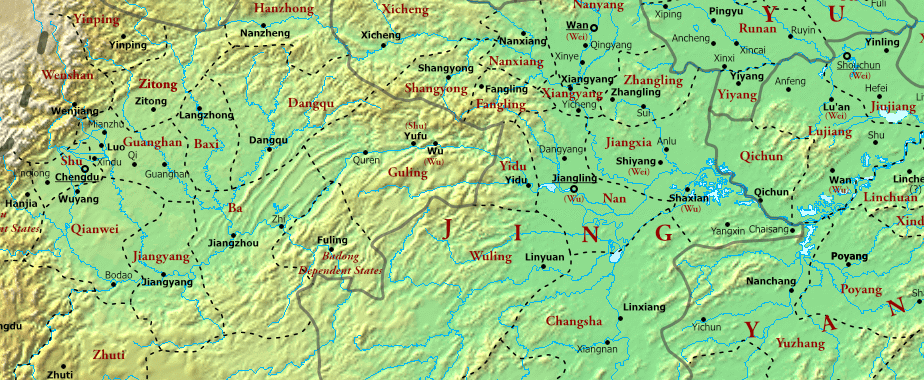
- They were also known as the Wuling Man 武陵蠻, as the area they lived in was under Wuling commandery. ↩︎
- A mythical ancient sage-king, also known as Lord Ku. Since Gaoxin was a figure in Sinitic legend, the king in the original Man myth may have had a different name. ↩︎
- The identity of the Rong Wu is unclear; it may be a transcription of an ethnonym in the Man language. In other (fragmentary) versions of the tale, the adversaries are identified as the Quan Rong (Dog Rong) known from Western Zhou texts, and Wu is the surname of their general. The irony of a people known as the Dog Rong being defeated by a real dog would not have been lost on the audience. ↩︎
- Li Xian’s Hou Hanshu commentary quotes a lost fifth-century geographical text called the Wuling ji (Record of Wuling) that identifies this cave with a massive cavern on Mount Wu 武山 in Luxi county, Chenzhou prefecture (corresponding to modern Luxi county, Hunan): “The mountain is extremely tall, and halfway up there is Panhu’s stone chamber, which is large enough to hold tens of thousands of people. In the stone chamber are a stone bed and footprints left by Panhu.” Li Xian himself may have visited the cave, as he adds, “In front of the mountain chamber are stone sheep and stone beasts. The number of strange ancient landmarks there is exceptionally large. The stone chamber is as large as a three-room house. In the distance, one can see a rock that is still shaped like a dog. The Man have a legend that this is a statue of Panhu.” ↩︎
- Here I follow the reading in the Hou Hanshu version, which has banlan 班蘭. The Soushen ji version has bianlian 褊褳, which may be a synonym. ↩︎
- Unlike the Chinese of Gan Bao’s time, who knelt on mats in a posture similar to the Japanese seiza. ↩︎
- This phrase is a euphemistic reference to Man resistance to Chinese efforts at moving them out of the mountains and changing their customs so that they can be taxed like regular imperial subjects. ↩︎
- That is, half dog and half human qi. The Hou Hanshu version reads, “Because their forefather rendered meritorious service and their female ancestor was a sage-king’s daughter, they may engage in agriculture and commerce without having to carry travel passes and tallies, nor do they have to pay taxes.” ↩︎
- Liang-Han corresponds to the upper Han River basin in southern Shaanxi; Ba-Shu corresponds to Sichuan. Wuling and Changsha were in Hunan and Hubei. Lujiang was in Anhui, ↩︎
- “Red hips and wide skirts” presumably refers to the colors and styles of clothing favored by the Panhu Man. Li Xian’s Hou Hanshu commentary preserves a similar passage from a lost work by Gan Bao, an annalistic history of the Western Jin dynasty: “The barbarians (Yi) of Wuling, Changsha, and Lujiang commanderies are descendants of Panhu. They lived scattered among the Five Rivers. The Panhu [barbarians] live in inaccessible mountains and repeatedly cause us harm. They mix rice with fish and meat and put it in a feeding trough as an offering to Panhu, bowing and wailing. There is a customary saying, ‘Red hips and wide skirts,’ which refers to [Panhu’s] descendants.” ↩︎
 Ethnic Identity in Imperial China
