
The Suishu is an official history of the short-lived Sui dynasty, compiled in 636 CE (under the Tang dynasty) on the basis of surviving records from the Sui imperial court. The chief editor was Wei Zheng (580-643), best known for his boldness and bluntness in remonstrating with Tang emperor Taizong. The passages translated below are concerned with the indigenous peoples of south China, as well as a military expedition to an island likely to have been Taiwan.
~~~~~
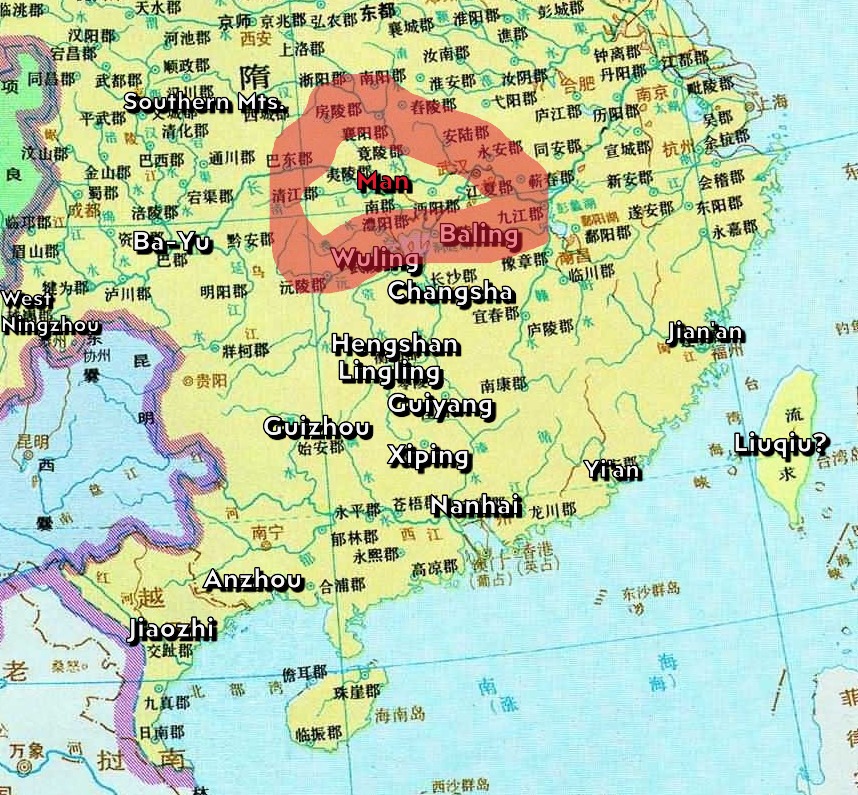
- From “Treatise on Geography”
[Translator’s note: These passages are from the Suishu geographical treatise, a description of all the Sui empire’s regions and commanderies and the characteristics and customs of their populations. They give a rare glimpse of the dynamics of “Sinicization” in two southern frontier zones (Shaanxi-Sichuan and the Middle Yangzi). After centuries of tension and violent conflict, many indigenous communities are now living in close proximity to the Chinese settler population and gradually being acculturated. The observation that the indigenous peoples disliked being called Man suggests that they had become sensitive to the classical label’s derogatory connotations, even if they were not yet ready to give up their autonymic identities and begin identifying ethnically as Hua or Xia. Instead, the Man of the Five Rivers in Hunan had apparently renamed themselves as Moyao, a Chinese phrase emphasizing their claim to exemption from taxation and corvée on the basis of descent from Panhu. The Moyao are believed to be the ancestors of the Yao people, who are now mostly found in Hunan and Guangxi (with smaller populations in Guangdong, Guizhou, and Yunnan) and still regard Panhu as their ancestor.]
In the foothills of the southern mountains1, Lao 獠 households live mixed [with the Hua]. The richer families among them often intermarry with Xia people, and are no different from the Hua in their clothing, dwellings, and speech.2 There are also the Rang 獽, Dan 狿, Man 蠻, and Cong 賨 peoples, whose dwellings, customs, clothing, and diet are quite similar to the Lao, but are also similar to the [Hua] people of Shu (Sichuan)….
The commanderies of Nan, Yiling, Jingling, Mianyang, Yuanling, Qingjiang, Xiangyang, Chongling, Handong, Anlu, Yong’an, Yiyang, Jiujiang, and Jiangxia have many dispersed populations of Man.3 Those who live scattered among the Xia people are no different from the Hua. Those who live in remote hills and valleys speak unintelligible languages and have completely different tastes and dwellings from ours. But they are very similar in customs to the inhabitants of the Ba-Yu 巴渝 region (Chongqing).4
The Man originated from the descendants of Panhu, and that is why they often decorate their clothing with multi-colored cloth.5 They are deeply offended when someone calls them Man. Since the Jin dynasty moved south, Nan and Xiangyang commanderies have both been important military garrisons and regional centers.6 Therefore, the number of robed and capped elite clans living there has increased, and their people now esteem ritual propriety and moral duty and classical texts to a slightly greater degree.7 …
In Changsha commandery, there are dispersed Yi 夷 and Dan 蜒, known as Moyao 莫徭 (literally “no corvée”).8 They say that their ancestor rendered meritorious service and was permanently exempted from corvée, thus they use this as their name. Their men wear just a shirt and a pair of trousers, both made of white cloth, without any headscarf or leggings. Their women wear blouses of blue cloth and skirts of striped cloth. Neither men nor women wear shoes or sandals. In marriage, they use a clothes iron, made of iron, as the bride price. [The Moyao] in Wuling, Baling, Lingling, Guiyang, Liyang, Hengshan, and Xiping commanderies are all the same as this [in clothing and marriage custom]. Their funeral customs are quite similar to the various other Zuo 左 (i.e., Man).9
[Translator’s note: The passage below, also from the “Treatise on Geography,” describes the indigenous peoples of the Lingnan region, which at this time encompassed Guangdong and Guangxi but also Jiaozhi (the Red River delta). The author evidently considers these peoples to have been relatively unchanged by contact with Chinese ways, though he also recognizes certain admirable qualities in their culture.]
There are more than twenty commanderies to the south of the Nanling Mountains. In general, the land is low-lying and humid and all of it is prone to miasma (zhangli 瘴厲), so people there tend to die young. Nanhai (Guangzhou) and Jiaozhi (Hanoi) are both major cities situated near the sea. They have large amounts of exotic treasures such as rhinoceros horns, elephant ivory, tortoiseshell, and pearls.10 Hence, many merchants who go there achieve great wealth.
The people there are all agile and brave in war and easily instigated to rebel. They wear their hair in mallet-shaped topknots and sit with their legs splayed out, as is their old custom.11 The Li 俚 people are honest and direct, and esteem trustworthiness. The Man peoples are brave and independent. All of them place great value on gift-giving, and are unafraid of death; only the rich among them can hold positions of leadership. They live in stilt houses12 and on cliffs and devote themselves to farming. They carve notches on wood to make agreements, and when they have made an oath, they do not break it as long as they live. Fathers and sons have separate property, and a father who is impoverished may even mortgage himself to his son. All the Lao 獠 are like this.
They cast bronze into large drums, and when these are finished, they hang them in their halls and bring out wine to invite their own kind. Those who come include the sons and daughters of the rich and powerful, who use gold and silver to make large hairpins, which they use to strike the drums. Then they leave these behind as gifts for the host, calling them “bronze drum hairpins.” By custom, they like killing one another and have many feuds. When they wish to attack one another, they strike these drums, and they then assemble [for battle] like a host of clouds.
2. From “Account of the Southern Man”
[Translator’s note: This passage appears at the beginning of the Suishu chapter on “Southern Man,” as an explanation for why the chapter only describes four countries in Southeast Asia and does not describe the Man of south China, unlike the ethnographic chapters in earlier dynastic histories. The reasoning here apparently reflects the early Tang court’s policy toward the southern indigenous peoples, which was to treat them like regular Chinese subjects wherever possible.]
The various kinds of southern Man live mixed with the Hua people and are called variously the Dan 蜒, Rang 獽, Li 俚, Lao 獠, and Yi 㐌. They all have no rulers and live in caves in the mountains. These are the peoples who in ancient times were called the Hundred Yue. Their custom is to cut their hair short and tattoo their bodies, and they like attacking one another. They gradually grew weak and submitted to the Central Lands, and all are now governed under commanderies and counties, in the same manner as regular commoners. Hence we do not describe them in detail.
3. From the biographies of Linghu Xi (540-602) and Liang Pi (527-610)
[Translator’s note: These excerpts from the Suishu biographies of two Sui officials who served on the southern frontier illustrate the methods by which at least some Chinese administrators learned to manage relations with frontier peoples without relying on force and coercion.]
The emperor, seeing that in the Lingnan region the barbarians (“Yi 夷 and Yue 越”) frequently rebelled, appointed Linghu Xi as Regional Supervisor for military affairs in Guizhou (Guilin, Guangxi) and sixteen other prefectures, and authorized him to act at his own discretion and appoint officials up to the rank of prefect. He was given a staff of five hundred men and a gift of five hundred bolts of silk, as well as porters to transport his household property [to Guizhou]. His noble title was changed to Duke of Wukang Commandery.
When Linghu Xi arrived in his area of jurisdiction, he made a big display of generosity and trustworthiness. The chiefs of the mountain valley settlements (xidong 溪洞, literally “streams and caves”) said to one another, “The previous regional supervisors all used their armies to threaten us, but the new one communicates with us through letters. How can we go against him?” They then submitted to him one after the other.
Previously, because the prefectures and counties were in a state of unrest, most of the county officials and clerks could not get to their posts and had to administer them remotely from the regional supervisor’s headquarters. Linghu Xi sent them all to their posts and instructed them to build cities and towns and open schools. The Hua and barbarians (Yi) alike felt gratitude and respect for him, and it was said that he achieved a great civilizing transformation.
At that time, there was a [local chief named] Ning Mengli who had been born on the same day as the last Chen emperor (Chen Shubao, r. 582-589) and claimed that he had the face of a man destined for greatness. In the days of the Chen dynasty, he had already seized control of the Nanhai region (Guangdong and Guangxi). After conquering the Chen (in 589), Emperor Gaozu (Sui Emperor Wen, r. 581-604) continued to conciliate him and appointed him prefect of Anzhou (Qinzhou, Guangxi). However, he was arrogant and, counting on the inaccessible terrain that he controlled, had never gone to report to the regional supervisor’s headquarters. Linghu Xi wrote him a letter in his own hand, explaining his desire to establish a bond of friendship. When Mengli’s mother was ill, Linghu Xi sent her medicinal herbs. Mengli was moved by this and went to report to Linghu Xi; he no longer dared to engage in wrongdoing.
…
Because Liang Pi had begun his career in the Censorate and was now in charge of administrative affairs in the imperial capital, he enforced the law impartially, without fear or favor, and thus offended many of the rich and powerful. Because of this, he was posted out as prefect of West Ningzhou (Xichang, Sichuan, corresponding to Yuesui Commandery) and his noble title was changed to Marquis of Handan County. He served in this prefecture for eleven years.
Previously, the barbarian (Man-Yi) chiefs all wore gold crowns, and the one who had the most gold was regarded as the greatest. As a result, they continuously sought to seize each other’s crowns and went to war over this. The frontier never saw a year of peace, greatly worrying Liang Pi. Later, when the chiefs came together to present him with gifts of gold, he put the gold beside his seat and wept bitterly, saying to them, “I can’t eat this when I’m hungry or wear this when I’m cold. You have destroyed each other over it countless times. Now you are bringing it to me; does that mean you want to kill me?” He refused to accept any of the gold and returned it all. The barbarians were enlightened by his words and ceased to attack each other.
4. From “Account of the Eastern Yi”
[Translator’s note: The passage translated here is from the Suishu ethnographic chapter on “eastern Yi,” that is, foreign countries to the east of the Sui empire, including the Korean peninsula, Manchuria, and Japan. The passage describes a country called Liuqiu 流求 that the Sui only briefly (and violently) made contact with in 607–610. Modern historians have disagreed over whether the “Liuqiu” described was Taiwan or one of the Ryukyu Islands. Chinese historical records indicate that Liuqiu generally referred to Taiwan before the Ming dynasty and was only regularly applied to Okinawa starting from the early Ming. Ming sources refer to Okinawa as Big Liuqiu and Taiwan as Little Liuqiu. This name then entered the Okinawan language as Ruuchuu and the Japanese language as Ryukyu. Many aspects of the Suishu description of Liuqiu suggest a location in Taiwan, not the Ryukyus.]
The country of Liuqiu is on an island in the sea, east of Jian’an commandery (northern Fujian). One arrives there after five days of travel by sea. The land has many caves. Its king has the clan name Huansi and the name Keladou. We do not know how many generations his dynasty has ruled. The natives address him as Kelaoyang and his wife as Duobatu. Their residence is called Boluotan Cave. It has three layers of moats and fences and is surrounded by rivers and briar patches. The palace has sixteen halls, carved with many images of animals.
This country has many doulou trees, which are like the mandarin orange tree but have more leaves; the branches are as thin as hair but hang downwards.13 The country has four or five chiefs who govern the caves, and each cave has its own minor king. There are many villages, and each village has a niaoliao chief, all of whom are chosen for their martial prowess. They are autonomous and manage the affairs of their village. The men and women tie their hair up with rope made of white ramie fiber, coiling it into a knot from the back of the crown to the forehead. The men wear headdresses made of bird feathers and decorate them with pearls and cowry shells and red feathers, in varying styles. The women wear square hats made of ribbed white cloth. They weave doulou bark, ramie fiber of various colors, and various furs and feathers into clothing of different designs. They decorate their clothes with multicolored belts of fur and conch shells, with small cowry shells hanging down to make clinking sounds like our jade waist pendants. They wear earrings and bracelets and necklaces of pearls. They weave rattan into hats and decorate them with fur and feathers.
Their weapons include single-edged swords, lances, bows and arrows, double-edged swords, and long-bladed spears. Their land has few iron deposits, so their blades are thin and small and often reinforced with bone or horn. For armor, they use woven ramie fiber and sometimes also bear or leopard cat hides. The king rides a wooden beast carried by his attendants, with only several tens of men in his entourage. The minor kings ride on small tables carved in the shape of beasts. The people of this country like to attack one another. All are brave warriors and good runners, hard to kill and resilient to wounds. Each cave has its own army and they do not aid one another. When they meet in battle, three to five of their bravest men come forward and leap and shout, taunting and insulting the other side. Then they start striking and shooting at each other. If one side’s men are defeated, the whole army flees and then sends people to apologize, and peace is restored. They collect the bodies of enemies killed in the battle and gather to eat them. Then they bring the skulls to the king’s palace. The king then rewards the victorious warriors with headdresses and appoints them as army commanders.
They do not have regular taxation; when there is a need, then they tax everyone equally. Nor are there standard laws and punishments; justice is administered on a case by case basis. Those who commit crimes are referred to their niaoliao chief for judgment; if they will not accept the judgment, they can appeal it to the king, who orders his ministers to deliberate together and come to a decision. Their prisons do not have cangues and shackles; prisoners are restrained with ropes only. They carry out executions using iron awls as thick as chopsticks and more than a footin length. These are drilled through the crown of the head, killing the condemned. For lighter crimes, they use flogging with sticks. They do not have a writing system. They keep track of the passing of months by observing the waxing and waning of the moon, and the passing of years by observing the withering of grass and herbs.
The people of this country have deep eyes and long noses, quite similar to the Hu (Central Asians)14, and have a sort of low cunning or cleverness. Rulers and subjects do not observe hierarchical protocols, such as the rituals of kowtowing and bowing. Fathers and sons sleep in the same bed. The men pluck their facial hair and sideburns, and also remove all their body hair. The women tattoo their hands with ink in worm and snake patterns. In weddings, they use wine, food, pearls, and cowry shells as bridal gifts. In some cases, a man and a woman are attracted to each other and become a couple without any wedding. When a woman gives birth, she always eats the placenta. She heats herself with fire after giving birth to make herself sweat, and then is fully recovered within five days.
They boil seawater in wooden mangers to make salt, squeeze the sap of trees to make vinegar, and ferment rice and rice noodles to make very weak wine. When eating, they all pick up food with their hands. When they come across a rare delicacy, they offer it to their respected elders first. At banquets, anyone with a wine cup must wait for his name to be called before drinking. Those who offer wine to the king also call the king by his name. Their communal drinking customs are quite similar to those of the Türks: They sing and stomp their feet, one man singing and the others echoing him, in voices that sound quite sad and resentful. They dance holding a woman’s upper arm with one hand and waving the other hand. When a person is about to die, the whole community goes to his room, and his kin and guests all wail and weep to mourn him. They bathe the body and wrap it in hemp cloth and silk, then an outer layer of reeds and grass. They bury him without a coffin and do not erect a mound over the tomb. Sons mourning their fathers abstain from eating meat for several months. In the southern part of this country, the customs are slightly different. When a person dies, the whole village gets together to eat the body.
The country has bears, jackals, and wolves. There are especially many pigs and chickens, but no cattle, sheep, donkeys, or horses. The soil in this country is fertile. They first use fire to burn [the forest] and then channel water to irrigate the land. They plow the land with stone-bladed hoes more than a foot in length and several inches in width. The soil is suitable for rice, foxtail millet, proso millet, hemp, soybeans, red beans, broad beans, and black beans. The trees include maple, cypress, camphor, pine, pian, nan, sugi, catalpa, bamboo, and rattan. The fruits and herbs are similar to those of the lower Yangzi region. The weather and climate are similar to the Lingnan (Guangdong) region.
By custom, they worship gods of the mountains and sea with offerings of wine and food. When they kill men in battle, they use their victims as offerings to the gods. They erect small shrines under big trees with dense foliage, or hang skulls from the trees and shoot them with arrows, or pile up rocks and tie banners to them to make shrines. In the king’s palace, there are displays of rows of skulls at the base of the walls, which they consider beautiful.15 The people’s homes always have the heads, bones, and horns of animals hung above the doors and windows.
In the first year of the Daye era (605), the sea captain He Man and others reported that every spring and autumn, when the sky was clear and the winds subsided, they would look east [from the coast] and see something that resembled smoke or mist thousands of li away. In the third year (607), Emperor Yang (r. 604–617) ordered the Commandant of Plumed Cavalry, Zhu Kuan, to go out to sea in search of foreign peoples. He Man told him what he had seen. Zhu Kuan therefore set sail with He Man and came to the country of Liuqiu. They could not understand the local language, but captured one man and returned. The next year (608), the emperor again ordered Zhu Kuan to go and gain their submission. Liuqiu did not comply, so Zhu Kuan captured a suit of their ramie cloth armor and returned. At that time, an envoy from the country of Wo (Japan) had arrived at the imperial court with tribute. He saw the armor and said, “This is the kind used by people of the Yiyajiu (Iyaku) country.”16 The emperor sent the Commandant of the Tiger Guards, Chen Leng and the Grand Master for Court Audiences, Zhang Zhenzhou, to lead an army across the sea from Yi’an (Chaozhou, Guangdong) and attack Liuqiu. They sailed to Gaohua Island, then sailed east for another two days and arrived at Goubi (Turtle) Island. After one more day, they reached Liuqiu.
Chen Leng had conscripted men from the countries to the south into his army, and they included Kunlun men who understood the Liuqiu language quite well.17 He sent one of these men to communicate his intentions, but Liuqiu did not comply and attacked the imperial troops. Chen Leng repelled them and advanced to their capital. They fought back but were defeated each time. Chen Leng burned down their palace, captured several thousands of their men and women18, and returned with much plunder. After this, all contact with Liuqiu was lost.
[Translator’s note: Chen Leng’s biography in the Suishu provides more details on his expedition to Liuqiu, translated below.]
4. From the biography of Chen Leng
In the third year of the Daye era (607), he was promoted to Commandant of the Tiger Guards. Three years later (610), he and the Grand Master of Court Audiences, Zhang Zhenzhou, led more than ten thousand soldiers from Dongyang (Jinhua, Zhejiang) to cross the sea from Yi’an and attack the country of Liuqiu. They arrived after more than a month. When the Liuqiu people saw the expedition’s ships, they mistook them for merchants and often came to trade with the army. Chen Leng led his army ashore and sent Zhang Zhenzhou forward as the vanguard. The local ruler Huansi Keladou sent his soldiers out to resist, and Zhang Zhenzhou repeatedly defeated them. Chen Leng advanced to Motan Cave, where the minor king Huansi Laomo led his army to resist. Chen Leng defeated them and killed Laomo. That day was misty and rainy, dark and overcast, and the officers and men were all afraid, but Chen Leng sacrificed a white horse to the sea god and the mist cleared. He then divided the army into five prongs, all headed for the capital.
Keladou led several thousand men to resist, but Chen Leng again sent Zhang Zhenzhou as a vanguard to repel them. Seizing the momentum from this victory, Chen Leng pursued the enemy and reached the fences around the capital. Keladou formed up his army in front of the fences, and Chen Leng attacked with all his crack troops. The battle raged fiercely from early morning to mid-afternoon. Keladou, seeing that his troops were exhausted, withdrew them behind the fences. Chen Leng then had the moats filled and broke through the fences. He killed Keladou and captured his son Daochui, as well as several thousand men and women, and returned victorious. The emperor was delighted and promoted Chen Leng to an official of the lower second rank, retaining the title of Commandant of the Tiger Guards, and promoted Zhang Zhenzhou to an official of the upper third rank.
- The Micang and Daba mountain ranges south of Hanzhong, on the modern border between Shaanxi and Sichuan provinces. ↩︎
- On the Lao, see source 5.5. These acculturated Lao would have been labeled as Cooked Lao and may have included families that submitted to Western Wei/Northern Zhou officials and generals like Lu Teng, Zhao Wenbiao, and Li Hui. ↩︎
- These commanderies were located in modern Hubei, Hunan, and Jiangxi. The Sui abolished all prefectures (zhou 州) and changed them to commanderies (jun 郡), as the two administrative categories had become nearly identical in function by the sixth century (the zhou were originally a higher tier that included multiple jun, but had proliferated in number and decreased in size over time). The Tang continued this reform but renamed all the commanderies as prefectures. ↩︎
- This suggests that the Chinese settlers of Ba-Yu were in turn seen as culturally hybrid, with some influence from Man customs. ↩︎
- See source 5.3. ↩︎
- This refers to the Jin imperial court being reconstituted at Jiankang (Nanjing) after losing north China to Xiongnu rebels in 311-316 CE. As a result, Xiangyang and Nan commanderies became highly strategic points in the Eastern Jin (316-420) and Southern Dynasties’ (420-589) defenses against northern regimes. ↩︎
- This statement seems to give credit to literati officials for “civilizing” both Chinese settlers and Man communities in these areas. ↩︎
- The Liangshu (History of the Liang), a dynastic history of the Liang dynasty (502-557) completed in 635 (one year earlier than the Suishu), also contains a brief mention of the Moyao as of 543-548: “In the commanderies of Lingling and Hengyang, within the borders of Xiangzhou prefecture, there were the Moyao Man, who lived in inaccessible mountains and had not submitted to imperial rule throughout successive dynasties….” Xiangzhou prefecture encompassed most of today’s Hunan province. ↩︎
- The term Zuo (literally “left”) was used as a label for the Man peoples in the Southern Dynasties, often used in combination with Man (i.e., as Man-Zuo). ↩︎
- Most of these commodities arrived via maritime trade with Southeast Asia and the Indian Ocean, though pearls were also harvested in the seas off Hainan. ↩︎
- The Chinese regarded sitting on the ground with one’s legs extended or splayed out to be a rude, barbaric practice. The proper sitting postures were kneeling and (less formally) cross-legged. ↩︎
- Literally “nests,” usually interpreted as a reference to stilt houses. ↩︎
- This is probably the paper mulberry or tapa cloth tree, which was used to make barkcloth in Austronesian cultures. ↩︎
- On the Hu, see Chapter 4, Part 2. ↩︎
- These are presumably the skulls brought to the king by his victorious warriors, as mentioned earlier in the text. Headhunting was an important cultural practice among many of the Taiwanese indigenous peoples, although the practice of cannibalism (also mentioned earlier) is not attested in later sources on early Taiwan. ↩︎
- The Taiwanese scholar Ts’ao Yung-ho (1920–2014) identified Iyaku as the island of Yakushima, one of the northernmost Ryukyu islands. This need not mean that Liuqiu was Yakushima, only that similar forms of armor also existed in the Ryukyus. ↩︎
- On the Kunlun, see Chapter 4, Part 4. These men were probably Malays, as the Taiwanese languages and the Malayic languages belong to the same Austronesian family. They may have been Malay sea merchants, who frequently visited south Chinese ports in the sixth and seventh centuries. Chen Leng presumably drafted them to serve as translators. ↩︎
- Much of the ethnographic and geographic information in the Suishu description was probably obtained from these captives, rather than by direct observation. ↩︎
 Ethnic Identity in Imperial China