
Zhang Jianzhi (625-706), the newly appointed prefect of Shuzhou (Chongzhou, Sichuan), submitted this memorial to the female emperor Wu Zhao (r. 690-705) in mid-698. It shares a similar geopolitical context to Di Renjie’s anti-expansionist memorials proposing the abolition of the Anxi and Andong protectorates in 697 and 699 (see source 2.12), but is also valuable for its unusually frank observations on the unsavory realities of Chinese colonialism in Yunnan.
The Tang empire had established Yaozhou prefecture (Yao’an county, Yunnan) as an outpost in western Yunnan for the purpose of countering the Tibetan empire’s growing influence over the Man peoples of the region. Precariously connected to the rest of the empire by Suizhou prefecture (Xichang, Sichuan) to its north (across the Dadu River or Lu 瀘 River) and a large area of autonomous “bridled” (jimi) Man prefectures to its east, Yaozhou was tasked with overseeing the Man chiefs of the bridled prefectures and managing relations with other independent chiefs to the south. The prefecture was garrisoned by troops from Sichuan, rotated on a yearly basis, but many of the five hundred men deployed each year died in the treacherous mountain terrain en route to Yaozhao. The human cost of this policy, as well as the rampant corruption, vice, and crime in Yaozhou, led Zhang Jianzhi to propose that the prefecture be abolished, for the second time since the 660s. In his arguments, he drew on the history of the Han colonization of Yongchang commandery in the first century CE (see source 5,2), as well as the strategy that the Shu-Han chancellor Zhuge Liang (181-234) had used to manage the Yunnan-Guizhou frontier during the early years of the Three Kingdoms period (220-280).
The full text of Zhang Jianzhi’s memorial is preserved in his biography in the Jiu Tangshu (Old History of the Tang).
~~~~~
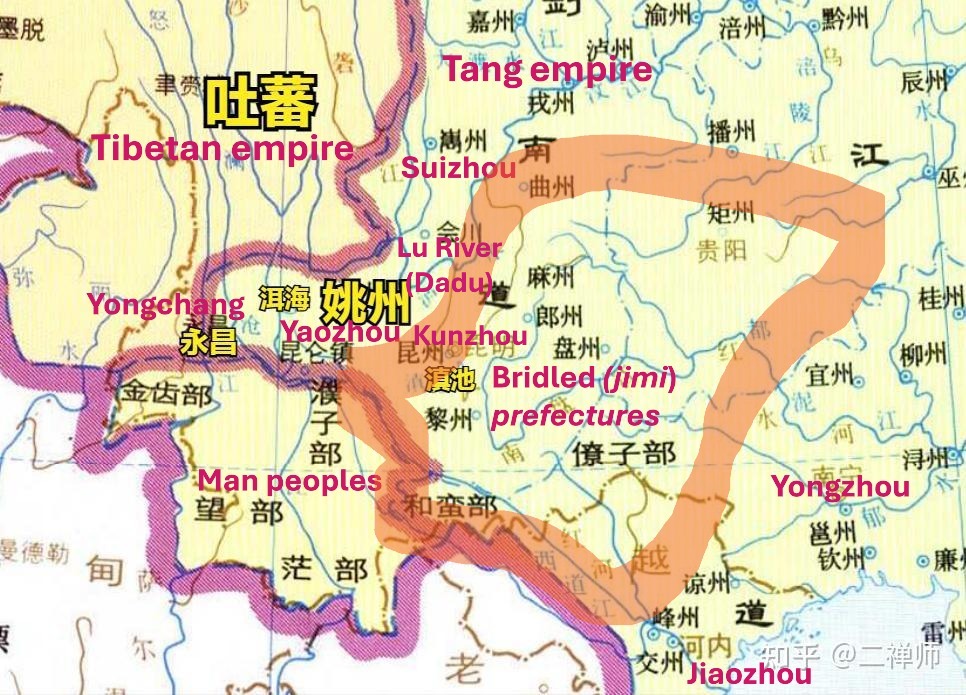
I, your subject, humbly note that Yaozhou was the country of the Ailao in ancient times. It is a remote land at the edge of the world, where the mountains are high and the rivers deep. From the first human beings to the Later (Eastern) Han, it had no contact with the Central Lands.1 In the Former (Western) Han, Tang Meng made contact with Yelang, Dian, and Zuo, but the Ailao did not submit.2 In the last years of Emperor Guangwu’s reign, they asked to submit to imperial rule for the first time.3 The Han court established Yongchang commandery to govern them and levied taxes in salt, cloth, and wool carpets to benefit the Central Plains. This country was connected to Daqin in the west4 and Jiaozhi in the south5, and it paid a tribute of exotic treasures every year without fail.
When Liu Bei conquered Ba-Shu (Sichuan), he often lacked military resources.6 After Liu Bei’s death (in 223), Zhuge Liang crossed the Lu (Dadu) River in the fifth month (of 225) and gathered the region’s gold, silver, salt, and cloth to augment the army’s supplies.7 He ordered Zhang Boqi (Zhang Ni) to select its best native troops to bolster the army’s ranks. That is why the Record of Shu [in the Sanguo zhi (Record of the Three Kingdoms)] says that after Zhuge Liang’s southern campaign, the state grew rich and the army was well-supplied. Judging from this, the benefits of establishing a commandery there were quite substantial in former times. But now, [Yaozhou] pays no taxes in salt and cloth and no tribute of exotic treasures. It provides no troops or weapons to the army, nor does it contribute any valuable goods to our great state. Instead, we are emptying our storehouses, and driving our commoners to serve the barbarians (Man-Yi) like slaves and spill out their brains and guts for them. I, your subject, humbly feel sorry for this on the dynasty’s behalf.
In the past, the Han empire, seeing much profit to be gained, crossed the Bonan Mountains and the Lancang River to establish two counties, Bonan and Ailao. The people of Shu (Sichuan) were aggrieved and resentful, and those traveling on the road sang:
We cross the Bonan
And ford the Lancang,
But crossing the Lancang
Is for others, not ourselves.8
This was to mock the Han for coveting the profit from exotic goods, salt, and cloth and thus becoming like slaves to the barbarians. Even though the Han gained the profit, its people still sang a song of resentment. Now we are exhausting the state’s reserves, and the cost increases daily. We are causing Your Majesty’s children (subjects) to fertilize the weeds with their bodies, their abandoned bones never returning to their homes. Their aged mothers and adolescent sons wail in grief, making offerings to the dead across a distance of a thousand li. There is not even a silk strand’s worth of benefit to the country, while the people suffer a lifetime of anguish. I, your subject, humbly feel pained by this on the dynasty’s behalf.
Formerly, when Zhuge Liang conquered the Nanzhong region, he allowed the local chiefs to rule their own people and did not appoint Han officials over them. Nor did he leave troops behind to garrison the region. When someone asked why, Zhuge Liang said that there were three difficulties with appointing officials and leaving troops behind. The gist of this was that if he appointed officials and caused the barbarians and Han people to live mixed together, mutual suspicion would surely arise. If he left troops behind and had to transport grain to supply them, the danger [of them being cut off] would intensify. If a rebellion suddenly broke out, the costs involved would only increase. He only had to establish a general legal order and the region naturally became peaceful and stable.9 I, your subject, humbly suggest that Zhuge Liang’s strategy was a brilliant method for bridling (jimi) the barbarians (Man-Yi).
Now, the officials appointed to Yaozhou have neither the intent to stabilize the frontier and pacify the bandits, nor the skill that Zhuge Liang displayed in repeatedly freeing and capturing [Meng Huo].10 They only know how to engage in cunning and deceitful scheming and unrestrained and brutal exploitation. They have committed avaricious plunder for years on end, and it now feels normal to them. They fan the flames of conflict among the local chiefs and form factions with them, bowing and smiling obsequiously. They curry favor with the barbarians, kowtowing on their knees and prostrating themselves with no sense of shame. They promote their own sons and younger brothers; they invite the vicious and foolish into their entourages. They hold meetings just to gamble, betting tens of thousands of cash on each throw of the dice. Over two thousand households of fugitive criminals from Jiannan (Sichuan)11 and the Central Plains live scattered across this prefecture, with pillage and plunder as their sole livelihood.
Yaozhou was first established as a prefecture in the Longshuo era (661–663) in answer to a proposal from Shi Ziren, the secretary of Wuling county.12 Later, the prefectural chief clerks Li Xiaorang and Xin Wenxie were both killed by the Man. The previous emperor (Gaozong) sent the lieutenant general Zhao Wugui to lead a punitive expedition against the Man, but Wugui and his soldiers from Shu were immediately defeated and annihilated to the last man. The general Li Yizong was sent to lead another expedition, but his lieutenant general Liu Huiji was killed in battle. The prefecture was then abolished. I, your subject, humbly observe that Zhuge Liang’s words about there being three difficulties with appointing officials and leaving troops behind have indeed been proven true by these events.
In the fourth year of the Chuigong era (688), the Man lieutenant general Wang Shanbao13 and the prefect of Kunzhou, Cuan Qianfu14, requested that the prefecture of Yaozhou be reestablished. In their memorial, they claimed that all tax revenue necessary for sustaining Yaozhou would come from within the prefecture’s own jurisdiction, with no further burden or disruption imposed on the Shu region. After the prefecture was reestablished, its Secretarial Advisor Li Leng was killed by the Man. In the Yanzai era (694), the prefectural clerk Cheng Chen submitted a memorial requesting that seven forts be established to the south of the Lu (Dadu) River, and that troops from Shu be sent to garrison them. Since then, the Shu region has been in a state of unrest, which has not subsided to this day.
Moreover, the fifty-seven [bridled] prefectures supervised by Yaozhou are plagued by rogues and vagrants beyond count. The dynasty appointed officials to various responsibilities for the purpose of transforming local customs and preventing criminality, yet their shamelessness and insatiable greed has produced utter corruption and chaos. Now, both the barbarians and the Xia are steeped in crime. People are robbed and murdered on the roads, and nothing can be done to stop it. I fear that if one day, an upheaval should break out, even greater disasters would ensue. I prostrate myself and beg that Yaozhou be abolished and that its population be placed under the jurisdiction of Suizhou prefecture. Let the local leaders pay tribute once a year, in the same manner as foreign (Fan) countries. The forts south of the Lu (Dadu) River should all be abandoned as well, and checkpoints established to the north of the river. The common people should not be allowed to [cross the river] and interact with [the barbarians] unless they are on diplomatic missions. Military recruitment in Suizhou should be stepped up, and honest and good officials should be chosen to govern that prefecture. I, your subject, foolishly believe that this will ensure lasting stability.”
[Translator’s note: Wu Zhao did not accept Zhang Jianzhi’s proposal, presumably due to the strategic need to maintain a military presence in Yunnan so as to keep Tibetan influence out. Instead, the Tang empire eventually responded by increasing its investment in colonizing Yunnan, but this backfired disastrously, as reflected in a passage from the Jiu Tangshu biography of Xu Jian (659-729):
At that time (710-712), the Censorial Inspector Li Zhigu had requested troops with which to attack the Xi’er River Man of Yaozhou. He requested that upon their surrender, a city should be built and they should be taxed heavily. Xu Jian argued that the barbarians (Man-Yi) were headstrong by nature and could be bridled (jimi) rather than ruled under the same institutions as the Hua-Xia. If an army was sent over a great distance, the gains would not make up for the losses. He alone suggested that it was not a prudent plan, but Ruizong (r. 710-712) did not listen and ordered Li Zhigu to mobilize southern troops to go and build a city, intending to turn it into a regular prefecture and counties. Li Zhigu thus plotted to massacre the local leaders and enslave their sons and daughters. The Man were terrified and killed Zhigu, and rebelled one after another. The expeditionary troops collapsed in a rout, and the route between Yaozhou and Suizhou was therefore cut off for years on end.
A passage in the Jiu Tangshu chapters on the Tibetan empire adds further details of Li Zhigu’s demise, and also shows how the Tang-Tibetan rivalry impacted the Yaozhou situation:
When Ruizong became emperor, the acting Censorial Inspector Li Zhigu reported, “The Man of Yaozhou previously submitted to the Tibetans. I request that an army be mobilized to attack them.” The emperor thereupon ordered Zhigu to draft soldiers in Jiannan (Sichuan) to deal with the problem. The Man chief Bangming invited the Tibetans in to attack Zhigu and kill him. They then dismembered his body as a sacrifice to Heaven.
The Tang responded to this debacle with a new strategy of supporting the rise of the Nanzhao kingdom as a counterweight to the Tibetans. By 750, Nanzhao had conquered numerous other proto-states in the region with assistance from the Tang, but its king Geluofeng (r. 748-779) then fell out with the new prefect of Yaozhou (then known as Yunnan commandery), a thoroughly corrupt man named Zhang Qiantuo who sexually assaulted Geluofeng’s wives and repeatedly demanded bribes from him, insulting him and slandering him to the imperial court when he failed to comply. Enraged, Geluofeng attacked and captured Yaozhou, killing Zhang, and then realigned his kingdom with the Tibetans to fend off a Tang punitive expedition in 751. Thirty-two remaining “barbarian” (bridled) prefectures in the Yaozhou region are said to have transferred their allegiance to Nanzhao.
The Tang expeditionary army was routed after crossing the Dadu River, reportedly losing 60,000 out of 80,000 men. A second expedition in 754, numbering 70,000 men, besieged the Nanzhao capital but ran out of supplies and lost 70-80% of its troops to hunger and disease. The remaining troops were pursued and wiped out when they attempted to withdraw. Nanzhao next took advantage of the An Lushan Rebellion (755-763) to advance north and capture Suizhou in 756, securing a buffer zone north of the Dadu River. These victories laid the foundation for an independent Yunnan for nearly 500 years until the Mongol conquest of Dali in 1253.]
- This part of the memorial is based almost verbatim on the opening of the Hou Hanshu entry on the Ailao barbarians (see source 5.2). ↩︎
- In 135 BCE the diplomat Tang Meng spearheaded the Han empire’s expansion into southern Sichuan and Guizhou, which resulted in the establishment of commanderies in the Zuo (or Zuodu) and Yelang kingdoms. However, Tang Meng did not get to the Dian kingdom in Yunnan and only heard about it from the Yelang king. First contact was made with Dian in 122 BCE, followed by a Han military conquest in 109 BCE. ↩︎
- This refers to Ailao king Xianli’s submission to the Han in 57 CE, though Yongchang commandery was not established until 69 CE (see source 5.2). ↩︎
- Daqin was the Han name for the Roman empire, particularly its territory in Syria. ↩︎
- On Jiaozhi, see source 5.2. ↩︎
- Liu Bei (161-223) was a late Eastern Han warlord who seized control over the Shu (Sichuan) region in 214 and declared himself emperor of Han in 221, claiming to be a descendant of the Western Han Emperor Jing. His state, which continued under his son’s ruler from 223 to 263, is conventionally called Shu-Han or Shu. ↩︎
- Zhuge Liang’s campaign into the Yunnan-Guizhou region (then known as Nanzhong 南中, “in the middle of the south”) in 225 was launched in response to a local revolt led by one Yong Kai. However, victory in the campaign also allowed him to extract resources from the region to supply his northern expeditions against the Cao-Wei state. ↩︎
- For the full version of this song, see source 5.2. ↩︎
- This story is from the fourth-century historian Xi Zuochi’s Han-Jin chunqiu (Annals of Han and Jin), as quoted in Pei Songzhi’s (372-451) commentary to the Sanguo zhi. The original account reads: “After pacifying Nanzhong, Zhuge Liang appointed all the local chiefs as officials. Someone remonstrated with him over this, but he said, ‘If we leave outsiders behind, then we will have to leave troops behind as well, but the troops left behind will have nothing to eat. This is the first difficulty. In addition, the barbarians have just recently been defeated, and are still recovering from their wounds and mourning the fathers and elder brothers whom we killed. If we leave outsiders behind without any soldiers to protect them, they will surely be in danger. That is the second difficulty. The barbarians have also repeatedly committed the crime of overthrowing and killing [Han officials], and they know that their blood guilt is severe. If we leave outsiders behind, they will never be trusted [not to punish the guilty]. This is the third difficulty. Now I wish not to leave troops behind or transport grain to supply them, and this is simply for the purpose of establishing a general legal order in which barbarians and Han can live in relative peace.’” ↩︎
- The story of Zhuge Liang capturing and freeing the Nanzhong chief Meng Huo seven times is also found in the Han-Jin chunqiu: “Zhuge Liang arrived in Nanzhong and was victorious wherever he campaigned. He heard of one Meng Huo who was respected by barbarians and Han alike, and issued orders to have him captured alive. After capturing him, Zhuge Liang had him observe the army’s camp and formations and then asked, ‘What do you think of this army?’ Meng Huo replied, ‘Previously I did not understand its capabilities, and that is why I was defeated. Now that you have generously granted me a tour of your camp and formations, then if that is all you have, I can certainly beat you easily.’ Zhuge Liang laughed and released Meng Huo, inviting him to fight again. He released Meng Huo seven times and captured him seven times, and was about to let him go again when Meng Huo refused to leave, saying, ‘You, sir, are as powerful as Heaven itself. We men of the south will not rebel again.’ Zhuge Liang then advanced to Lake Dian.” ↩︎
- Jiannan was the Tang empire’s administrative circuit encompassing Sichuan. ↩︎
- Other information in the Jiu Tangshu indicates that Yaozhou was established as a prefecture in 621 but elevated to a military area command (dudu fu 都督府) in 664. ↩︎
- Nothing else is known about Wang Shanbao, but his designation as a “Man lieutenant general” could be interpreted in two ways: either as evidence that he was a Man leader who had been recruited into the Tang army, or as a military title indicating that he was responsible for military operations involving the Man. The abridged version of Zhang Jianzhi’s memorial in the Tongdian (see source 2.13) names Wang as “Lieutenant General of the Southern Man” 南蠻郎將, which could indeed be a title, though it appears nowhere else in the sources. ↩︎
- Cuan Qianfu belonged to the Cuan family whose leaders had served as autonomous prefects in the Kunming area since the 300s. They claimed ancestry from Chinese settlers and were literate in Sinitic, but are likely to have had indigenous origins. Under Tang suzerainty, the Cuan ruled several bridled prefectures in eastern Yunnan, including Kunzhou, until they were conquered by the Nanzhao kingdom in the 740s. ↩︎
 Ethnic Identity in Imperial China