
The Yunnan tongzhi was a provincial gazetteer of Yunnan commissioned by the Yongzheng emperor in 1729. Compilation was initially supervised by Ortai, the governor of Yunnan and Governor-general of Yunnan, Guizhou, and Guangxi. After Ortai’s term ended in 1731, the project continued under his successors as Governor-general, the Han Bannerman Gao Qizhuo 高其倬 (in 1731-1733) and the Manchu Bannerman Yengišan 尹繼善 (Yin Jishan, in 1733-1736).
The excerpts translated below are from the gazetteer’s chapter on native chieftaincies. The first excerpt is the introduction to the chapter, which frames the recently concluded gaitu guiliu program (see source 5.24) as a great success and evidence of the Qing emperors’ sagely moral charisma, rather than the violent collision of state coercion and native resistance that it actually was.
The second excerpt contains ten examples from the chapter’s short narratives of the history of individual native chieftaincies in Yunnan, including five that were eliminated during the gaitu guiliu program of 1726-1727, and a few that had already been eliminated during the Ming and the early Qing.
The third excerpt is from the chapter’s appendix, an ethnographic description of the indigenous peoples of Yunnan. It illustrates the remarkable cultural diversity of the peoples whom imperial officials labeled generically as Luoluo or Luo. In fact, the Luoluo category did not even encompass all the Yunnan ethnic groups known to the Qing state – the appendix also describes numerous others, including the Bai people 白人, the Baiyi 僰夷/擺夷/百夷 (i.e., “Hundred Yi,” primarily Dai/Tai1), the Hani 窩泥/斡泥, the Achang 峨昌/阿昌, and the Luohei 猓黑 (Lahu).
~~~~~
From Chapter 24, “Native chieftaincies (tusi 土司), with an Appendix on peoples (zhongren 種人)”
- Introduction
Dian (Yunnan) is the land of the southwestern barbarians (Yi). The Han was the first to establish commanderies (jun 郡) and counties (xian 縣) here. The Sui and Tang established bridled prefectures (jimi zhou 羈縻州). Apart from the area commanders (dudu 都督) and prefects (cishi taishou 刺史太守), everything else followed the approach to governance used by the Martial Marquis Zhuge [Liang] 武侯諸葛—that is, ruling through the native chiefs.2 Starting from the Yuan and Ming, the imperial courts began appointing rotating officials (liuguan 流官) extensively to govern using the laws of the Central Lands. But in the early Ming, there were still over 320 native chieftaincies (tusi 土司). By the last years of the Ming, fewer than half of them remained: these ones relied on their control of treacherous terrain to rampage around like wild boars and wolves. Many others had been slain and their clans exterminated, but the state had exhausted itself in the process.
After our dynasty pacified the southwest, the native chieftains who accepted its authority were allowed to hold hereditary positions, while those who had committed crimes were removed. All have submitted to our dynasty’s civilizing influence in awe of the emperor’s divine power, washing their hearts and minds clean of all disloyal thoughts. As for Lan Xang (Nanzhang 南掌) and the Nu [River] Barbarians (𱮐夷) offering tribute in submission, that is truly unprecedented since antiquity.3 Is this not because a sage ruler sits upon the throne, his moral charisma and beneficence spreading far and wide, reaching even the most distant regions without exception, so that even those secluded in remote and obscure places have all received enlightenment and renewal?
As for the ways in which [the barbarians] differ from each other in local customs and practices, clothing, diet, and modes of dwelling, these are recorded separately, both to provide material for the interpreters’ records and to bear witness to the magnificent sight of tributary peoples assembled at the imperial court. This chapter records the native chieftains (tusi) and includes an Appendix with accounts of the various peoples (zhongren).
…
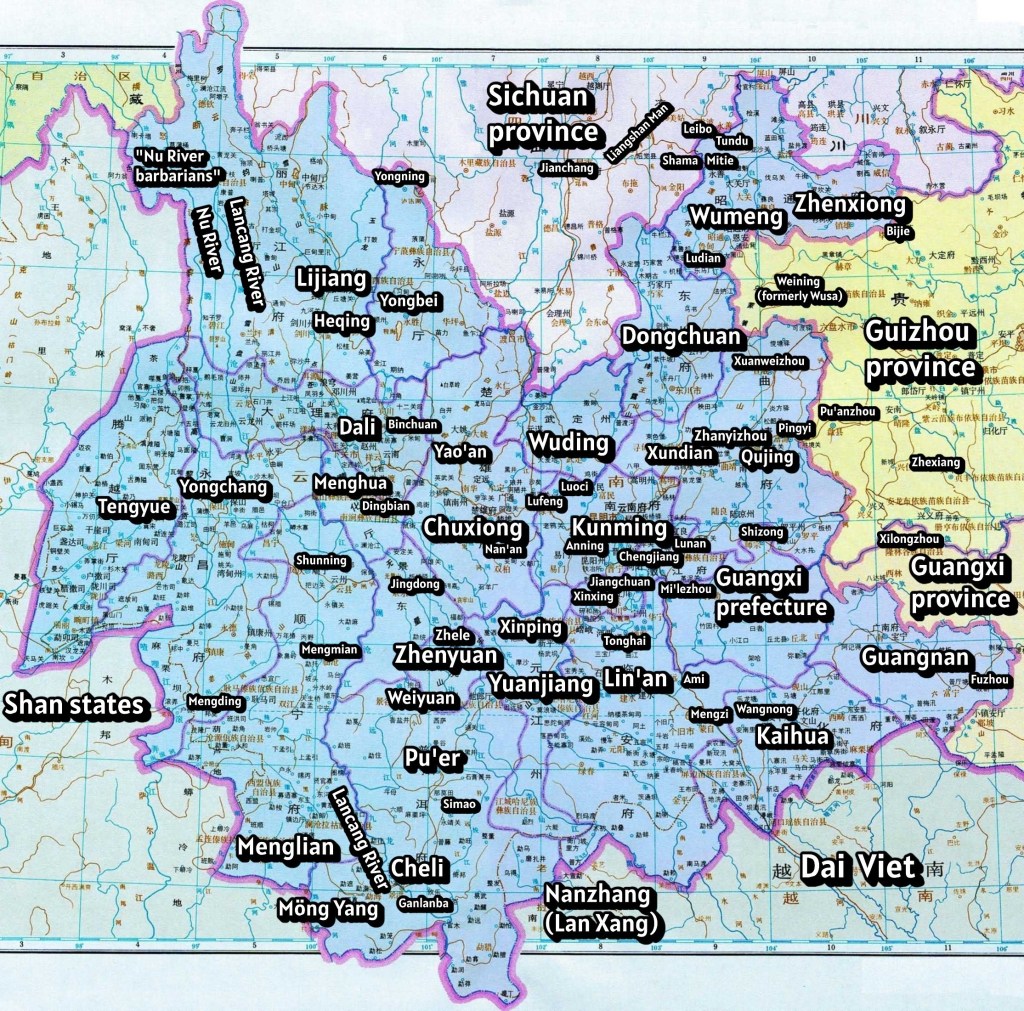
2. Native chieftaincies (selected)
The Native Subprefects (tu zhizhou 土知州) of Zhanyi subprefecture (Zhanyizhou 霑益州): During the Yuan, An Juzong 安舉宗 was Pacification Commissioner (xuanweishi 宣慰使) of Qujing 曲靖. At the beginning of the Ming, during the conquest of Dian (Yunnan), one Baobu 實卜, the wife of [An] Luzhe 禄哲, submitted together with her husband’s younger brother A’ge 阿哥. Baobu was appointed Prefect (zhifu 知府) of Wusa 烏撒 (modern Weining Yi, Hui and Miao Autonomous County, Guizhou), and A’ge was appointed Subprefect of Zhanyi. The latter position passed down to Jiuding 九鼎 and the family line then became extinct. An Shaoqing 安紹慶 of Wusa was appointed to inherit it; he was in fact the seventh-generation descendent of Luzhe. When Shaoqing died, his second son Shaoliang 紹良 succeeded him and simultaneously managed the affairs of Wusa Prefecture. When he died, his eldest son Qijue 其爵 succeeded to the post in Wusa, while his second son Qilu 其禄 succeeded to the post in Zhanyi. Qilu was succeeded by Chongzhen 重鎮, and Chongzhen by An Min 安民.
When our dynasty pacified Dian (Yunnan, in 1659), An Min submitted and was reappointed to his post on a hereditary basis. When An Min died, he was succeeded by his son Shiji 世基, who was criticized by his subordinates for his brutality. He was replaced by his son Yufan 于蕃. In the fourth year of the Yongzheng era (1726), Yufan was removed from his post for unlawful behavior and relocated to Jiangning 江寧 (Nanjing).4 Xuanweizhou 宣威州 (Xuanwei, Yunnan) was established on his lands.5
…
Guangxi prefecture 廣西府 (Luxi county, Yunnan)
The Native Prefects (tu zhifu 土知府) [of Guangxi prefecture] came from the Ang 昂 clan. At the beginning of the Ming, their patriarch Pude 普德 submitted and was appointed as Native Subprefect (tu zhizhou 土知州) of Mi’lezhou subprefecture (Mi’lezhou) 彌勒州 (Mi’le, Yunnan). He was subsequently promoted to Prefect of Guangxi prefecture. During the Chenghua era [of the Ming] (1465–1487), Ang Gui 昂貴 was removed from his post for unlawful behavior and replaced with a rotating official (sheliu 設流).
…
The Native Vice Subprefects (tu zhoutong 土州同) of Shizong subprefecture (Shizongzhou) 師宗州 (Shizong county, Yunnan) were descended from one Pu’en 普恩 who served as General of Martial Virtue 武德將軍 during the Yuan. His descendants held the hereditary post of Subprefect. At the beginning of the Ming, Adi 阿的 submitted and was appointed as Vice Subprefect. His post was inherited by his grandson Longge 瓏哥, and the clan then adopted Long as its clan name. The post passed down to Long Geng 瓏耿, who sent Li Huang 李璜 to the capital to request that his succession [as Subprefect] be approved. Instead, Li Huang requested that the court replace the native official with a rotating official (gaitu sheliu 改土設流), and the post was thus eliminated.
[Translator’s note: According to the Shizongzhou zhi 師宗州志 (Gazetteer of Shizong Subprefecture), compiled in 1717-1729, Li Huang was a man from Shizong who served as Long Geng’s envoy to the Ming court during the Hongzhi era (1488-1505). Upon arrival in Beijing, Li unexpectedly requested Long Geng’s replacement by a rotating official on the grounds that he ruled autocratically and was harming the people. The request was granted, and the local people of Shizong honored Li Huang by building shrines to him.]
Guangnan prefecture 廣南府 (Guangnan county, Yunnan)
Native vice prefects (tu tongzhi 土同知): During the Yuan, Nong Langkong 儂郎恐 was appointed as Pacification Commissioner (xuanfu 宣撫). He had two sons: the elder was Buha 布哈 and the younger was Zhengyou 正祐. Buha’s son Langjin 郎金 submitted and was appointed as Native Vice Prefect [of Guangnan]. He died without an heir, and Zhengyou succeeded him but was later executed for a crime. During the Hongxi era (1425), Nong Langju 儂郎舉 was demoted to Assistant Prefect (tongpan 通判) over an offense. When Langju died, his son Yinzu 印祖 succeeded him. During the Zhengtong era (1436–1449), Yinzu was restored to the post of Vice Prefect for his contributions to a military expedition against Luchuan 麓川 (Möng Mao, during the Luchuan-Pingmian campaigns). The position passed down to Wenju 文舉, who repeatedly distinguished himself with contributions to military campaigns. When Wenju died, Yingzu 應祖 succeeded him and accompanied government troops in a campaign against the Three Villages 三鄉 (in 1593), personally capturing the rebel leader Aji 阿機 and others. Later, he was awarded the robes of a fourth-grade official in recognition of his contributions to campaigns against the Tibetans (Tufan 吐蕃, in 1600) and [rebel chiefs in] Xundian 尋甸 (in 1608). When Yingzu died, his son Shaozhou 紹周 succeeded him. He accompanied expeditions against Dongchuan 東川 and Xundian and rendered contributions, for which he was appointed as Prefect (zhifu). When Shaozhou died, his son Peng succeeded him.
When our dynasty pacified Dian (Yunnan), Peng submitted and was appointed as Vice Prefect (tongzhi) on a hereditary basis. When Peng died, his son Shengying 繩英 succeeded him. When Shengying died, his son Zhenji 振紀 was still a child, so his widow Madam Yan 嚴氏 served as regent. Zhenji later died, and [Shengying’s] son by a concubine, Zhenyi 振裔, then assumed responsibility for managing local affairs.
…
Yuanjiang prefecture 元江府 (Yuanjiang Hani, Yi and Dai Autonomous County, Yunnan)
… The Native Prefect Na Zhong 那中 submitted with his followers during the Hongwu era (1368–1398) of the Ming and was appointed as Native Prefect. During the Jiajing era (1521–1567), Na Jian 那鑑 rebelled.6 The Provincial Administration Commissioner (buzheng 布政) Xu Yue 徐樾 led an army on a punitive expedition against him (in 1552), and when Na Jian used a stampede of elephants and horses to trample the government troops, Xu Yue was struck by a stray arrow and died. Na Jian committed suicide out of fear of punishment, and the court then eliminated his position. The Commander of the Lin’an Guard 臨安衛 (modern Jianshui county, Yunnan) was ordered to go and sign the handover agreement, but the prefect’s seal was still held in the Na clan’s home. Whenever the Commander needed to use the seal to sign an official document, [the Na clan] always assembled barbarian troops like a swarm of bees to watch him. As soon as the document was signed, they would swarm off with the seal [to prevent the Commander from keeping it]. [Na Jian’s] descendant Tianfu 天福 usurped his elder brother’s position and elevated himself [as Prefect], and the position passed down to Song 嵩.
When our dynasty pacified Dian (Yunnan), [Na] Song submitted, but he later rebelled with Xu Mingchen 許名臣 and others and was quelled.7 He was then replaced by a rotating official.
…
The Native Prefects of Zhenyuan 鎮沅 (Zhenyuan Yi, Hani and Lahu Autonomous County, Yunnan): Dao Zhongwang 刀中旺 was the Circuit Commander (zongguan 總管) of Yuanjiang Circuit 元江路 at the end of the Yuan dynasty. At the beginning of the Ming, he submitted together with his sons Dao Zhi 刀直 and Dao Ping 刀平. Ping was appointed as a Chiliarch (qianfuzhang 千夫長) and led his militia to gain the submission of 32 stockaded villages in six valleys. He was placed in charge of collecting taxes, and later exterminated [the rebel chiefs] Dao Menghun 刀猛溷 and Dao Mengpo 刀猛婆, as well as the Yiding 遺定 and Anban 案板 stockaded villages. The court established Zhenyuan subprefecture (Zhenyuanzhou 鎮沅州) and appointed Ping to oversee the subprefecture’s affairs.
During the Yongle era (1403-1424), he accompanied a military expedition against Lan Na (Babai 八百), and also accompanied attacks on the Shiyan 石巖 and Zheda 者達 stockaded villages. An entire line of outer barbarians came to surrender and present local products as tribute, and an edict was issued elevating Zhenyuan to a prefecture (fu 府), with Ping in charge. Later, his official seal was seized by the Na clan [of Yuanjiang], and his descendants mostly wielded authority on an unofficial basis, using the caps and belts conferred by the court [as symbols of authority]. When the position passed down to Dao Ren 刀仁, he attacked Na Jian, captured the seal, and presented it to the court, which returned it to him.
When the position passed down to Dao Yunzhong 刀允中, our dynasty pacified Dian (Yunnan), and Yunzhong submitted and was reappointed to his post on a hereditary basis. His son Changgeng 長庚 succeeded him. The position passed down to Dao Han 刀瀚, who was dismissed from his post in the fifth year of the Yongzheng era (1727) for being greedy and incompetent.8 He was transferred to Jiangning 江寧 (Nanjing) and replaced by a rotating official.
…
The Native Subprefects of Weiyuan 威遠 (Jinggu Dai and Yi Autonomous County, Yunnan): At the beginning of the Ming, Dao Peihan 刀佩罕 was a native official in Luchuan. He accompanied an imperial campaign against Mubang 木邦 (Hsenwi) and died in battle. He was succeeded by his son Suandang 筭黨. Soon after, the Ming established Weiyuan subprefecture and appointed Suandang as Subprefect. The position passed down to Dao Zhu 刀鑄, and upon his death, his son Hanchen 漢臣 succeeded him.
When our dynasty pacified Dian (Yunnan), Hanchen submitted and was allowed to continue holding his post on a hereditary basis. His son Guodong 國棟 succeeded him. The position passed down to Dao Guanghuan 刀光煥, who in the second year of the Yongzheng era (1724) was removed from his post for colluding with and sheltering wild bandits.9 He was relocated to Jiangxi [and replaced with a rotating official].
Zheledian Chieftaincy 者樂甸長官司 (modern Enle 恩樂 town, Zhenyuan county): At the end of the Hongwu era (1368-1398) of the Ming, Dao Muban 刀木板 submitted to imperial rule and was appointed as head of a Chieftaincy (zhangguansi 長官司). The position passed down to Dao Sheng 刀晟, who rendered contributions when he accompanied a campaign against Pu Mingsheng 普名聲 and was appointed as Pacification Commissioner (xuanfusi 宣撫司) and given the rank of Colonel (youji 遊擊).10
When our dynasty pacified Dian (Yunnan), Sheng’s son Zongqiao 宗喬 submitted and was allowed to continue holding his post on a hereditary basis. Zongqiao died and was succeeded by his son Peiyu 佩玉. Peiyu died and was succeeded by his younger brother Peizhang 佩璋. Peizhang and was succeeded by his son Liandou 聯斗. In the fourth year of the Yongzheng era (1726), Liandou agreed to hand over his Chieftain seal and requested to be replaced by a rotating official.11 Liandou’s land was then converted to Enle county 恩樂縣 and he was rewarded with the cap and robe of a ninth-grade official.
…
The Native Prefects of Wumeng 烏蒙 (Zhaotong, Yunnan): At the beginning of the Ming, Apu 阿普 submitted and was appointed Prefect of Wumeng Frontier Prefecture 烏蒙軍民府.12 His clan held this position for generations, and were under the jurisdiction of Sichuan. In the fourth year of the Yongzheng era (1726) in our dynasty, troops were dispatched to arrest Lu Wanzhong 禄萬鍾 for covering up his misdeeds and taking hostages. He was exiled to Jiangxi and his prefecture was transferred to the jurisdiction of Dian (Yunnan), under rotating officials.13
The Native Subprefects of Zhenxiong subprefecture 鎮雄州14 (Zhenxiong county, Yunnan): Originally, the Long 隴 clan of Mangbu Circuit 芒部路 had been chiefs for generations.15 At the beginning of the Ming, Mangbu Prefecture 芒部府 was established (in 1382) under the jurisdiction of Yunnan province. In the sixteenth year of the Hongwu era (1383), it was changed to Mangbu Frontier Prefecture 芒部軍民府 and placed under the jurisdiction of Sichuan, and the Long clan were retained as the prefects. In the third year of the Jiajing era (1524), the brothers Long Zheng 隴政 and Long Shou 隴壽 fought over leadership, and the prefecture was converted to administration by rotating officials, with Mangbu being renamed as Zhenxiong Frontier Prefecture 鎮雄軍民府. In the seventh year (1528), the barbarian (Yi) chief Punu 普奴 and others rebelled and were quelled. The court then ordered Long Shou’s son Sheng 勝 to succeed him as prefect. Sheng passed his position down to his son Qing 清, and Qing passed it down to his son Laifeng 來鳳. When Laifeng died, his wife Madam Lu 禄氏 changed her name to Long Yingxiang 隴應祥 and managed the prefecture’s affairs. When the chiefs of Shuixi 水西 (Mu’ege) rebelled (in 1621-1629), Yingxiang rendered contributions in defending her area and was given authority over Guixi Circuit 貴西道 [in Guizhou]. When she died, she was posthumously honored as Grand Master for Proper Consultation (zhengyi dafu 正議大夫). Her son Huaiyu succeeded her and was conferred the title of Chief Minister of the Imperial Stables (taipu qing 太僕卿). Huaiyu died and was succeeded by his son Hongxun 鴻勳.
When our dynasty pacified Dian (Yunnan), Hongxun submitted and was allowed to continue holding his post on a hereditary basis. The position passed down to Tiancheng 天成, Lianyue 聯嶽, and Liansong 聯嵩. When Liansong died, his son Qinghou 慶侯 succeeded him. In the fifth year of the Yongzheng era (1727), Wumeng rebelled and Qinghou was removed from his position for harboring criminals.16 He was exiled to Jiangxi and his native prefecture was changed to a subprefecture with rotating officials, under the jurisdiction of Yunnan.
…
3. From the Appendix on peoples (zhongren 種人)
The White Luoluo 白玀玀: Men and women wrap their heads and go barefoot, wearing two-piece clothing. The women wear copper earrings, dress in robes like the kasaya of Buddhist monks and nuns, and tie leather belts around their waists. In their funerary rites, they do not use coffins; the dead are bound with hemp, wrapped in felt, and carried on bamboo beds. Seven people in armor lead the procession, armed with muskets and crossbows, shooting in all directions—this is called “warding off evil and putting an end to killing.” The body is then cremated in the mountains. During the cremation, they sound gongs and carry flags to call back the soul. They then wrap a small piece of cotton in bamboo slips, place it in a small bamboo basket, and hang it by the beds of the living kin like an ancestral tablet. On the twenty-third day of the fifth lunar month, they stick three hundred mountain hazel branches outside their door, line these baskets up on the ground, slaughter and roast a piglet, offer a small amount of pork to each basket, along with wine and food, recite barbarian (Yi) scriptures, and surround the baskets and prostrate themselves in ritual worship.
They only marry within their kind (zhonglei 種類), with cattle and horses as bridal gifts. On the wedding day, crowds gather at the bride’s house, snatch the girl, and bring her back. Their nature is to be lazy, licentious, and addicted to drink; they believe in ghosts and cultivate gu poison. They measure their skirt hems by hand [for divination] and throw wheat into water, divining the future from whether it floats or sinks.
In Yunnan, those who live in Chengjiang 澄江, Lin’an 臨安, and Yongchang 永昌 have gradually learned to practice civilized ways and are the same as registered commoners. Those in Mengzi 蒙自 and Dingbian 定邊 are still known for being recalcitrant. Those in Qujing 曲靖 are deemed of low status (jianzhong 賤種) among the barbarians (Yi). They are called Samadu 撒馬都 in Jiangchuan 江川, Dali 大理, and Yao’an 姚安; called Jiumo 酒摩 in Chuxiong 楚雄; and called Samaduo 撒馬朵 in Yongchang. In general, all are small in number, weak, and easy to govern.
The Black Luoluo 黑玀玀: Their men tie up their hair with cloth bands, wear double earrings, drape felt capes over their shoulders, and carry knives at all times. The women cover their heads with a square of blue-green cloth, decorated with red and green beads mixed with beads made from cowrie and giant clam shells. They wear tubular skirts, ivory bracelets, and go barefoot. The Black Luoluo are considered nobility among the barbarians (Yi). All the native officials 土官 and garrison commanders 營長 are of their kind.17 Even though the native officials dress in Hua style, they have not given up their barbarian (Yi) customs.
The native officials’ wives wrap their heads with colored silk, wear large gold and silver earrings, and wear multicolored brocade robes with blue-green satin collars. The robes trail more than a foot long on the ground. They drape on their backs black sheepskins decorated with gold and silver bells on chains. The garrison commanders’ wives all wear thin and short felt robes with blue-green cloth collars.
Those living in Qujing 曲靖 dwell deep in the mountains. Even on high ridges and barren hillsides, they practice slash-and-burn cultivation, planting both sweet and bitter buckwheat to sustain themselves. They are skilled at raising horses, who abound in numbers. Their household utensils consist of bamboo baskets and wooden trays. In trade and loans they use no written contracts; instead, they split a notched tally stick in two, each party keeping one half. Markets are held on the chou and xu days of the sixty-day cycle. At funerals, the wealthy are wrapped in tiger skins, while the poor are wrapped in sheepskins. They are cremated in the open countryside, and their ashes are discarded.
Those living in Lunan 路南 know how to make cheese (rulao 乳酪), which they sell in the markets together with firewood and fodder. They are foul-smelling and barbaric, resembling deer or wild pigs.
Those in Anning 安寧 and Lufeng 祿豐 mostly earn their living by carrying salt along the roads.
Those in Nan’an 南安 make clothing from grasses, worn over felt or woolen garments.
In general, their disposition is fierce and violent, delighting in raiding and plundering. Those in Wuding 武定 and Qiaodian 荍甸 are especially savage and obstinate.
The inhabitants of the forty-eight villages of Heqing 鶴慶, also known as the Haixizi 海西子 (People West of the Lake), likewise belong to this stock and are particularly violent. Tiesuojing 鐵索箐, Binchuan subprefecture 賓川州, Chining 赤寧, Shiya 石崖, Tanglang 螳螂, and Gudi 古底 were formerly notorious as refuges of such people, but these have been cleared out since the early years of the Wanli era (1572–1620).
The Sami Luoluo 撒弥玀玀: The men wear their hair tied up in a topknot, with long upper garments and short trousers. The women wear short jackets and short skirts. They are found throughout the prefectural towns around Dianchi Lake. They are poor at making a living but do not dare engage in robbery or banditry. Those dwelling in the mountains cultivate poor, barren soil and sell firewood in the markets. Those living by the water make fishing their family occupation, barely managing to support themselves.
The Miao Luoluo 妙玀玀 are all descendants of the native Man officials. Some are called Huotou 火頭 (Fire Chiefs), others Yingzhang 營長 (Garrison Commanders), and others Guanna 官娜. They differ markedly from the Black and White Luoluo. They wear rings in their ears and ordinarily dress in garments made of suoluo 梭羅 cloth. The women’s garments are embroidered across the chest and back. In front the garment does not cover the shins, while behind it trails upon the ground. The edges of the robe curve like the tail of a banner; it has neither lapels nor fastening bands. At the top is an opening like the mouth of a well, through which it is slipped over the head to hang down over the body. Their barrel-shaped skirts are finely pleated. Those living in Ami 阿迷 are respected and feared by all the other groups. When one of them dies, the entire stockaded village contributes money to assist with the funeral.
Those living in Menghua 蒙化, Lijiang 麗江, Heqing, Tengyue 騰越, Chuxiong, Yao’an, Pingyi 平彝, Xinxing 新興, Yongbei 永北, and the Wangnong Mountains 王弄山 are not distinguished into separate subgroups but are simply called Luoluo. Their thatched houses have a hearth in the center of the main room, around which fathers and sons, mothers-in-law and daughters-in-law all sleep together. They fear beatings and corporal punishment but do not fear death. In sacrifice they offer sheep and pigs, killing them by clubbing rather than by cutting their throats. Those in Yao’an are crafty and fierce by nature and are fond of robbery and banditry. Those in Xinxing, who live in Changming Hamlet 昌明里, support themselves through diligent farming. Those in Tengyue rely exclusively on hunting with the bow.
Yongbei also has a people called Luoluo, who are of the same kind (lei 類) as the Luo of Jianchang 建昌 (Xichang) in Sichuan. They dress entirely in felt and wool, and both men and women go barefoot. Whenever they gather to dance and sing, however, they put on leather shoes. The men play the lusheng, while the women wear garments of stitched cloth. They dance and sing, each performance following its own rhythm and measure. They are also called Luoluo Man 猓落蠻. The men wear magpie-shaped caps and pleated robes; the women wear three-pointed headdresses. They make their living by gathering firewood and cultivating the land.
Those living in Xinping are also called White-footed Luoluo 白脚玀玀; they are thus named because they bind white cloth around their lower legs.
Azhe Luoluo 阿者玀玀: Their clothing is generally similar to that of the Black Luoluo, while their marriage and funeral customs resemble those of the White Luoluo. Their distinguishing feature is their exceptionally large earrings. In the east they are found in the various counties of Jiangchuan, and in the west in Binchuan. Among those of Tonghai 通海, cattle are given as the bride-price in marriage, and the bridegroom personally carries the bride home on his back. They cultivate mountain fields and hunt for a living, and by nature are fond of migrating from place to place.
Dry Luoluo 乾玀玀: Their marriage ceremonies are marked by exceptional extravagance, surpassing those of all the other groups. At funerals, the corpse is wrapped in an ox hide, bound with brocade, and covered with firewood. Before every meal, they plant their chopsticks upright in the rice, raise their faces toward heaven, and offer a prayer, believing this to be a way of repaying the source of their existence. They esteem courage and delight in fighting. One who kills another may settle the matter by paying compensation in property. If they bear a grudge, they will draw the knife against even their father, son, or brothers. Many do not understand the Hua language. Among goods, they especially value salt and garlic.
Luwu Luoluo 鲁屋玀玀: Their clothing resembles that of the Black Luo[luo], but they constitute a distinct group (zhong 種). They rely on spears and shields, are especially fierce and ferocious by nature, and delight in riding horses and hunting. They are found only in Luguo Village 鲁郭村 in Lin’an.
Sawan Luoluo 撒完玀玀: They live in villages like Mingyue 明月 in Mengzi county and are distinct from both the Black and White Luoluo. They are diligent in farming and catch insects, grubs, and rats for food.
Hai Luoluo 海猓玀: They are found in Xundian 尋甸 and are also called Ba 垻 Luoluo because they live on level river plains and cultivate paddy fields. The local people call level, arable plains hai (sea/lake) or ba (plain), hence the name. They live intermixed with the Han people, and their dwellings, food, and clothing are entirely the same as those of the Han. Only when speaking among their own people do they continue to use their barbarian (Yi) language. Their houses are frugal and unpretentious, and they are gentle and honest in disposition. They also know how to read and write. They are likewise found in Shizong 師宗. Their houses are made of tree bark, and they wear sheepskins over their bodies.
Axie Guoluo 阿蝎猓玀: They cultivate grain, buckwheat, and wild hemp, but recognize no distinctions of rank, seniority, or age.
Ge Luoluo 葛猓玀: They are found in Mi’le 彌勒. Their disposition is fierce and violent, and they regard death in battle as the mark of courage. They are fond of hunting and also wear earrings and bone hairpins. Their customs are similar to those of the Black Luo[luo], except that the men wear garments of hemp cloth, while the women’s robes and skirts are somewhat shorter.
Luowu 羅婺: Also called Luowu 羅武, and colloquially Luowu 羅午. They originally belonged to the people (zhong 種) of Wuding 武定, and in antiquity gave their name to [Wuding] prefecture (which means “stabilized [Luo]wu”). Today they are found in Chuxiong, Yao’an, Yongbei, and Luoci 羅次. The men bind their hair in a tall topknot, wear bamboo hats and felt cloaks, and dress in garments woven from “fireweed cloth” 火草布. This grass (Gerbera delavayi/Oreoseris delavayi) is gathered from the mountains, processed into fiber, and woven into cloth that is coarse but durable. It is sometimes sold in the provincial capital, where it is made into sacks for storing rice and wheat.18 The women wear their hair in two braids hanging over the shoulders, ornamented with strings of giant clam shell beads. They wear black garments with square collars and long skirts, and go barefoot. They dwell in forests and on high hills, making their living by herding livestock. Their houses have no beds; instead they spread pine needles upon the ground for bedding. At weddings and other festive occasions, they erect a temporary pavilion of pine branches for the banquet. They cremate their dead. They carry knives at their waists and long muskets, and never set them aside, whether walking or sitting. They are fond of drinking and fighting, and are crafty and difficult to govern.
Mocha 摩察 are a distinct branch (bielei 別類) of the Black Luoluo. Those living in Dali and Menghua carry wooden bows with poisoned arrows; whenever they encounter birds or wild animals, they shoot and never fail to capture them. They rob everyone they meet, and whenever confronted by a stronger force, they resist rather than submit. Those living in Wuding are also called Mucha 木察, and their customs are somewhat gentler and more tractable.
- Note that the Yunnan tongzhi conflates the terms Bo 僰 (previously identified with the Bai 白 people) and Baiyi 百夷 as labels for the Tai-speaking “Hundred Yi.” A Ming gazetteer of Yunnan completed in 1510 shows that this conflation was already occurring in the early 1500s: “Today, some write the word bai 百 [in Baiyi] as bo 伯 or bo 僰; both are incorrect.” The Yunnan tongzhi does not contain new information about the “Hundred Yi” and instead recycles descriptions from Ming sources, most of which are derivative of the Baiyi zhuan 百夷傳 from 1396. ↩︎
- For Zhuge Liang’s strategy, see source 5.7. ↩︎
- Lan Xang is said to have presented two elephants to the Qing as tribute in 1729, while the “Nu River barbarians” of the Upper Salween River (presumably the Nu people or Lisu people) are said to have presented animal skins as tribute in 1730. The ethnographic appendix to this chapter of the Yunnan tongzhi describes the “Nu People” 怒人 as follows:
“The men tie their hair with ropes in a topknot seven to eight inches tall. The women tie their hair with cloth. Their custom is generally to be cruel and fond of killing; in other aspects, they are similar to the Moxie 麽些 (Mosuo). Some are found in Lijiang 麗江. Beyond the frontier at Weixi 維西 in Heqing prefecture 鶴慶府, more than ten days’ travel after crossing the Nu (Upper Salween) River 怒江, there are wild barbarians (yeyi 野夷) called Fanzi 犯子 who have never had contact with the Central Lands since antiquity. In the eighth year of the Yongzheng era (1730) of our dynasty, they came together to Weixi, bringing as tribute twenty tiger skins, ten mountain donkey skins, thirty squares of hemp cloth, and eighty catties of beeswax, and expressed a desire to present the same tribute every year from then on.”
The Yunnan tongzhi appears to base its account on a memorial from Ortai to the Yongzheng emperor, dated the twentieth day of the fourth month of 1730, which reports this tribute mission and claims that it was motivated by the civilizing efforts of a local official: “[The Fanzi] engaged in robbery, murder, and pillage and had long lived beyond the boundaries of civilization (huawai 化外). The newly established subprefectural magistrate (tongpan 通判) of Weixi, Chen Quan 陳權, was quite methodical in restraining, conciliating, and stabilizing [the frontier population], so the Fanzi were all filled with graitude and came together to Wei[xi] with twenty tiger skins, ten mountain donkey skins, thirty squares of hemp cloth, and eighty catties of beeswax, asking the interpreters to convey their request to submit these local products as tax and become subjects of our sagely dynasty forever.”
A recent article by Wang Lianming argues that Ortai staged the Lan Xang tribute of elephants in 1729 as a publicity coup for Yongzheng to make up for the troubled rollout of gaitu guiliu in Yunnan (see source 5.24, Appendix). See Wang Lianming, “Walking Elephants To Beijing: Manipulation, Local Bureaucracy, and the Forging of Peace in the Qing Southwest Frontier, 1700–1800,” Monumenta Serica 74.1 (2026), 147-190. If so, then the tribute from the Nu River barbarians or Fanzi may well have been staged as well. ↩︎ - For details, see source 5.24. ↩︎
- As part of Zhanyi(zhou)’s conversion to direct rule, the northern part of its territory was split off into a new prefecture, Xuanwei(zhou). ↩︎
- In 1546, Na Jian killed his nephew Na Xian 那憲, the Native Prefect of Yuanjiang, and seized control of the prefecture, resulting in Ming military intervention. ↩︎
- According to other sources, Na Song and his clan dominated an area stretching from Yuanjiang to Cheli (Sipsongpanna). Together with the Yunnan Chinese commander Xu Mingchen, the Na clan supported the last Southern Ming emperor Yongli and facilitated his escape from Yunnan to Burma. The Na clan made a failed attempt at capturing Kunming, then committed mass suicide by fire when Qing forces commanded by Wu Sangui besieged Yuanjiang in 1659. ↩︎
- For details, see source 5.24. ↩︎
- According to Kato Kumiko’s analysis, Dao Guanghuan was charged with sheltering a bandit leader named Pu Youcai 普有才 who had plundered the Tea Mountains of Sipsongpanna. His removal gave the Qing state direct control over the rich salt wells of Weiyuan, and was a harbinger of the gaitu guiliu program that targeted neighboring Zhenyuan in 1726. In fact, Ortai used the Zhenyuan native chieftain Dao Han’s clashes with Qing soldiers and workers at the salt wells as a pretext to pursue his arrest and removal (see source 5.24). See Kato Kumiko, “Qing China’s View of the Sipsonpanna in the 1720s,” The Journal of Humanities, Nagoya University Vol. 1 (2018), 172, downloadable here. ↩︎
- Pu Mingsheng was the native chieftain of Ami subprefecture 阿迷州 and led a rebellion against the Ming state in 1631-1634. ↩︎
- According to the Qing shigao, Dao Liandou was intimidated by the arrest and removal of Dao Han at Zhenyuan, and voluntarily surrendered his position for fear of losing his life. See the Appendix to source 5.24. ↩︎
- In the Ming and Qing empires, the frontier prefecture (junminfu 軍民府) was a type of administrative unit in frontier areas that was characterized by high militarization and, in many case, autonomous rule by native chieftains. ↩︎
- For details, see source 5.24. ↩︎
- This is erroneous and should read “The Native Prefects of Zhenxiong Native Prefecture” 鎮雄府土知府. ↩︎
- Mangbu Circuit was established in the Wumeng region by the Yuan in 1273. ↩︎
- Long Qinghou had given shelter to the fugitive native chieftain of Wumeng, Lu Wanzhong, who resisted the gaitu guiliu program. See source 5.24, Appendix. ↩︎
- By this time, the Nuosu (Yi) peoples whom the Chinese state called Luoluo had developed a caste system in which the Black caste of aristocrats dominated the White caste of free commoners. ↩︎
- Gerbera delavayi was recently reclassified as Oreoseris delavayi. Various indigenous peoples in Yunnan have traditionally used the leaves of this plant to weave textiles, and the practice survives today. ↩︎

