
The Qiongzhou fuzhi is a gazetteer of Hainan (then known as Qiongzhou prefecture and administered under Guangdong province) commissioned by the Qiongzhou prefect Mingyi 明誼 (1792-1868, a Mongol bannerman) and compiled by a team of scholars led by the Hainan-born Zhang Yuesong (1773-1842), who had the distinction of scoring third place in the jinshi examinations of 1809.
The 1841 gazetteer updates, expands, and often quotes the contents of two Qiongzhou gazetteers from the 1700s: a Qiongzhou fuzhi compiled under the prefect Jia Tang 賈棠 in 1706, and a Qiongzhou fuzhi compiled under the prefect Xiao Yingzhi 蕭應植 in 1774. The 1774 gazetteer’s description of indigenous Li customs (which the 1841 gazetteer quotes) uses some material from Fan Chengda’s Guihai yuheng zhi of 1175, indicating that in the eyes of Qing administrators, the Li people’s practice of facial tattooing, their funerary rites, and their tendency to take Chinese hostages over financial disputes had not changed fundamentally after 600 years. While this perception may not have been fully accurate, the excerpts translated below do seem to show that certain dynamics of the Hainan frontier had persisted for that long: namely, the administrative division of the Li into Raw and Cooked categories, the steady influx of Chinese fugitives from the mainland into the Cooked Li population, the resulting ambiguity and fluidity of boundaries between the Cooked Li and the Chinese “commoner“ (min 民) population, and the threat that the Cooked Li (or, in some areas, the even more liminal “Half-Raw and Half-Cooked” Li) posed to the security of “commoner” communities by engaging in raiding and revolts, during which they might be joined by Raw Li.1
The excerpt from Chapter 22 of the 1841 gazetteer contains accounts of five Li revolts from 1815 to 1833, and illustrates the common causes of these revolts, including official corruption and abuse of power, famine, and tensions or conflicts between Chinese settlers and Cooked Li. We see examples here of the combination of military suppression, conciliation, co-optation, and reform that the local authorities employed to restore order, if only for a relatively short time.
~~~~~
From Chapter 20: The sea and the Li 海黎, Part 5: The situation of the Li 黎情
From Xiao Yingzhi’s gazetteer (1774):
The Li are divided into Raw and Cooked. The Raw Li live deep in the mountains and are fierce and violent by nature. They do not submit to imperial rule, pay no taxes or corvée labor, and never set foot in the lands of the commoner (min 民) population. They only wage violent feuds among their own kind (lei 類); whenever they threaten settled commoners, it is because the Cooked Li have aided them in doing so.
They make bows from wood and bowstrings from bamboo. Their iron arrowheads have no fletching, and they never lay aside their weapons whether going out or returning home. They use daggers as weapons and fashion armor from animal horn. Their utensils consist of earthen pots and gourds. Their only beverage is Sichuan peppercorn wine. They delight in beating drums, live by hunting with bow and arrow, use notched arrows as pledges of trust and oath-taking, and divine the future by cutting open chickens.
By custom, they place great importance on vengeance. If someone’s father, grandfather, or fellow villager is killed, they always seek revenge, even generations later. Their land produces aloeswood and abounds in betel nuts, coconuts, small horses, kingfisher feathers, and beeswax. They build thatched houses shaped like inverted basins. The upper level serves as living quarters, while cattle and pigs are kept below.
Their clothing is made of cloth sewn like a single blanket, or sometimes woven from kapok fiber. The garment hangs down in front and behind without sleeves, with a hole cut in the center through which the head passes. The lower garment is a skirt that does not reach below the knees. They wear their hair in a mallet-shaped topknot, go barefoot, insert silver or bronze hairpins in their hair, wrap patterned cloth around their heads, and wear hexagonal hats woven from rattan. Their women wear tall hairbuns, with bronze rings looped on their hairpins. Their earrings hang to their shoulders, and both their blouses and skirts are woven from multicolored kapok cloth. Their skirts are called Li tube skirts (Li tong 黎𧚔), and they do not wear loincloths as undergarments.
When a young woman is about to marry, the groom’s family first carries out the ceremony of tattooing her face. Her family gathers all their relatives together, and using needle and ink, they tattoo the girl’s face with exceedingly delicate designs of insects, moths, and flowers, calling the practice “embroidering the face.” Female slaves do not receive such tattoos.2
When a parent dies, they neither wail in mourning nor make an offering of rice to the dead. Nor do they eat glutinous rice [as is customary among the Han when mourning the dead]. Instead, they eat only raw beef, considering this the utmost expression of grief. They hollow out entire tree trunks to make coffins. Their burial custom is to carry the coffin in a procession, with one person walking in front and throwing eggs on the ground. If an egg falls and does not break, then that ground is considered auspicious [and used for the burial].3
Outsiders wishing to enter their territory must employ a Cooked Li as a guide. In trade, they neither cheat others nor allow themselves to be cheated. Once they establish trust with someone, they treat that person like a close relative and are generous in lending money or goods. If someone breaks an agreement, they seize him whenever they encounter him and hold him hostage, putting his neck in a cangue and caging him behind wooden bars, and only releasing him after compensation has been made. For every string of cash owed, the debt doubles each year; this stops only when the debt has increased tenfold.4
Among the Raw Li, those dwelling beside the Five-finger Mountains include a kind (zhong 種) called the Raw Qi 生歧. Their disposition is even bolder and fiercer. Even the other Raw Li have no dealings with them. They are scarcely distinguishable from the monkeys and deer of the mountains.
The Cooked Li were originally people from Nan’enzhou 南恩州 (Yangjiang, Guandong5), Tengzhou 虅州 (Teng county, Guangxi), Wuzhou 梧州 (Wuzhou, Guangxi), Gaozhou 高州 (Gaozhou, Guangdong), and Huazhou 化州 (Huazhou, Guangdong). Most bear the surnames Wang 王 and Fu 符. Their ancestors accompanied military expeditions to this region and, finding its mountains, rivers, and farmland favorable, established villages and mountain valley settlements (dong 峒). Those who arrived first became the chiefs of the settlements (dongshou 峒), while those who entered together with them and shared the labor became headmen (toumu 頭目). When a father dies, his son succeeds him; when a husband dies, his widow assumes authority. Many fugitives from Min (Fujian) and Guang (Guangdong and Guangxi) also live among them.
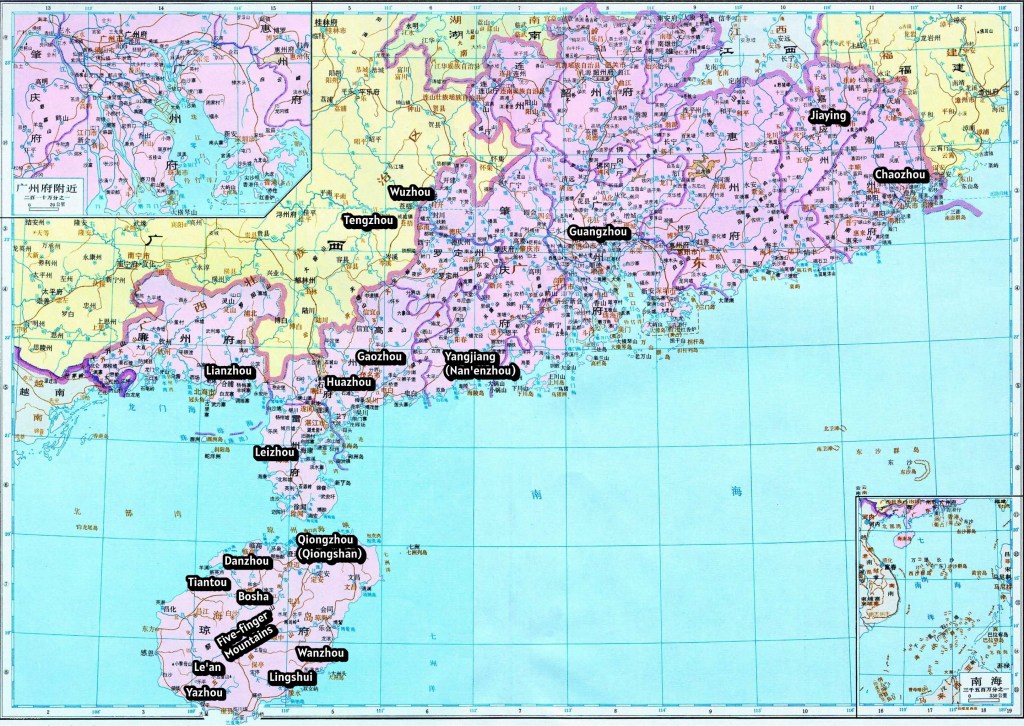
Some settlements pay grain taxes and perform corvée service; others pay taxes but are exempt from labor service. They are also fierce and unruly by nature [like the Raw Li]. Regardless of kinship, if a single word gives offense, they immediately turn knives and bows against one another. If their wives step between them, however, the quarrel is at once resolved.
They sit together without regard for rank or status. When ill, they slaughter cattle and sacrifice to spirits. At funerals, they always butcher cattle to serve to their guests. In the spring they hold swing festivals, during which men and women from neighboring settlements, adorned in their finest attire, come to visit. They walk hand in hand and shoulder to shoulder, singing joyfully to one another, a custom known as zuoju 作劇 (“making merry”). Some seize the occasion to get married, and their parents generally consent without objection. They do not avoid marriage between people of the same surname.
Those [Cooked Li] living near the Raw Li have customs similar to those of the Raw Li. They frequently allow disputes and resentments to escalate into violence, slaughter cattle to assemble their armed followers, and incite the Raw Li to create disturbances. Those living near the [Han] commoner (min) settlements, however, are virtually indistinguishable from the common people (qimin 齊民). In recent times, many observe the imperial law. They shave their heads, wear trousers, and have their sons study the classics. They speak the Li language, which differs from the [Han] speech of Qiongzhou (Hainan), and the various Li groups also differ somewhat from one another in their speech. Both the Raw and the Cooked Li devote themselves to farming. They harvest two crops [of rice] each year and also cultivate a variety of other grains.
From Jia Tang’s gazetteer (1706):
The Li are of two kinds (zhong), Raw and Cooked, and they can be found wherever there is land [in Hainan]. Although the Raw Li are fierce and untamed and do not submit to imperial rule, they do not go out and harm the settled population. Those who do harm to the people are only the Cooked Li. These were all originally merchants from Min (Fujian) who, after losing their fortunes, fled the law and became Li. Others are people from various prefectures of this province (Guangdong) who, attracted by the land and its customs, likewise become Li. In the past, the Li repeatedly rebelled, sometimes because they were driven by excessive exactions, and sometimes because they were driven by oppression and abuse. At other times, unscrupulous traders seeking profit from their aromatic woods and other local products encouraged them to rebel, while also inciting them to provoke the Raw Li. Shifting their allegiance as circumstances dictated and manipulating both sides, these men exploited the situation for their own advantage. They are the true instigators of Li unrest, and such people have been a common source of trouble in every age.
…
[This content is original to the 1841 gazetteer]
The Li of Yazhou (Yazhou district, Sanya, Hainan) are divided into three categories: Raw Li, Cooked Li, and Half-Raw, Half-Cooked Li. The Raw Li are people such as the Dry Foot Qi 乾脚歧. Naked and beast-like in nature, they live in caves, eat uncooked food, and dwell around the foot of the Five-finger Mountains. Separated entirely from the commoner (min 民) population, they cause no harm to the people. The Cooked Li are those who have long submitted to imperial rule. Their food, clothing, and manner of dress are the same as those of the common people (minren 民人), except that they wear their hair tied in a topknot on the crown of the head. Although they retain many of their traditional customs, they come and go daily in the market towns, exchanging goods that they have for those that they lack, and communicating in speech with [the common people]. Some among them are even able to read and write. Their households are registered into the tujia (圖甲) tax collection system, so the local authorities can govern them. Consequently, they too do not trouble the populace.
The Half-Raw, Half-Cooked Li are those who might become either Raw or Cooked. When well governed, they behave as Cooked Li; when disorder arises, they become Raw Li. They themselves are divided into two groups, called the Big Aprons (dachan 大襜) and Small Aprons (xiaochan 小襜). Generally speaking, the wealthy belong to the Big Aprons, while the poor belong to the Small Aprons. In ordinary times, they cultivate fields, pay taxes, and obey official regulations just as the Cooked Li do. Yet they are by nature fond of drinking liquor and fighting, constantly carry poisoned arrows and hooked knives for self-defense, and will kill over the smallest slight.
If Han miscreants (Hanjian 漢奸)6 exploit or humiliate them and their resentment becomes unbearable, they immediately cut down the offender with their own hands. When officials fail to investigate the circumstances and rashly dispatch troops or constables to arrest them, or entrust the task to unsuitable personnel who then harass them further, the Li then seize defensible positions in the mountains, determined to resist, rise up in groups against the authorities, and thereby become Raw Li.
Among the Li of Yazhou, those of this intermediate sort constitute seven out of every ten, and they live intermixed with the commoner population. Commoner settlers live within Li mountain valley settlements, while Li people are likewise found in commoner villages; it is impossible to draw a clear boundary between their respective territories. Altogether, if one counts all three categories of Li, their population exceeds that of the commoners by roughly two to one.
To the east, west, and north of the subprefectural seat rise lofty mountains and steep ridges, while to the south lies the open ocean. From east to west the territory extends more than 530 li. The commoners occupy only a narrow strip along the coast; all the remaining country comprises the Li mountains. These mountains rise in tens of successive ranges. Beyond each ridge, wherever there is a patch of level ground, the Li build thatched huts and settle there. Sometimes a village consists of several tens of households, sometimes several hundred, and such a settlement is also called a gong 弓. The largest villages number over a thousand people, while the smallest contain only a few families.
Their dwellings are not permanently fixed, and villages frequently disperse and reassemble elsewhere. Wherever they cultivate fields, there they settle. Once the soil becomes exhausted after years of farming, they move on to another place. Consequently, the names of villages and mountain valley settlements change repeatedly within only a few years, making it impossible to identify their former locations.
The mountains themselves are covered with dense forests and tangled bamboo thickets; one might travel through them for two full days without seeing the sky. Elsewhere, precipitous cliffs block the way, while poisonous springs and miasmic mists render the terrain impassable, with no roads to follow. The Li, however, are as nimble as monkeys, moving through these regions with ease. Since there are no post stations or watchtowers by which distances can be measured, the actual length of their routes cannot be accurately determined….
From Chapter 22: The sea and the Li, Part 8: Defending against the Li and pacifying the Li 防黎撫黎 (with Appendix: Proposals on managing the Li 黎議)
In the twentieth year of the Jiaqing era (1815), at Fanlun Village 番崙村 on the border of Qiongshan 瓊山 [county] (Qiongshan district, Haikou, Hainan7) and Danzhou 儋州, the former Li headman (Lizong 黎總) Fu Kexian 符克先, who had already been removed from office, rebelled. He gathered several hundred Raw and Cooked Li and plundered neighboring Li villages, gradually extending his depredations into Danzhou territory.
The Li headman Fu Gongbao 符功保 of Fengxu settlement 馮墟峒 led the “good Li” (liang Li 良黎8) to resist them. Fu Kexian was struck by an arrow and killed, while the rest of his followers were defeated by government troops and local militia. Nevertheless, the Li bandits again assembled and plundered the villages of Linwan 林灣, Jialu 加祿, and others in the Qiongshan region.
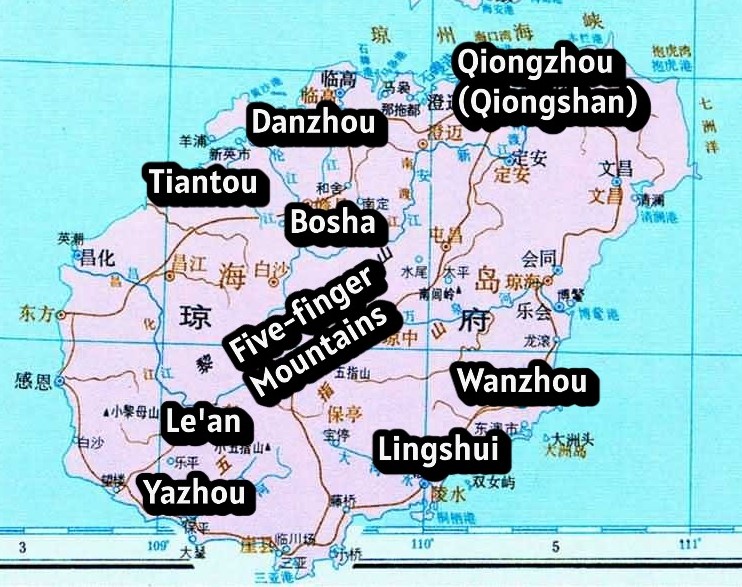
Wan Dingchen 萬鼎琛, the magistrate of Qiongshan county, and Yan Shangwei 言尚煒, the subprefect of Danzhou, combined their forces and led their troops deep into Li territory. They combined proclamations of amnesty with a tight defensive cordon, leaving the rebels no opportunity to emerge and raid. When the rebels learned that larger government forces were approaching, they all concealed themselves in the remote mountains. Wan therefore ordered Fu Gongbao, together with Deng Kuixing 鄧魁星, headman (dongzhang 峒長) of Linwan settlement, and others, to lead the Li of their respective settlements in collective defense. He further instructed the various Li chiefs to jointly nominate honest and impartial Li men to serve as supervisors (zongguan 總管) of the various large and small settlements, charging them to restrain the scattered Li communities and permit no disturbances. Thus, peace was restored throughout Qiongshan and Danzhou.
On the fourteenth day of the eighth month of the twenty-first year of the Jiaqing era (1816), the Raw Li Fu Na’er 符那二 of Bosha settlement 薄沙峒, angered by the excessive severity and arbitrary exactions of the Li headman Fu Zaixing 符再興, joined with the Li bandits Fu Bayao 符巴要, Fu E 符惡, and others from Gouge Village 狗革村 and neighboring villages in rebellion.
Government troops pursued them, whereupon the rebels scattered and went into hiding. The Circuit Intendant for Defense of Leizhou 雷州 and Qiongzhou, Shi You 史祐, together with Commander Hong Ao 洪鰲 of the Qiongzhou garrison, agreed to appoint the prefectural registrar (jingli 經歷) Wang Zhu 王柱 to accompany Danzhou garrison commander Liang Guoying 梁國英 in leading troops into the settlements. They summoned the inhabitants of Fengxu, Longtou 龍頭, and Qifang 七坊 to submit. The supervisors of the three settlements led their people out to welcome the officials and surrender. Only Bosha settlement and the two villages of Dui’e 對峨 and Gouge held their positions and refused to come out.
The government troops cut paths through the mountains and circled around behind the villages. The rebels gathered in force to resist, but several were captured or killed. On the following day, the troops advanced straight into the settlements. With their situation hopeless, the rebels cried out and begged for mercy. Wang Zhu accepted their surrender and returned. The Li were deeply grateful. After the army withdrew, fifty soldiers were left stationed at Diaonan Market 調南市 to guard the mountain passes.
In the twenty-second year of the Jiaqing era (1817), the clerks, runners, and soldiers of Yazhou exploited and extorted the Li people through illegal exactions, provoking the Li of Baoxian 報賢 and other villages to the east and west of Le’an Outpost 樂安汛 (Ledong, Hainan) to revolt. They roamed widely, plundering villages throughout the region.
The acting subprefect Yu Zishan 俞孜善 was dismissed from office for failing to maintain discipline among his subordinates. The captains (qianzong 千總) Wen Guangzong 文光宗 and Han Biao 韓彪 of Le’an Outpost were likewise removed from their posts.
The Governor-general [of Guangdong and Guangxi] Jiang Youxian 蔣攸銛 ordered Tian Wenshou 田文壽 to assume charge of the subprefecture temporarily. He also transferred the captain Zhou Mingqing 周明凊 from the Wanzhou 萬州 (Wanning, Hainan) garrison to lead his troops and join Wang Yingqing 王應清, acting lieutenant colonel (shoubei 守備) of the Yazhou garrison, in blockading and pursuing the rebels.
Soon afterward, Shi You 史祐 of Qiongzhou prefecture and colonel (youji 游擊) Ma Tianyi 馬天益 of the [Guangdong] provincial garrison forces were ordered to lead troops to encamp at Le’an. Wang Yingqing was entrusted with entering the Li settlements to offer amnesty. He issued proclamations instructing the various Li headmen to seize and deliver all rebellious Li under their jurisdiction for punishment. At the same time, those clerks and soldiers found guilty of cheating, extortion and exploitation were to be investigated rigorously and punished according to the law.
The long-standing abuse whereby officials contracted out (baona 包納) the collection of the Li people’s grain taxes was abolished permanently. Thereafter, following the system already used for the Li grain tax in Lingshui 陵水, each year the Li headmen collectively gathered the tax and remitted it directly to the subprefectural government, thereby preventing embezzlement and unauthorized deductions. The various Li accepted these measures with delight and submitted willingly, swearing that they would never rebel again.
In the ninth year of the Daoguang era (1829), Li Yaji 黎亞雞, a Li person, rebelled in Yazhou. Eighty li east of the subprefectural seat lies Yanglin Ridge 洋淋嶺, a broad and fertile region encircled by several tens of Li villages and mountain valley settlements. The Li habitually feared government officials, and therefore always entrusted local [Han] commoners to pay their land taxes on their behalf. These intermediaries were known as jiatou 甲頭 (tax agents). In most cases, unscrupulous scholars and corrupt yamen underlings monopolized this business. Some even claimed to be acting under official authority and extorted additional payments, collecting two or three times the lawful amount.
Unable to endure these abuses, the Li people plotted to entice the Raw Li into rebellion and also murdered several jiatou. That year a famine occurred, and the Raw Li lacked food. Li Yaji and others of Yanglin Village therefore guided the Raw Li out to raid the surrounding settlements. The troops stationed in the subprefecture proved unable to repel them. The Prefect Puxiang 普祥 and General Sun Defa 孫得發 hurried to the scene with their troops. The Li fled into hiding, and Puxiang employed native [Han] people to persuade them to come out, offering them generous terms. When the rebels learned that there was no intention of quelling them by force, they all emerged to receive rewards, and consequently came to hold the government troops in even greater contempt.
Meanwhile Li Yaji died of illness, and someone cut off his ears and presented them as proof of his death. Believing that the work of pacification had been completed, Puxiang memorialized his superiors reporting his success. Before long the troops were withdrawn. Yet scarcely had the army departed than the rebels resumed burning and plundering as before. Another pair of Li leaders, Zhang Hongxu 張紅鬚 (“Red-Beard Zhang”) and Zhang Yaji 張亞基, then emerged at the head of the rebels, and the killing and pillaging became even more severe. Puxiang again went to the area, but still insisted upon a policy of conciliation. The Governor-general [of Guangdong and Guangxi] Li Hongbin 李鴻賓 urgently ordered that the rebels be suppressed and captured. Sun Defa and Puxiang accordingly recruited additional local militia, transferred troops from the provincial garrison forces as well as from the Danzhou and Wanzhou garrisons, and convened civil and military officials to discuss strategy.
Puxiang continued to advocate conciliation, whereas Sun Defa favored military suppression. Their subordinates hesitated between the two positions, and no decision could be reached. As the rebels grew increasingly rampant, repeated urgent dispatches arrived ordering immediate military action. At length there was no alternative, and the twenty-eighth day of the twelfth month was fixed as the date for the advance.
At the time, however, many transport laborers had returned home to celebrate the New Year, making it impossible to recruit sufficient porters. Women were therefore pressed into service alongside the men to carry provisions and military equipment. The rebels learned of this through their spies. They first felled trees and placed them beside the roads, then covered them with gunpowder and cut grass. They also instructed miscreant commoners to present themselves at the government camp and volunteer to act as guides. Sun Defa trusted them and divided his forces into eastern and western columns. The following day, the army reached Yanglin Ridge. Its provisions were exhausted, and many of the transport laborers encountered rebels, abandoned their baggage, and fled. The government troops hastily retreated, only to find the road blocked by huge tree trunks. Fires suddenly flared up and an ambush was launched. The soldiers routed and fled, and Sun Defa himself barely escaped with his life. Captain Zhou Mingqing 周明清 of the Wanzhou garrison and staff officer (jiwei 記委) Huang Zhenjiang 黃振疆 of the Yazhou garrison were both killed in action, while casualties among the soldiers were extremely heavy.
When news reached the [Guangdong] provincial capital, the Governor-general and Governor immediately dispatched express memorials to the throne. At the same time, they impeached the Circuit Intendant of Leizhou and Qiongzhou Zhang Ming 張銘, General Sun Defa, Prefect Puxiang, Subprefect Qi Yuanfa 齊元發, Acting Subprefect Yuan Sixiong 袁斯熊, and others. All were stripped of office.
Li Hongbin personally hurried to Leizhou [from Guangzhou] and ordered Provincial Military Commander (tidu 提督) Liu Rongqing 劉榮慶 to lead more than a thousand elite troops at full speed to Yazhou and combine military suppression with offers of amnesty. Zhang Hongxu and the other rebel leaders fled into hiding and refused to emerge. The various Li headmen thereupon, through local intermediaries, requested permission to surrender. Liu Rongqing ordered them to redeem themselves by binding and delivering the rebel chiefs. He also proclaimed a reward of five hundred taels of silver for anyone who captured a rebel leader alive. At the same time, he ordered the Li to make up the arrears of ninety taels of poll taxes and permanently abolished all the longstanding abuses connected with the tax agents. The people rejoiced, and all signed written pledges confessing their offenses and expressing repentance.
After hiding for a long time in remote mountain valleys, Zhang Hongxu and his associates were finally lured into the city by Liu Rongqing and captured by soldiers waiting in ambush. They were captured, conveyed in cages to Leizhou, and all publicly executed as a warning.
Peace was restored in Yazhou. Civil and military officials then jointly deliberated on measures for the aftermath. For the first time, they established a permanent defense fund by lending government treasury capital at interest. The annual income, amounting to about two thousand taels of silver, was deposited in the circuit treasury to cover future expenses for defense against the Li. The organization of the Yazhou garrison was also reformed, with additional troops assigned and new guard posts established.
During this campaign, several tens of commoner villages were pillaged and burned, more than a thousand people were killed, the region remained in turmoil for three years, and untold millions in military expenditures were consumed. Although it may be said that the Li are by nature fierce and difficult to govern, the disaster in fact originated with the abuses committed by the tax agents. Thereafter, indecision between suppression and conciliation only compounded the harm day by day. How could such matters fail to demand the utmost caution?
In the seventh month of the thirteenth year of the Daoguang reign (1833), the Li of Danzhou, led by Li Yayi 黎亞義 and others, rose in rebellion. That year an extreme drought struck the region, and impoverished Li went in every direction seeking food. Unscrupulous [Han] commoners lent them money and grain on the condition that they would repay double after the harvest. When autumn arrived, however, the famine continued. Unable to recover the debts owed them, the creditors refused to extend any further loans. The Cooked Li all harbored resentment and began plotting together. They intended to kill every Han miscreant, but had not yet found a suitable opportunity to act.
Originally, the Li did not practice settled agriculture on a large scale, and much of their land lay uncultivated. People from Leizhou, Lianzhou 廉州, Chaozhou 潮州, and Jia[ying] 嘉應 (Meizhou, Guangdong) subprefectures secretly entered the Li settlements and borrowed land to cultivate in return for rent paid in grain, or leased fields from the Li. While cultivating these fields, they also cleared adjoining wasteland until the newly reclaimed fields stretched continuously across the countryside.
The Li possessed neither written deeds nor fixed boundary markers. As the years passed, these reclaimed lands were repeatedly divided and sold from one owner to another, entirely without the Li’s knowledge. The Li simply assumed that all of the land still belonged to them, content so long as they received enough rent to live on. When famine struck, however, the Li’s own fields yielded nothing but barren earth, while the immigrant cultivators harvested abundant grain. The Li were outraged. They murdered the immigrant settlers with whom they had grievances and called upon others to join them in rebellion. Poor Li from outlying settlements responded in large numbers. Signal arrows were then sent to the inner settlements of Longtou 龍頭 and Bosha 薄沙, inciting the Cooked Li to revolt as well. Bandits from Gaozhou and Leizhou, headed by Xue Fengzhang 薛鳳章, had fled into Li territory [earlier] and guided the rebels in their raids.
In the seventh month, Li Yayi and Xue Fengzhang led more than a thousand Raw and Cooked Li bandits in burning and plundering Tiantou Market 田頭市. All the inhabitants were stripped of their possessions. By the time the government troops arrived, the rebels had already withdrawn.
Colonel Talu 塔魯 of Danzhou and the assistant district magistrate (xunjian 巡檢) of Bosha, Lou Ruji 婁汝楫, led troops to pursue them into the outer settlements. There the government troops suffered severely from miasmic disease, and Lou Ruji died from miasma. The rebels then emerged again and plundered Wangwu Market 王五市. General Li Yuan 李元 and Circuit Intendant Wang Zhu 王鑄 ordered Colonel He Zhaoliang (何朝亮) to hasten to the scene with two hundred soldiers.
He Zhaoliang addressed the provincial military commander:
“These Li rebels are driven by hunger. They raid only to obtain food and preserve their lives. Once they hear that a large army has arrived, they will certainly scatter and hide among the forests. The mountain paths are steep and narrow, making them impossible to track down. The miasma is severe, and our troops cannot remain long. We shall fail to capture the rebels, yet if we withdraw our prestige will suffer. Would it not be better to block all the mountain passes, preventing the rebels’ scouts from moving about, while ordering the villages surrounding Li territory to organize themselves into mutual-defense corps and station firearms to alarm the enemy? Unable to continue plundering, the rebels will remain idle guarding these desolate mountains. After two months, their food will be exhausted. If they do not surrender, they will perish. At present the rebels enter and leave through the two settlements of Bosha and Longtou. Diaonan 調南 is their principal route and should be heavily guarded, while mobile patrols should continually watch the approaches to cut off all their movements.
The Li prize profit above moral duty. Once they have divided the spoils, they will inevitably quarrel among themselves. When their strength has been exhausted and their followers dispersed, we can summon them to surrender, using Li to attack Li and allowing them to redeem themselves by killing the remaining rebels. Those who remain defiant should be executed; those suffering from cold and hunger should be fed. If severity and benevolence are employed together, the rebellion can be suppressed without bloodshed. I therefore ask that we not rush into military operations, nor hastily proclaim a general amnesty.”
The provincial military commander and circuit intendant accepted his proposal. He Zhaoliang then advanced together with Prefect Fuerchonga 富爾崇阿 and the other officials. Upon reaching Diaonan, they successively captured several rebel leaders, including Wang Laoqiu 王老球, Fu Xiao’er 符小二, Fu Ailao 符愛老, and Wang Yi 王一.
The commissioner Songshou 松壽 and the local gentry Zhang Ji 張績 and Xing Hui 邢惠 supervised the training of village militia. Every village assembled its able-bodied men, equipped them with firearms, and erected wooden stockades for defense. Consequently, the rebels could no longer plunder at will.
Governor-general Lu Kun 盧坤 ordered the subprefect of Yazhou and commanders from the neighboring garrisons to assemble at Danzhou for a joint campaign. He Zhaoliang submitted a memorial explaining his strategy to the provincial authorities and received high commendation.
In the tenth month, the rebel leader Li Yayi died, while Xue Fengzhang was killed by other Li. Food in the mountains was exhausted, and the rebels began killing one another over supplies. Many dispersed and fled. Those who ventured out to plunder were all destroyed by government troops or local militia. The government army deliberately spread rumors that it would launch simultaneous attacks from five directions, and the rebels were greatly alarmed.
On the eighteenth day, the “good Li” Fu Shilong 符世隴, together with Fu Naxin 符那新 and the leaders of six villages, requested permission to surrender. He Zhaoliang and the other commanders accepted their submission, appointed them as the vanguard, and had them guide government troops into the mountains, where they captured eleven more rebels, including Fu Yuanxing 符元興.
Another Li headman, Fu Nami 符那密, led several dozen Raw Li in seizing their own chief, Fu Lao’er 符老二, together with the Han miscreant Chen Gui 陳瑰 and three others, whom they delivered to the authorities. They were transported in cages to the subprefectural city.
The remaining rebels all surrendered. The authorities conciliated them, proclaimed amnesty, dismissed them to return home, bestowed sheep, wine, silver, and silk upon them, and restored the various Li communities to their former livelihoods.
Only the Han miscreant Xue Fengzhang and the rebel chief Li Yayi, though already dead, had their corpses mutilated and their severed heads publicly displayed. Fu Yuanxing and the other captured rebels were paraded in cangues and sentenced according to law.
Previously, the villages of Dashui 大水 and Xiaoshui 小水 in Qiongshan had maintained communication with Bosha settlement, and some impoverished Li from those villages had joined the rebels in their raids. Later, when the government army steadily tightened its pressure and food became scarce, these men were themselves killed by the Li of Danzhou. The commanders ordered that no extensive investigation be made into the matter. They merely summoned the settlement headmen, instructed them to exercise strict discipline over their villages, and requested government relief funds to aid the famine-stricken Li of Danzhou for two months.
Thereafter, in the two settlements of Bosha and Longtou, one supervisor (zongguan) was appointed for each settlement to preside over the village headmen. The people all accepted the arrangement with satisfaction. Thus peace was restored in Danzhou.
- For detailed analysis of this dynamic in Qing-era Hainan from the 1640s to 1800, see Anne Csete, “Ethnicity, Conflict, and the State in the Early to Mid-Qing,” in Pamela Kyle Crossley, Helen F. Siu, and Donald S. Sutton (eds.), Empire at the Margins: Culture, Ethnicity, and Frontier in Early Modern China (Berkeley: University of California Press, 2006), 229-252. See also Qu Dajun’s description of the Li in the 1600s in source 5.20. ↩︎
- This passage is adapted from Fan Chengda’s Guihai yuheng zhi of 1175 and is also found in Zhou Qufei’s Lingwai daida of 1178 (see source 5.11). ↩︎
- Most of this passage is also adapted from the Guihai yuheng zhi or Lingwai daida, except for the sentence about tree trunk coffins. ↩︎
- Most of this passage is adapted from the Guihai yuheng zhi – see source 5.10, note 4. ↩︎
- Nan’enzhou was abolished as a prefecture in 1368, at the beginning of the Ming, and demoted to the county of Yangjiang 陽江. The text uses the obsolete name here in order to include Yangjiang among a list of prefectures or subprefectures. ↩︎
- On “Han miscreants,” see source 5.24, note 16. ↩︎
- Qiongshan county was also the seat of Qiongzhou prefecture. ↩︎
- “Good Li” was a term used for Cooked Li communities that were loyal to the Qing state and fought against Li rebels during periods of unrest. ↩︎

